48 hours in Bratislava: the honest city guide
Before you arrive
Forty-eight hours sounds like a lot until you’re standing at the foot of Bratislava Castle at sunset, wondering how it’s already your last evening. Two days here is enough to feel the city — not to exhaust it, not to collect every landmark like stamps, but to actually settle in and get a sense of what makes it worth the trip.
This guide is opinionated. It’s built around a specific order of events, specific places to eat, and specific trade-offs that I think are worth making. You can deviate from it — but if you’re arriving here uncertain how to spend your time, this is a plan that works.
| At a glance | |
|---|---|
| Where | Bratislava old town, castle, Devín, and the Small Carpathians wine country |
| Cost | Roughly 80–120 € per day solo, 55–80 € per person for two sharing, or 40–55 € budget |
| Time needed | 2 full days; see the 3-day itinerary if you can extend |
| Getting there | Bratislava Airport (BTS) or train from Vienna/Budapest into Hlavná stanica |
| Best time | Spring and early autumn for mild weather; September–October adds the wine harvest |
Logistics first: Bratislava has two main arrival points. Most budget flights land at Bratislava Airport (BTS), which is about 10 km from the centre — the Bratislava airport guide covers the bus connection into town. If you’re coming from Vienna by train, you arrive at Bratislava Hlavná stanica, about 15 minutes’ walk from the old town. From Budapest, the journey takes around 2.5 hours by train or bus.
Accommodation-wise, staying inside or immediately adjacent to the old town makes both days easier. A double room in a good mid-range hotel in the centre runs 70–100 € per night. Budget options exist from around 60 €. The where to stay guide breaks down the neighbourhoods if you haven’t booked yet.
Day one: the old town, the castle, and the evening
Morning: arrive, orient, eat something real
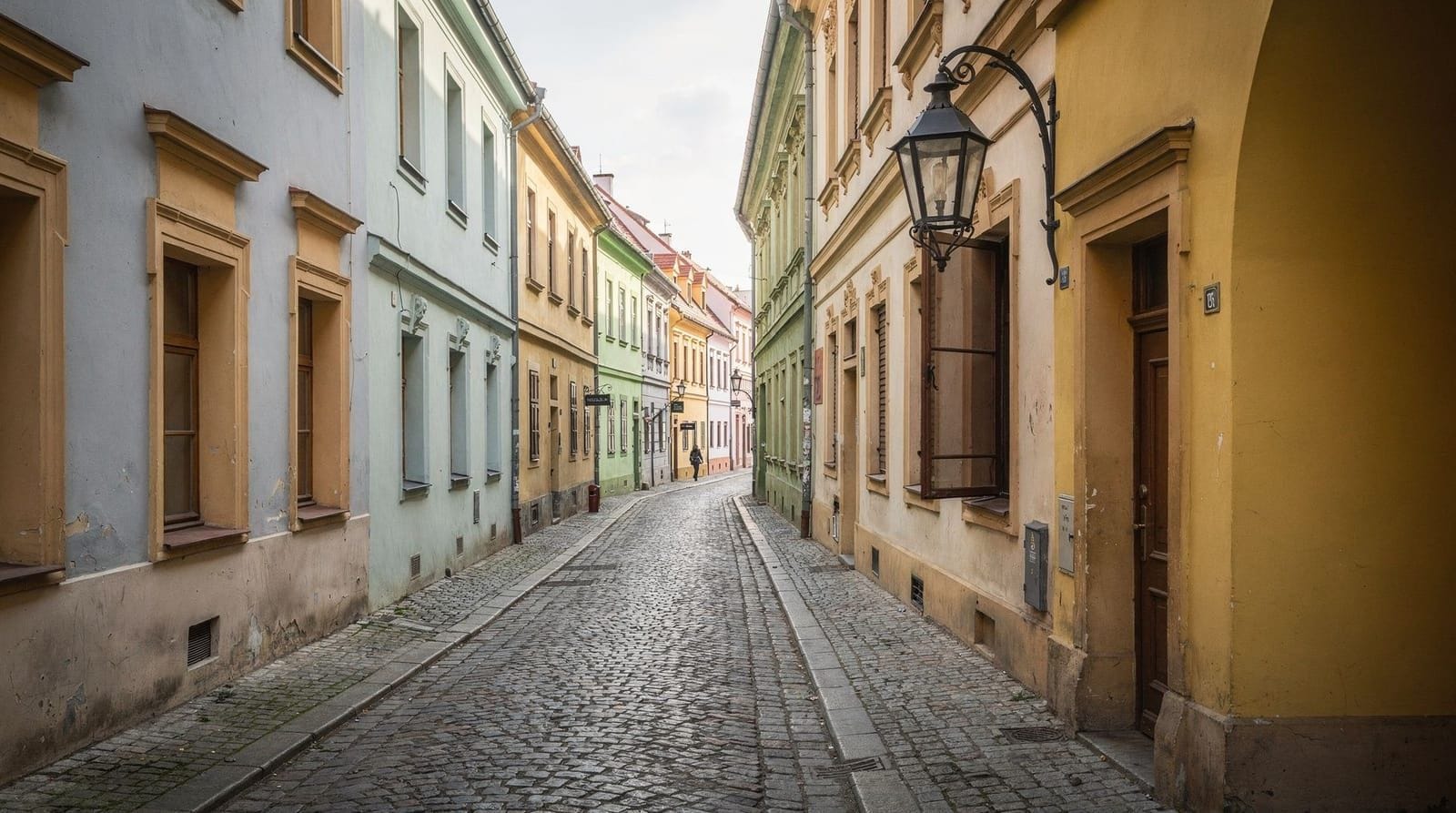
Don’t rush straight to any landmark. Give yourself thirty minutes to walk the old town before it fills up. If you arrive early enough, the Main Square (Hlavné námestie) is nearly empty before 9am, and that’s when you see it properly — the old town hall on one side, the Maximilian fountain in the centre, the pastel facades around the perimeter.
Breakfast: Caffè Florian on Sedlárska does proper espresso and a croissant for around 4 €. Urban Space on Obchodná is better for a sit-down breakfast with eggs and local pastries (6–9 €). Skip the hotel breakfast if it’s not included — there are better options a three-minute walk away.
After coffee, start the walk through the old town. Michalská brána — the 14th-century tower gate on the northern edge of the pedestrian zone — is the logical starting point. Pass through the archway and you’re on Michalská street, which leads down to the main square. The Michalská brána guide has the tower museum details if you want to climb it (small admission fee, good views).
The bronze statues scattered through the old town are a deliberate part of the experience. Čumil the peeper emerges from a manhole at the corner of Laurinská and Panská. Napoleon leans on a bench near the French embassy. The paparazzi photographer crouches behind a lamppost. These are not highbrow art, but they’re entirely characteristic of how Bratislava presents itself — with a sense of humour about its own modest scale.
Mid-morning: the castle
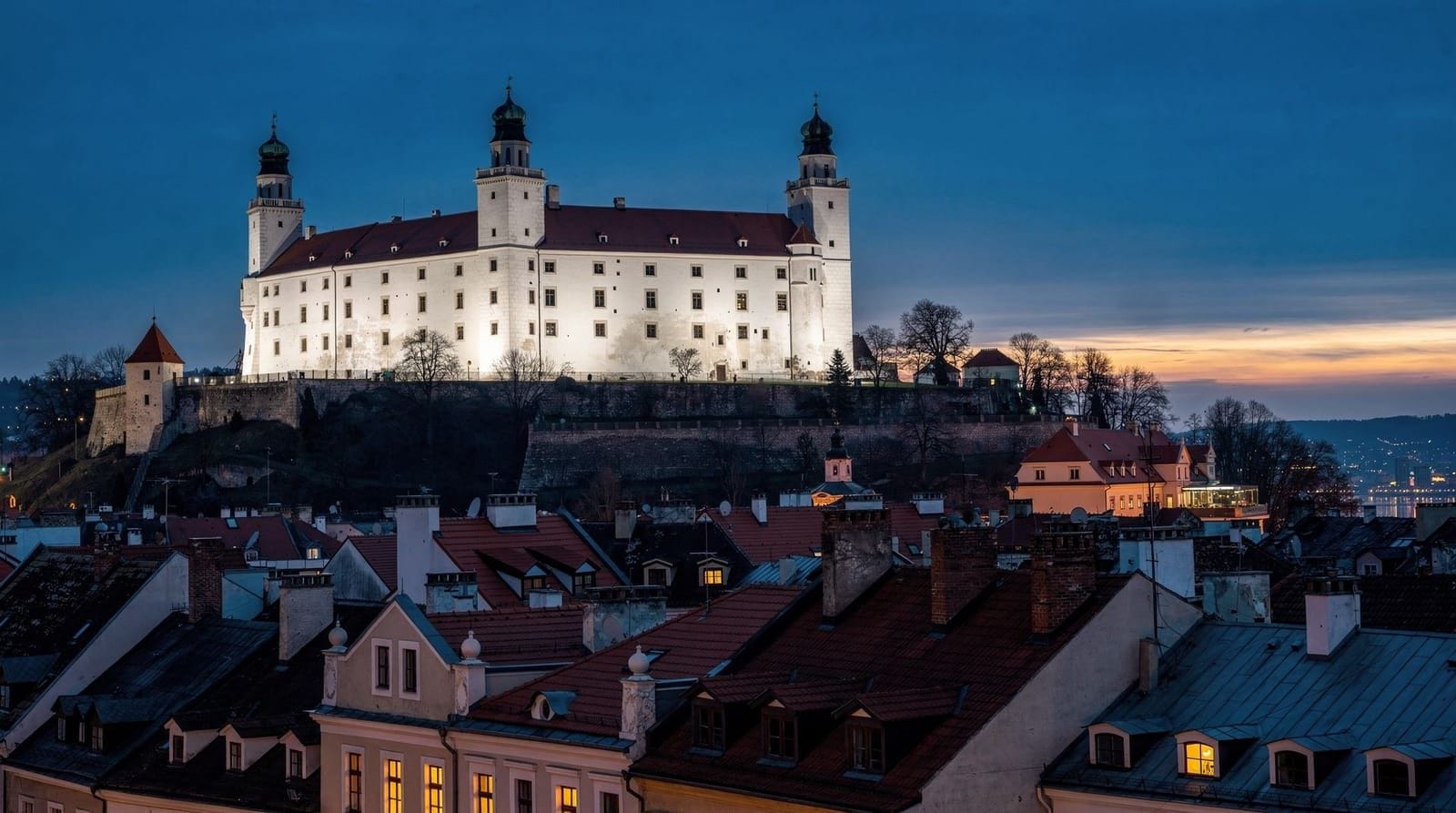
From the old town, the castle is a 20-minute walk uphill or a short bus ride. Go on foot going up, take the bus or walk back down. The approach through the castle gate delivers the payoff: the Danube below you, Petržalka’s Soviet-era apartment blocks across the water, Austria on the horizon.
The castle grounds are free and open until late. The museum inside covers Slovak history from prehistory through the 20th century — it’s worth an hour if that interests you, and the admission is around 10 €. Even if you skip the museum, the terrace views are reason enough to make the climb. The Bratislava Castle guide covers the full exhibition.
While you’re up there, look down at the SNP Bridge and its inverted-pyramid UFO structure sitting above the bridge deck. It’s either an eyesore or a fascinating piece of 1970s communist-era ambition, depending on how you look at it — the UFO observation deck guide covers the restaurant and viewing platform if you want to go up in the evening.
From the castle, you can also see St. Martin’s Cathedral below — the coronation church for the kings of Hungary, built in the 14th century and still the dominant religious building in the old town. The St. Martin’s Cathedral guide has the history and visiting hours.
GetYourGuideBratislava guided walking tour with castle entryCheck availability →Lunch: Slovak food done properly
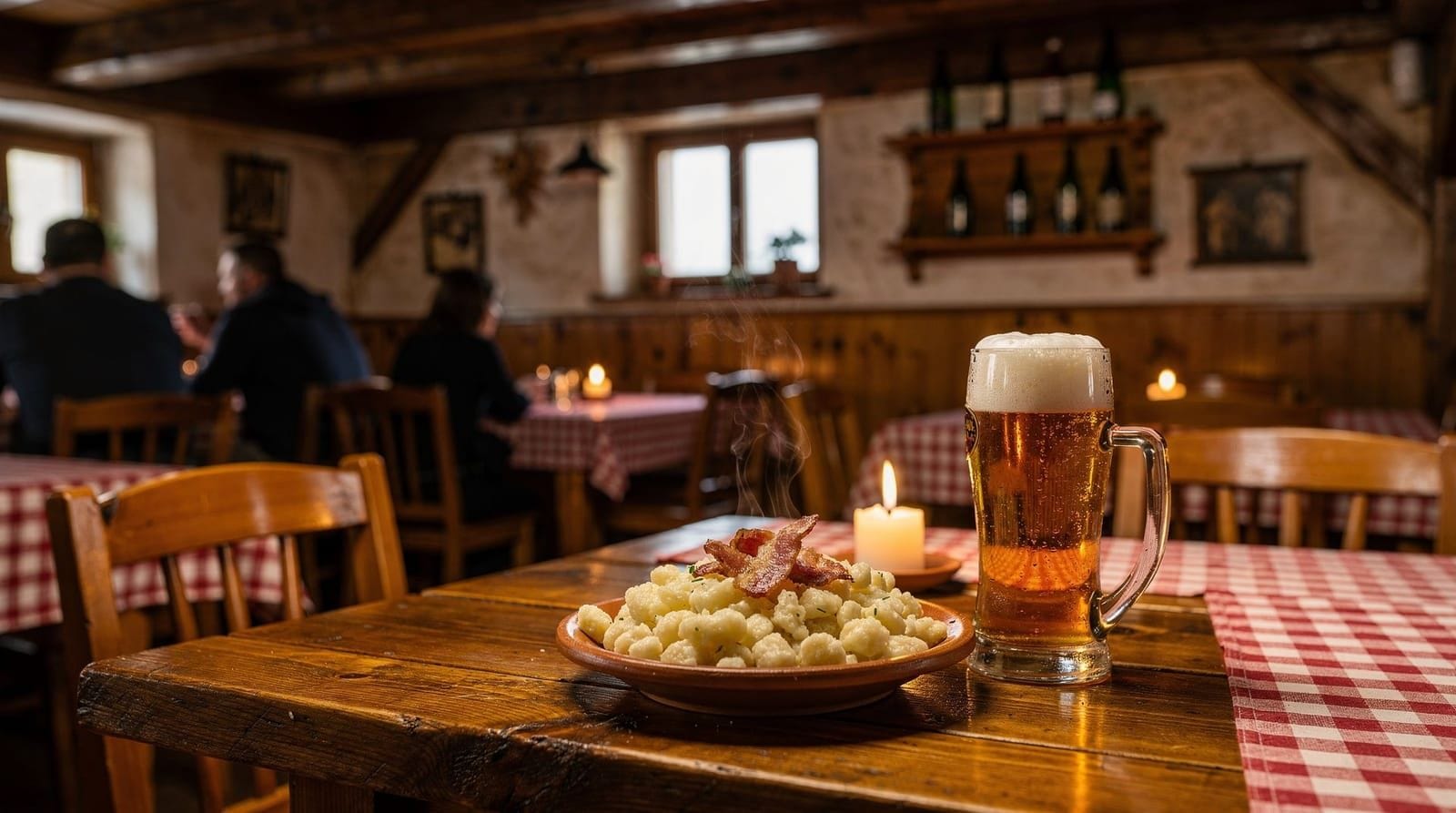
Come down from the castle around noon and head to Modrá Hviezda (Blue Star) on Beblavého street, a short walk below the castle. It’s a small, traditional Slovak restaurant in a historic building, and it does bryndzové halušky — the potato dumpling and sheep’s cheese dish — as well as any restaurant in the city. Expect to pay 9–12 € for a main course. It’s busy at lunch; arrive by 12:15 or expect to queue.
Alternatively, if you want something lighter, the Stará tržnica market hall on Námestie SNP has food stalls with good soups, sandwiches, and local specialties for 6–9 €. It’s a nicer space than it looks from the outside — a renovated 19th-century market building with a decent atmosphere.
The traditional Slovak food guide is worth a read before you eat out, so you know what you’re ordering.
Afternoon: the Blue Church and the Jewish quarter
After lunch, walk fifteen minutes east from the old town to the Church of St. Elisabeth — universally called the Blue Church. It’s baby blue, covered in Art Nouveau ornament, and completely unlike anything else in the city. It was built in 1913 and looks like something from a Wes Anderson film. It’s a working church, so entry depends on services, but the exterior alone is worth the walk. The Blue Church guide has visiting details.
On the way back, the area between Rybné námestie and the riverfront has fragments of Bratislava’s pre-war Jewish heritage. The city had a significant Jewish community before the Second World War — much of it destroyed, and the story is sobering. The Jewish heritage guide traces what remains.
By mid-afternoon, you’ve covered enough ground. Find a terrace, order a beer (2–2.50 € for a half-litre of Zlatý Bažant or Šariš), and sit down for an hour. This is not time-wasting; it’s the point.
Evening: dinner and the old town at night
Bratislava’s old town after dark is a different experience from the daytime version. The coach tours are gone. The light is softer. The restaurants have more atmosphere.
For dinner, Leberfinger on Obchodná is consistently good — Slovak and central European cooking, no tourist-menu pricing, mains at 12–18 €. If you want something more international, the cluster of restaurants around Laurinská street has Thai, Indian, and modern European options at similar prices.
After dinner, the best bars in the old town guide covers where to go for a drink. The bar on Páričkova street — a slightly scruffy street just outside the old town that has become the unofficial local bar strip — is worth knowing about. Less polished than the main square bars, cheaper, and more likely to have people from Bratislava rather than tourists.
If you booked a walking tour, evening is actually a good time for it — the old town is lit up and less crowded.
Day two: Devín Castle and the wine country
Morning: get out to Devín
Devín Castle is the other Bratislava. While the old town is compact and accessible, Devín requires a deliberate trip — and it rewards the effort. The castle ruins sit on a dramatic outcrop where the Morava River meets the Danube, 20 km west of the city centre. This was the frontier. For decades under communism, the Morava marked the Iron Curtain here, and the communist and Iron Curtain history guide explains what that meant in practice.
Bus 29 from the old town runs to Devín in about 20 minutes. It leaves from near the old town — check current timetables, as they run roughly every 30–60 minutes depending on the day. Alternatively, in good weather, you can cycle along the Danube path — the Danube riverside cycling guide covers the route.
The castle itself charges a modest admission (around 5–7 €). Give yourself 90 minutes to explore the ruins, walk the upper ramparts, and look out over the confluence. On a clear morning this is one of the best views in the region. The Devín Castle guide has more on the history, including the remains of the Great Moravian settlement predating the castle.
Bring your own coffee in a thermos if you’re an early riser — the café at Devín opens late and the coffee is unremarkable. There’s a decent restaurant near the castle entrance that does lunch from noon.
Late morning: back to the city, then the wine direction
Back in the city by midday. If you have energy for one more thing before lunch, the Slavín memorial — the Soviet war cemetery on a hill above the city — is worth the short climb. The view over Bratislava from the top is arguably better than from the castle. It’s always free, always open, and rarely crowded. Take tram 4 from the city centre toward Koliba.
Lunch and afternoon: into wine country
Eat lunch in the city — something light, since there will be food in the afternoon — and then take a bus or organised transport north toward Pezinok or Modra. The bus from Hodžovo námestie runs to Pezinok in about 35–40 minutes, and from there you’re in the heart of the Small Carpathian wine region.
Pezinok is the more substantial town, with a winery on almost every street in the older residential areas. The Víno Nichta winery does walk-in tastings (book ahead in peak season), and a standard tasting of five wines with bread and local salami costs around 12–15 €. The quality of the Welschriesling and Müller-Thurgau from this region is consistently underestimated — these are serious wines at completely unserious prices.
Modra, 30–40 minutes from Bratislava, is the other classic stop — quieter, smaller, and famous for its fajansy folk ceramics as much as its wine. The Pezinok and Modra wineries guide covers specific producers worth visiting and how to plan an afternoon without a car.
The Small Carpathians day trip guide has a broader overview if you want to combine wine with hiking — the trail system above the vineyards is genuinely good.
GetYourGuideBratislava guided culinary tourCheck availability →Evening: back to Bratislava for a proper send-off
Return to the city in the early evening. If you have a late train or early flight the next morning, the old town is the right place to spend your last hours in Bratislava.
For dinner on the second evening, consider somewhere you haven’t been yet. Bratislava has a small but thoughtful food scene that goes beyond the tourist restaurants. Zylinder on Hviezdoslavovo námestie is good for Slovak-inflected modern cooking at 15–22 € for a main. Štúr, near the university, is popular with locals and does Slovak classics at honest prices.
If the evening is warm, the Danube promenade below the old town — the riverside walk between the SNP Bridge and the ferry terminal — is where Bratislava actually lives in summer. Food trucks, people sitting on the steps, the river reflecting the bridge lights. It’s not a tourist set piece. It’s just the city.
One last drink: the wine bar Vino & Dino on Ventúrska does by-the-glass Slovak wines at 3–5 € a pour, and it’s small enough that you end up talking to whoever else is there. That’s a decent way to end two days in a city that rewards exactly this kind of unplanned proximity.
What I’d do differently on a repeat trip
If I came back for another 48 hours, I’d swap one thing: I’d trade the second afternoon’s wine country trip for a longer, unhurried stretch in the old town, maybe with a stop at one of the best cafés and coffeehouses I rushed past the first time.
Pezinok and Modra are genuinely worth the trip — see the Pezinok and Modra wineries guide for specifics — but they’re also the kind of detour better suited to a dedicated visit like the small carpathians wine weekend itinerary, rather than squeezed into an already full second day. First-time visitors should still do it this way; it’s the more complete introduction. But it’s worth knowing the trade-off going in.
One more thing worth flagging: if you’re travelling with children, this exact pacing is too ambitious. The family weekend in Bratislava itinerary covers the same ground at a pace that actually works with kids.
Frequently asked questions about 48 hours in Bratislava
Is two days enough time for Bratislava?
Two full days covers the essential ground comfortably — the old town, the castle, Devín, and a trip toward the wine country. What it doesn’t allow for is the slower kind of exploration: sitting in a café for two hours, wandering without a plan, or spending a full day at the Small Carpathians. If you can extend to three days, the Bratislava in 3 days itinerary uses the extra time well. But two days is genuinely enough to leave with a real sense of the city, not just a collection of checked boxes.
What’s the smartest way to structure the two days?
Old town and castle on day one, Devín and wine country on day two — in that order. The reason is simple: day one keeps you in the centre, close to your hotel, and you can navigate purely on foot. Day two requires buses and a bit of planning, and it’s better done once you’re already oriented. The Bratislava weekend itinerary follows this same logic and includes specific timing for each stop.
How much does two days in Bratislava cost?
For a solo traveller staying in a mid-range hotel: roughly 80–120 € per day all-in, including accommodation, meals, transport, and a couple of museum entries. For two people sharing a room: 55–80 € per person per day. Budget travellers staying in hostels and eating at market stalls can do it for 40–55 € per day. The budget guide has a full breakdown by category including accommodation tiers.
Do you need a car for Devín and the wine region?
No, but it makes things easier. Both Devín and Pezinok are reachable by public bus, and the routes are reliable. The trade-off is flexibility — you’re tied to timetables that may only run hourly. If there are two or more of you, renting a car for day two costs roughly the same as two taxi fares and gives you complete freedom to stop at smaller wineries and take the scenic road through the hills. The getting around Bratislava guide covers the practicalities.
Are there guided tours worth taking in Bratislava?
Yes — with some caveats. The old town walking tours are good value (10–15 € for 2 hours), particularly if you want the historical context behind the buildings. Free tours exist but tips are expected and quality varies. Food tours are worth it if eating and drinking is your priority — the combination of tastings and commentary is more useful than reading a guide separately. The Bratislava food tours guide covers the main options.
Culture & heritage tours
Verified deep-linked GetYourGuide tours. Book through these links and we earn a small commission at no cost to you.