Where to eat local in Bratislava: skip the tourist traps
| At a glance | |
|---|---|
| Where | Obchodná, Štefánikova, and the streets just off Hlavné námestie — not on the square itself |
| Cost | Lunch menus 6–10 €; sit-down dinner 12–18 € including a drink |
| Time needed | An hour for a proper meal; a half-day if you add Miletičova market |
| Getting there | Everything below is walkable from the Old Town, or a short tram ride |
| Best time | Weekday lunch (11:00–14:00) for the best-value obedové menu |
The honest version of eating in Bratislava
There are two ways to eat in Bratislava. The first involves sitting down at a table on Hlavné námestie, ordering from a laminated menu with eight language columns and food photos, and paying 18–25 € for a main course that was almost certainly defrosted somewhere backstage. The second involves eating where locals eat — and paying roughly half as much for food that’s actually cooked.
This guide is entirely about the second option.
Bratislava is not a difficult city to eat well in. It’s a small, manageable capital with a real food culture, a handful of genuinely good traditional restaurants, a strong coffee scene, and a wine tradition that most visitors underestimate. The trap isn’t that good food doesn’t exist — it’s that the old town makes it easy to wander into mediocrity without noticing. You cross the right square, take the wrong turn, and suddenly you’re eating a 22 € goulash while watching a folk music performance nobody asked for.
Avoid that. Here’s how.
What to eat: the Slovak dishes that are actually worth ordering
Before you walk into any restaurant, it helps to know what Slovak food actually is — and what it isn’t.
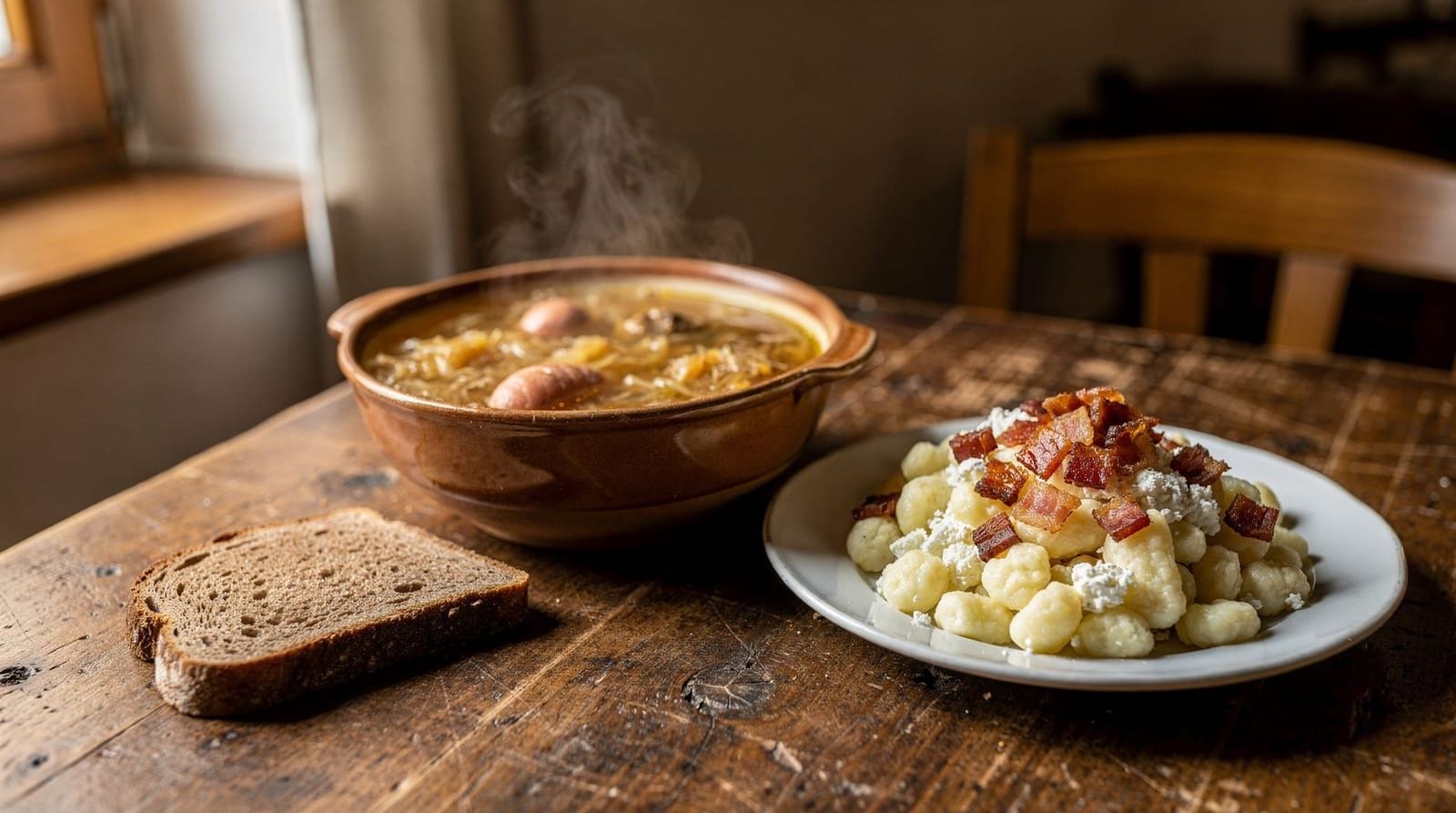
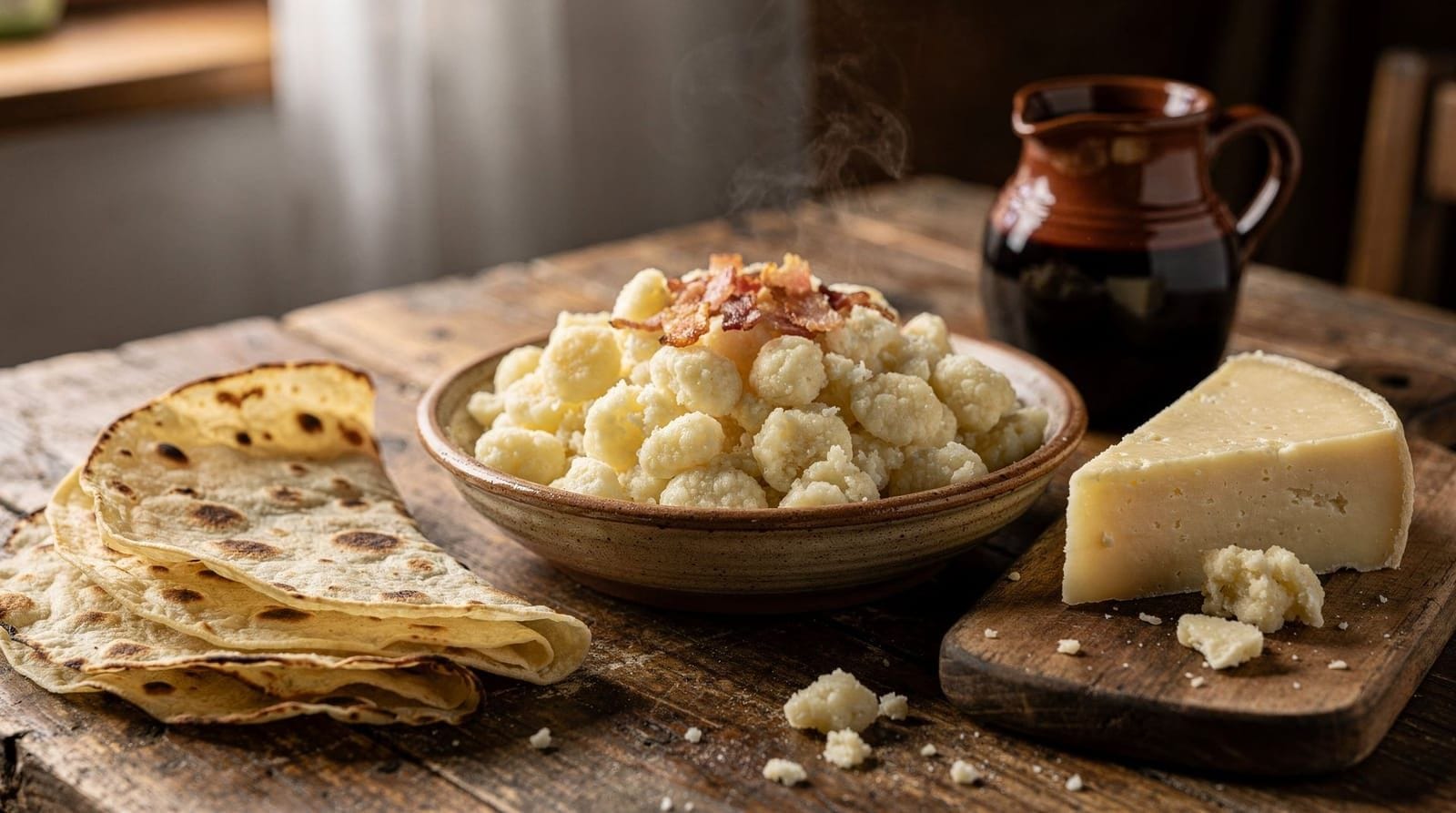
Bryndzové halušky is the national dish, full stop. Small potato dumplings, similar in texture to Italian gnocchi but denser, served in a sauce of bryndza — a sharp, slightly fermented sheep’s milk cheese made in the Small Carpathians. Topped with rendered bacon fat and crisped bacon bits. It’s rich, filling, and unlike anything you’ll find outside Slovakia. If you eat one traditional dish in Bratislava, this is it. A full portion runs 9–13 € depending on where you go.
Kapustnica is a sour sauerkraut soup made with smoked meats — usually a combination of smoked ribs, sausage, and sometimes mushrooms. It’s the kind of soup that belongs in winter but appears on menus year-round because enough people want it. Dense, slightly tangy, usually served with bread. Around 4–6 € as a starter.
Lokše are thin potato flatbreads, cooked on a dry griddle. They’re served plain with butter, or stuffed — the best version is filled with roasted duck and drizzled with rendered duck fat. Traditional street food in some parts of Slovakia, though in Bratislava you mostly find them in sit-down restaurants. Worth ordering if they’re on the menu.
Sviečková (beef sirloin in cream sauce) is technically Czech as well as Slovak — it shows up on both sides of the border and reflects the shared history of the two countries. Slow-roasted beef in a cream and root vegetable sauce, served with bread dumplings and cranberry sauce. It’s more refined than bryndzové halušky and more Austrian-influenced in character. Good versions are genuinely excellent.
Rezeň is a pork schnitzel, essentially the Slovak cousin of the Wiener Schnitzel. Breaded, pan-fried, served with potato salad. Simple, well-executed when the kitchen cares. Around 9–12 €.
Goulash is Hungarian by origin but has been thoroughly adopted across the former Austro-Hungarian region. Slovak versions are darker and less paprika-heavy than Hungarian ones. Good as a warming lunch dish, served in a bread bowl at some restaurants.
One thing to set straight: trdelník is not Slovak. Those spirals of dough wrapped around a cylinder and dusted with cinnamon sugar — you’ll see them everywhere in the old town, often branded as “traditional Slovak pastry.” They are not. They’re a tourist invention imported from the Czech Republic, where they were themselves a recent commercial phenomenon. Skip them entirely.
For a more detailed breakdown of the cuisine, the traditional Slovak food guide covers the full picture including regional variations and seasonal dishes.
Where to eat traditional Slovak food
Slovak Pub — Obchodná 62
The most straightforward recommendation in the city. Slovak Pub is large, reliable, and popular — it seats several hundred people across multiple rooms decorated with folk art and wooden furnishings. It’s not intimate, but it’s not pretending to be something it isn’t either.
The menu covers most of the dishes you’d want to try: bryndzové halušky, sviečková, kapustnica, rezeň, various meat dishes. Mains run 9–14 €, which is honest for what you get. Beer is around 2–3 €. The kitchen is consistent — not every dish is exceptional, but nothing is embarrassing, and the portions are large.
It gets busy in the evenings. Lunch is easier. It’s on Obchodná, Bratislava’s main commercial street, about ten minutes’ walk from the old town centre — which means you’re already slightly off the tourist circuit.
Modrá Hviezda — Beblavého 14
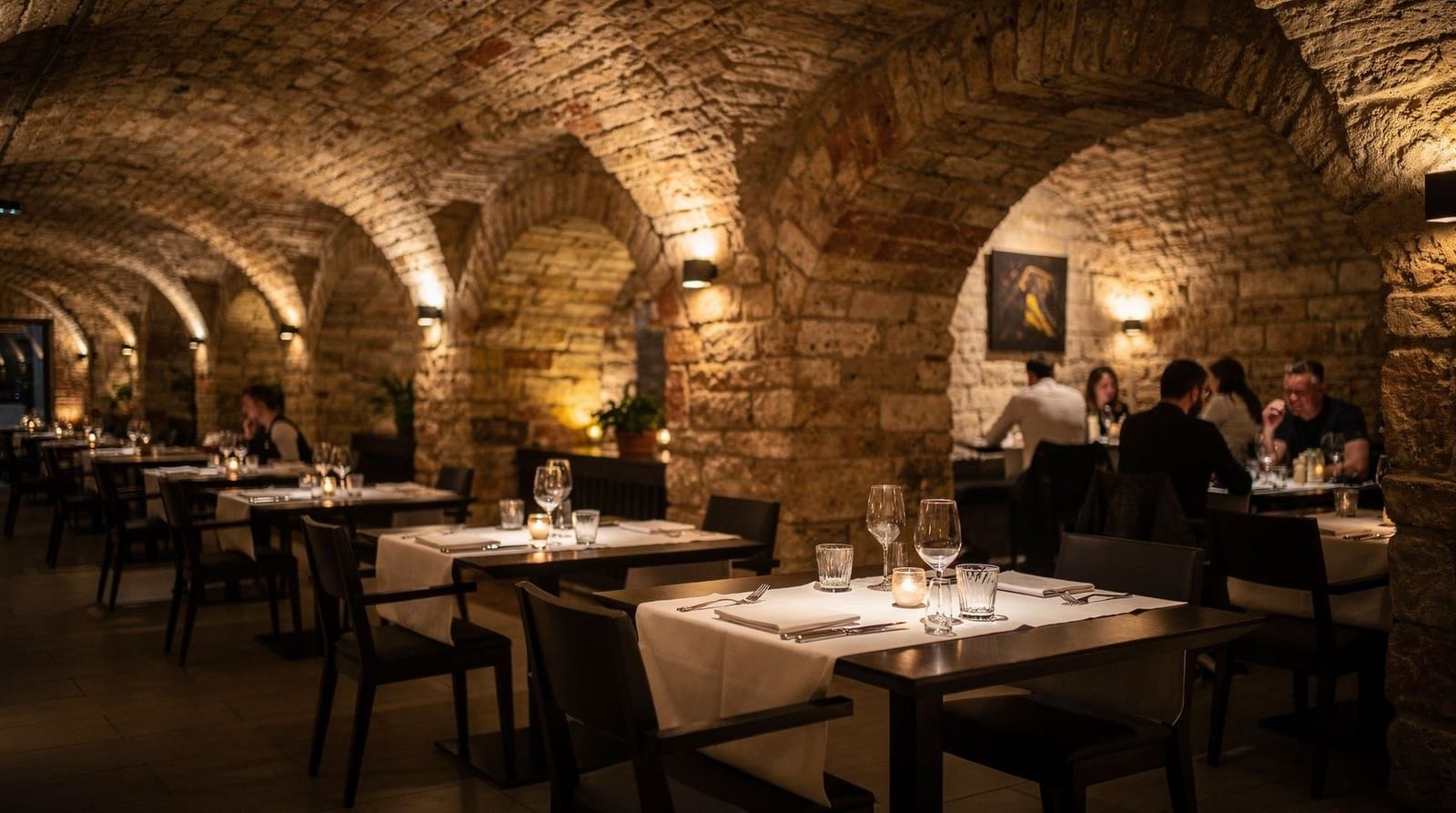
Modrá Hviezda (Blue Star) is a different proposition. It’s a small restaurant tucked into a narrow street just below Bratislava Castle, in a historic building with low ceilings and the feel of somewhere that has been feeding people for a very long time. It has.
The food is more refined than Slovak Pub — same dishes, more carefully executed. The bryndzové halušky here are among the best in the city. Mains go from 12–18 €, which is higher, but the quality justifies it. There are only around 50 covers, so booking is worth doing for dinner. For lunch, arriving early (before 12:30) usually means you can walk in.
It’s also well-placed if you’re spending a morning at the castle — Beblavého is a five-minute walk from the castle gates, and Modrá Hviezda makes an excellent post-castle lunch stop.
The best restaurants in the old town guide has more options at a similar level.
Lokál — Štefánikova
Lokál is the modern Slovak restaurant — casual, unpretentious, designed to feel like a neighbourhood place rather than a tourist destination. It sits on Štefánikova street, which puts it between the old town and the newer parts of the city, in a slightly more local residential area.
The menu is shorter than Slovak Pub but more considered. They do a good lokše, decent kapustnica, and a rotating weekly special that usually reflects what’s in season. Mains 8–13 €. The atmosphere is relaxed — this is where you go when you want good food without any formality.
Lunch menus: how locals actually eat on weekdays
The single most effective way to eat cheaply and well in Bratislava is the obedové menu — the weekday lunch menu. Almost every sit-down restaurant (not just the tourist-facing ones) offers this: soup plus a main course for 6–10 €, served between 11:00 and 14:00, Monday through Friday.
It’s how the city feeds itself at midday. Office workers, students, tradespeople — the restaurants around Obchodná and Štefánikova fill up at noon with people who live and work here, not tourists.
Look for the sign “obedové menu” posted in the window or on a board outside. If you don’t see a sign, it’s fine to ask: “Máte obedové menu?” is enough. The daily menu usually changes and isn’t printed in English — point at what looks good, or ask the server what’s available.
At 7–9 €, it’s one of the best-value meals you’ll find anywhere in Central Europe for food of this quality.
For a broader look at eating on a budget here, the budget guide covers meals alongside transport, accommodation, and activities.
GetYourGuideBratislava guided culinary tourCheck availability →The market at Miletičova: real Bratislava, real food
If you want to see where the city actually shops for food, take the tram or bus from the old town to Miletičova market — it’s about 15 minutes, and it’s worth every minute.
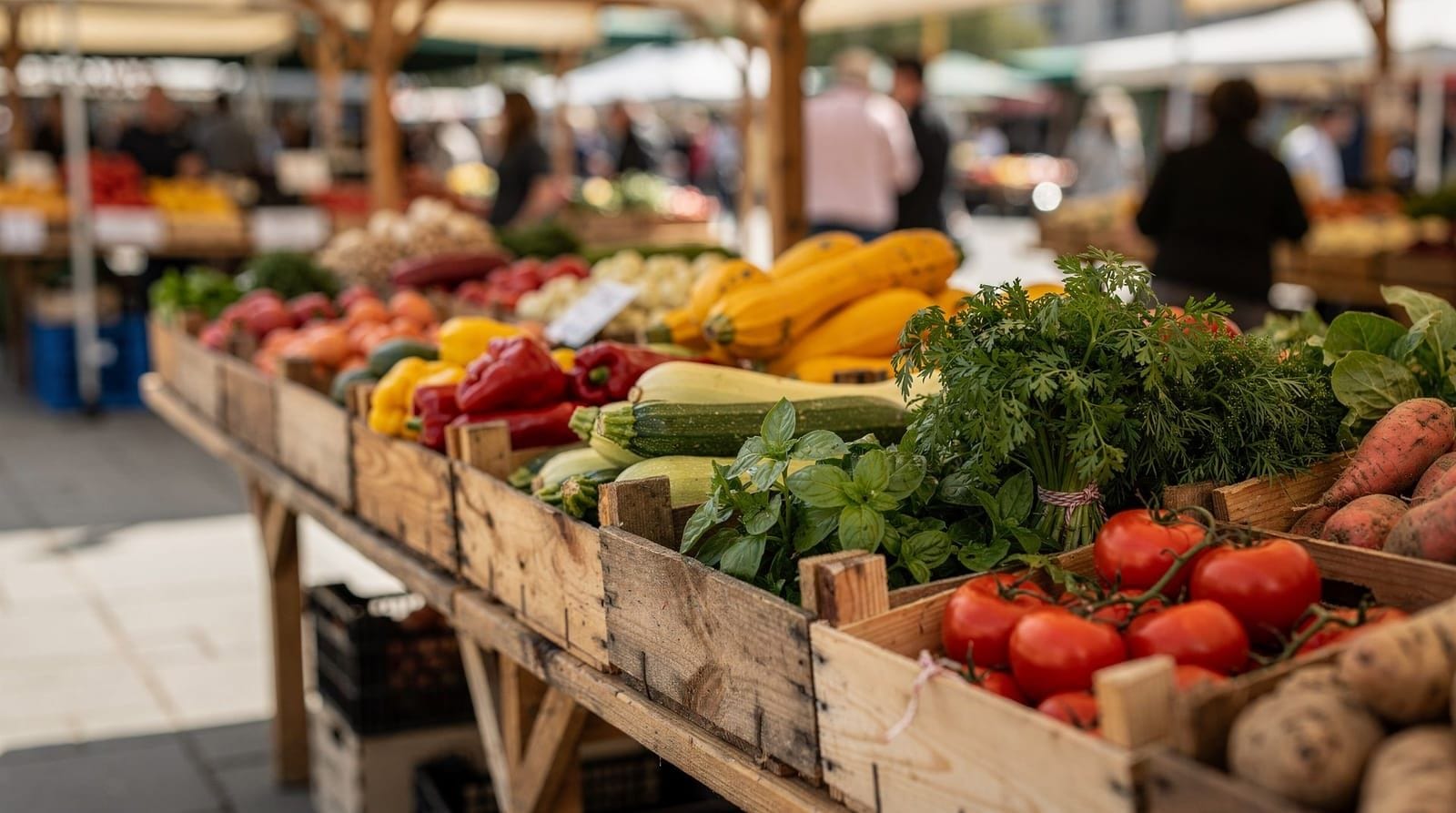
Miletičova is a covered market, not a farmers’ market for tourists. This is a working market where people buy their week’s groceries. You’ll find fresh produce, local cheese (bryndza, oštiepok — the smoked sheep’s milk cheese shaped like a ball or spindle), smoked meats, cured sausages, seasonal vegetables, and vendors who have been running their stalls for decades.
The market is open Monday through Saturday, mornings only — arrive before 11:00 and you’ll see it at full operation. By midday it starts to wind down.
If you have access to a kitchen, this is where to shop. If you don’t, it’s still worth going for the atmosphere and to pick up cheese and cured meat for a picnic — the riverside paths along the Danube make a good lunch spot, and a picnic assembled at Miletičova for two people costs around 8–12 €.
The contrast with the old town is striking: different part of the city, entirely different pace, entirely different prices. This is Bratislava without the performance.
Coffee culture: where to drink and what to expect
Bratislavans take coffee seriously. The default is espresso, often drunk standing at the bar, and the standard is genuinely high. This is not a city of bad coffee.
The chains on Hlavné námestie — international names, paper cups, 5 € lattes — are a waste of time. Walk a few minutes in any direction and you’ll find something considerably better.
Štúdio Gusto on Obchodná is one of the better specialty coffee spots in the city — small, focused, with properly sourced beans and baristas who know what they’re doing. Espresso around 2 €, flat white around 3 €.
Kafé Scherz has the atmosphere of a proper Viennese-style coffeehouse: slightly faded, comfortable, the kind of place where you can sit for two hours without anyone hovering over you. The coffee is good and the cake is better.
Urban House (also sometimes listed as Urban Café) is larger and busier, on Štefánikova, with good espresso drinks and a small food menu for breakfast or light lunch.
The cafes and coffeehouses guide covers more options across different neighbourhoods.
Wine bars: where to drink Slovak wine properly
Slovak wine is underrated outside Slovakia, partly because very little of it is exported. Within Slovakia, it’s excellent — particularly the whites from the Small Carpathians region immediately north of the city (Pezinok, Modra, Svätý Jur) and the reds from the southern Tokaj region.
In the city itself:
Vinotéka sv. Urbana is a wine bar near the old town with a serious selection of Slovak producers, by-the-glass pours from 3–6 €, and knowledgeable staff. It’s the kind of place where you can ask what you should try and get a genuine answer rather than a shrug.
Château Topoľčianky has a wine bar concept in the city if you want to try wines from one of Slovakia’s most established estates, though the primary estate is further afield.
If you have a half-day and a genuine interest in wine, the better option is to go to the source: Elesko Wine Park in Modra (about 30 minutes from Bratislava) is a modern winery with a proper tasting room and restaurant, and it represents the quality of the Small Carpathians region better than any city wine bar can. The Small Carpathians wine guide covers the region, and the Pezinok and Modra wineries guide has the practical information for a day trip.
Wine tasting in the old town is a good evening activity. Wine tasting in the actual vineyards is something else.
GetYourGuideBratislava taste of Slovakia private walking tourCheck availability →A counterpoint: when you want something that isn’t Slovak
There’s no point pretending that you will eat Slovak food at every meal for an entire visit. You won’t. And when the moment comes that you want something straightforward and just very good without thinking about cultural authenticity, Bratislava has an answer.
Lebowski on Obchodná is the best burger in the city. It’s named after the film, the aesthetic is appropriately laid-back, and the burger itself — quality beef, proper brioche, reasonable condiments — is around 9–12 €. It doesn’t pretend to be anything other than what it is, which is a well-made burger served in a casual environment. When you’ve eaten bryndzové halušky twice in two days and your stomach requests a break, Lebowski is the move.
It’s also worth noting that Bratislava has decent Vietnamese and Indian restaurants further from the old town — the city has a growing expat and international student population, and the food scene reflects it. But for this guide, those are outside scope.
What to avoid: the tourist trap checklist
A short, practical list.
Hlavné námestie restaurants: The outdoor seating on the main square looks appealing — warm evenings, historic architecture, good light for photographs. The food is overpriced (18–25 € for mains), the kitchens are largely industrial, and the only people sitting there are tourists. Walk off the square in any direction for a five-minute walk and you’ll find better food for less money.
Menus in eight languages with food photographs: This is the single most reliable warning sign in any Central European city. The moment you see a laminated menu with pictures of every dish and text in Slovak, English, German, French, Italian, Spanish, Russian, and Chinese, turn around. The food is designed for someone who doesn’t know what they’re ordering and won’t be back tomorrow.
Trdelník stands: As covered above — not Slovak, not traditional, not worth eating. The stands have multiplied in recent years precisely because tourists assume anything sold near a castle must be authentic. Skip them.
The folk-music-performance restaurants: Some restaurants in the old town offer live folk music during dinner. The music is generally fine; the food is generally not, and the prices are elevated to cover the entertainment budget. Unless you specifically want the experience of watching traditional Slovak music over dinner, there are better ways to spend 30 €.
The is Bratislava worth visiting guide has broader context on managing expectations in the city, and the first-timer mistakes blog post covers common pitfalls beyond just food.
Building a food itinerary: a practical sequence
Day one, lunch: Slovak Pub or Lokál for a proper first encounter with bryndzové halušky. Evening: wine bar at Vinotéka sv. Urbana, by-the-glass pour of a local Welschriesling or Müller-Thurgau.
Day two, morning: coffee at Štúdio Gusto, then tram to Miletičova market before 11:00. Pick up cheese and smoked meat. Picnic by the Danube or in one of the city parks. Afternoon: Modrá Hviezda for a proper lunch with the castle nearby — book ahead for dinner, walk in for lunch before 12:30.
Day three or on the way out: wine day trip to Pezinok or Modra, or a session at Elesko Wine Park. The Small Carpathians day trip guide has the logistics.
For a broader travel plan that incorporates food as part of a full visit, the Bratislava weekend guide structures two days with restaurant choices built in.
FAQ: frequently asked questions about food in Bratislava
Is Slovak food good for vegetarians?
Honestly, it’s not easy. Traditional Slovak cuisine is heavily meat-based — bryndzové halušky itself is sometimes considered a lighter option, though the bacon topping is core to the dish (you can ask for it without, and most kitchens will accommodate). Kapustnica usually contains smoked meat. Lokše can be eaten plain with butter and is vegetarian. Beyond traditional dishes, Bratislava has enough modern cafes and international restaurants to eat well as a vegetarian without much difficulty, but if you go specifically for Slovak food, the options narrow.
How much should I budget for eating per day?
A reasonable daily food budget for eating well — not extravagantly — is around 25–40 €. This covers a coffee and pastry for breakfast (3–5 €), a lunch menu at a local restaurant (7–9 €), an afternoon coffee or beer (2–4 €), and a sit-down dinner at a good traditional restaurant (12–18 € including a drink). If you’re using lunch menus both days and eating simply, you can manage on 20–30 € without feeling like you’re cutting corners. The overall budget guide covers the full picture.
Do restaurants in Bratislava accept cards?
Most do, including smaller restaurants and cafes. However, the Miletičova market and some street food vendors are cash-only, so carrying 20–30 € in cash is useful. ATMs are easy to find in the centre. Always check before ordering at smaller places if you’re unsure.
What’s the best time of year to eat locally in Bratislava?
Autumn (September–November) is the peak season for food and wine. The harvest brings fresh produce, the wine harvest (vinobrani) is celebrated in Pezinok and Modra in September, and the restaurant menus skew towards seasonal dishes like game, mushrooms, and root vegetables. Christmas market season (late November through December) brings outdoor food stalls with traditional dishes. Summer is fine — restaurant terraces are pleasant and the produce is good — but autumn is when the food culture is at its most interesting. The autumn wine harvest guide covers the seasonal specifics.
Is bryndzové halušky available year-round?
Yes. It’s on the permanent menu at most traditional Slovak restaurants, not a seasonal dish. You’ll find it at Slovak Pub, Modrá Hviezda, and Lokál year-round, as well as at most other restaurants that serve traditional food. The bryndza itself is produced throughout the year by Slovak dairy farms, though some producers argue the spring and summer milk produces the sharpest, best quality cheese. In practice, the restaurant version is consistently good regardless of when you visit.
Do I need to book restaurants in advance?
For the places on this list, only Modrá Hviezda genuinely needs a reservation, and only for dinner — it has around 50 covers and fills up. Slovak Pub, Lokál, and the coffee and wine bars generally don’t require booking; arriving before 12:30 for lunch or before 19:00 for dinner avoids most waits. Weekend evenings in the busier spots are the exception.
Bratislava food experiences on GetYourGuide
Verified deep-linked GetYourGuide tours. Book through these links and we earn a small commission at no cost to you.