10 mistakes first-time visitors make in Bratislava (and how to avoid them)
| At a glance | |
|---|---|
| Who this is for | First-time visitors planning a weekend or short city break |
| Biggest cost trap | Eating on Hlavné námestie — around 30–40% more than two streets over |
| Time to fix most mistakes | A few minutes of planning before you land |
| Easiest one to avoid | Currency mix-up — Slovakia uses euros, not Czech crowns |
| Best single fix | Book the wine region and Devín Castle before you land, since both need a bit of transport planning |
Bratislava is a genuinely great city to visit. Compact, walkable, cheaper than Vienna, packed with history, and sitting on the Danube with a castle on the hill — it ticks a lot of boxes. And yet first-time visitors manage to miss most of it, usually by making the same handful of predictable mistakes.
This isn’t a list of obscure blunders. These are the errors that well-intentioned, reasonably prepared travellers make every single weekend. Some are expensive, some just waste time, and one involves a surprisingly common geographical mix-up that really shouldn’t happen in 2026 but still does with alarming regularity.
Here’s how to do better.
1. Skipping Devín Castle because “you’ve seen the castle”
Bratislava has two castles. Most visitors do the big white one on the hill — fair enough, it’s impressive — and then consider the castle box ticked. They never make it to Devín.
This is a significant oversight. Devín Castle sits 20 minutes away by bus 29 (departing from Nový Most), perched on a dramatic rocky outcrop where the Morava River flows into the Danube. The ruins are far more evocative than the restored Bratislava Castle — crumbling towers, sheer cliffs, and views across to Austria that haven’t changed much since the Celts first fortified the site two thousand years ago.
During the Cold War, this was the edge of the Iron Curtain. The opposite bank was Austria, which might as well have been the moon. There’s a small memorial to those who died trying to cross. It puts a different frame on everything you see.
Bus 29 runs regularly, costs the same as any city bus, and the castle entrance fee is around 7 €. Allow two to three hours. See the full Devín Castle day trip guide for timing and what not to miss at the site.
2. Eating on Hlavné námestie
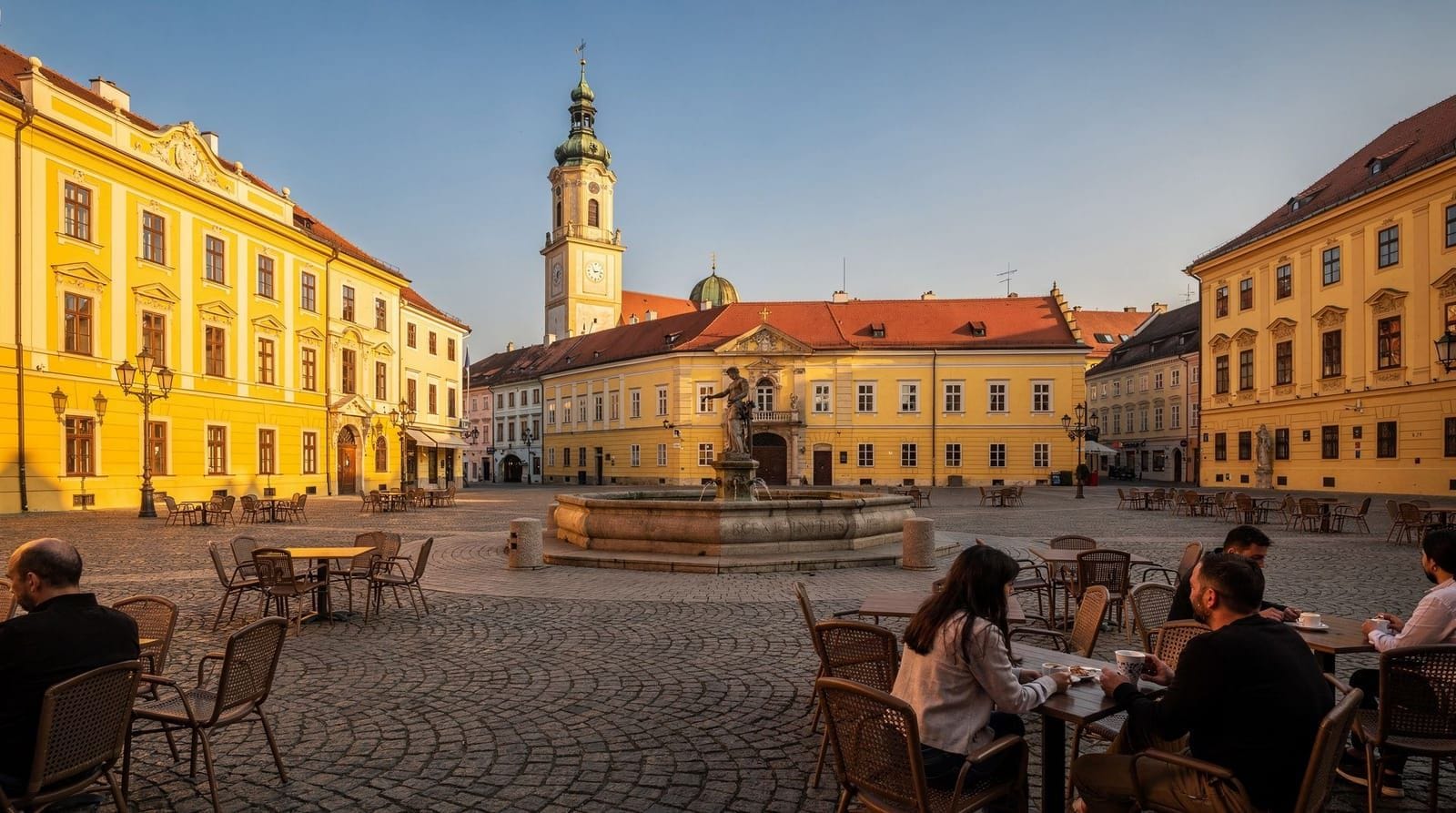
Hlavné námestie — the main square — is beautiful. The pastel baroque buildings, the Roland Fountain, the café terraces spilling out across the cobblestones. It looks exactly like a central European city square should look, and that’s precisely the problem: every restaurant facing it knows this and prices accordingly.
Mains at the tourist-trap establishments around Hlavné námestie regularly run 15–20 €. The food is rarely terrible, but it’s rarely worth it either. You’re paying for the postcard view, and the kitchens know you’re not coming back.
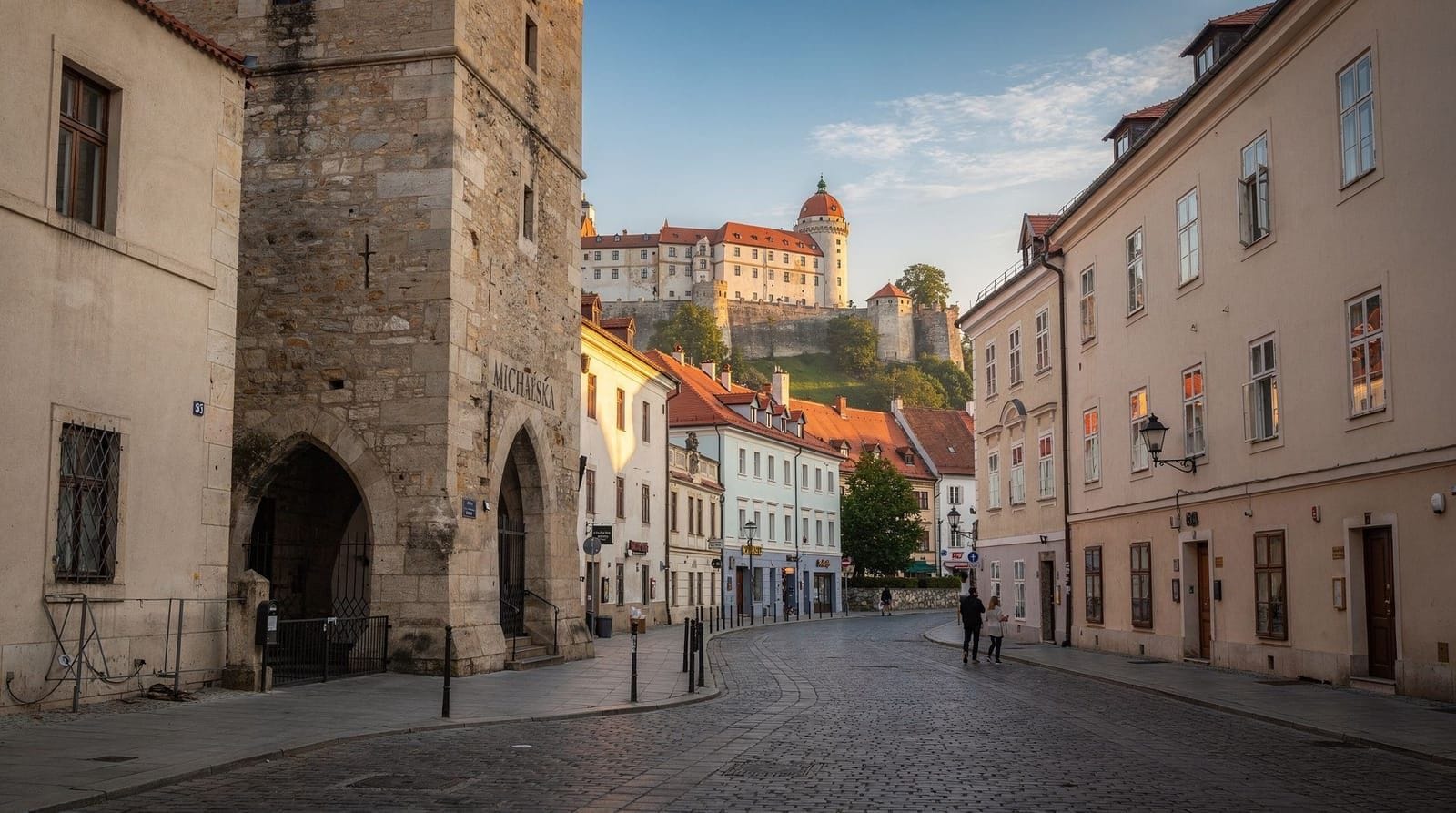
Walk two streets in any direction and the prices drop by 30–40%. The Old Town restaurants guide has specific addresses worth seeking out, including a few places on Obchodná street and in the lanes behind Michalská brána where locals actually eat lunch. For really good guidance on the whole eating landscape, the food tour options are worth considering — you’ll taste things you’d never find on your own.
Benchmark prices: a decent main course at a non-tourist restaurant should cost 8–13 €. A half-litre of Slovak beer should be 2–3 €. If either of those numbers is significantly higher, you’re in the wrong place.
3. Ignoring Slovak cuisine entirely
This follows logically from mistake number two. If you’re eating at tourist restaurants with multinational menus, you’re probably not eating Slovak food — and Slovak food, properly made, is genuinely worth your attention.
Start with bryndzové halušky: potato dumplings with sheep’s brynza cheese, finished with crispy bacon fat. It’s rich, slightly sour, deeply satisfying, and almost impossible to find outside Slovakia. Kapustnica is a sauerkraut soup that appears in various forms but always tastes like it was designed to get you through a winter. Lokše are thin potato pancakes, often served with roast duck and cabbage.
The traditional Slovak food guide goes into proper depth on what to order and where. The cafes and coffeehouses guide is also worth scanning — Slovak coffee culture is underrated and the cake situation is excellent.
GetYourGuideBratislava classic walking tourCheck availability →4. Taking unofficial taxis without checking the meter
The taxi situation in Bratislava is considerably better than it was five years ago, but there are still operators around the tourist areas who treat foreign visitors as an opportunity rather than a customer. The main train station and the airport are the most common flashpoints.
The solution is straightforward: use Bolt or Uber. Both operate in Bratislava, prices are fixed before you confirm the ride, and there’s no possibility of a scenic detour that adds 20 minutes and 15 € to your fare. For airport transfers specifically, the Bratislava airport guide has the current options laid out clearly, including which bus routes are genuinely useful.
If you do use a metered taxi, the fare should start at around 1.80 € and the per-kilometre rate shouldn’t exceed 1.20 €. City centre to the airport is roughly 15–18 € in a legitimate cab. If the driver quotes you a flat rate significantly above that before you get in, find a different taxi.
5. Missing the castle at sunset
People visit Bratislava Castle at various times of day. Some go in the morning, some fit it in after lunch. Very few go specifically for sunset, which is the obvious time to go if you’ve looked at the castle’s geography for even thirty seconds.
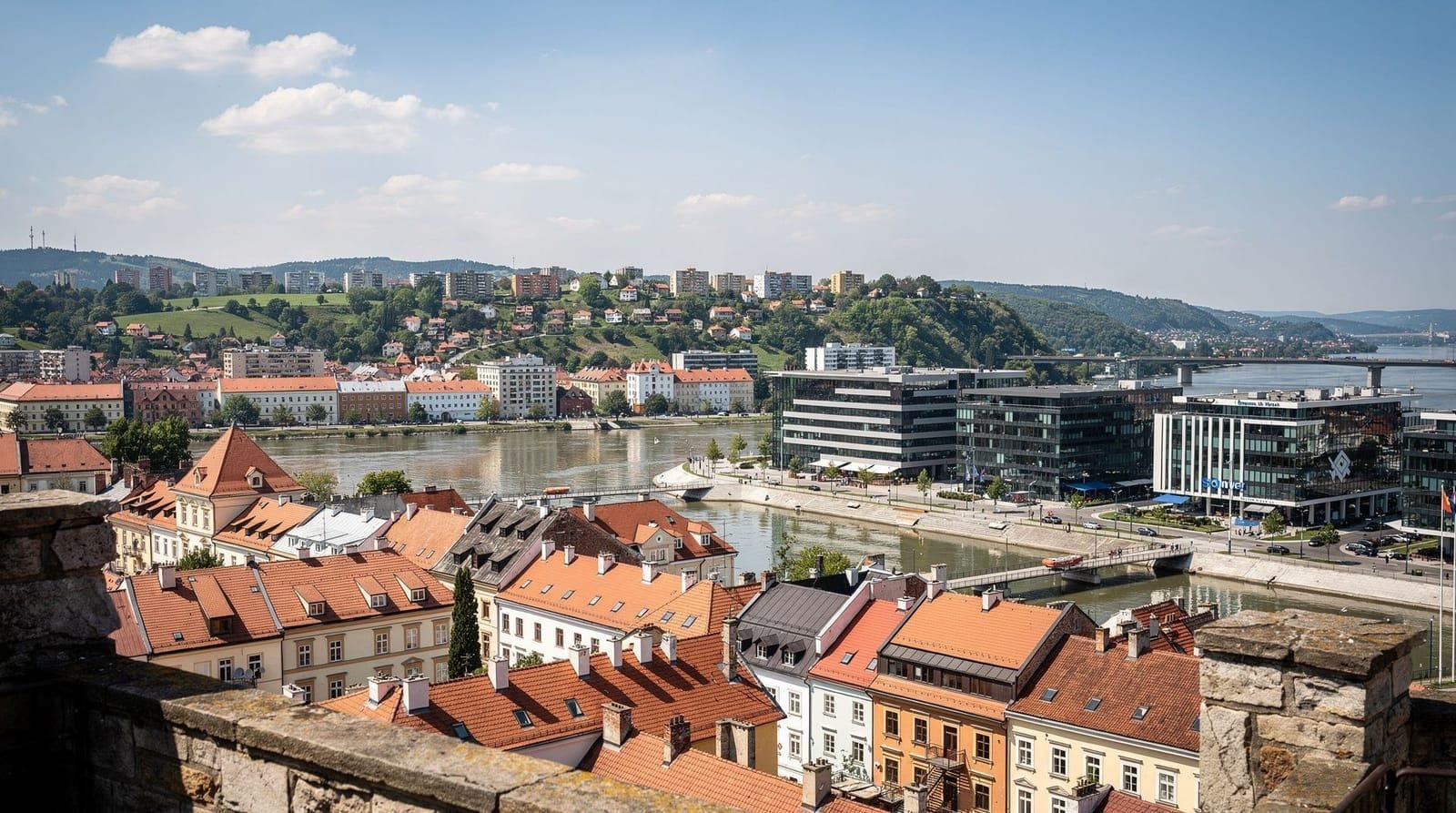
The castle sits on a hill above the Old Town on the western side of the city. The Danube runs below it to the south. At sunset, you get warm light over the river, the UFO Bridge in silhouette, and on clear days, the Austrian lowlands stretching into the distance. The viewing terrace on the south side of the castle grounds is free to access even when the museum inside has closed for the day.
The Bratislava Castle guide has opening times and what’s worth seeing inside the museum, but even if you skip the interior, time the visit for the last hour before sunset.
6. Confusing Slovakia with the Czech Republic (yes, really)
Slovakia and the Czech Republic are two separate countries. They share a language family and a history — they were one country (Czechoslovakia) until 1993 — but since then they’ve been distinct nations with distinct currencies, governments, and everything else that comes with nationhood.
Slovakia uses the euro (EUR). The Czech Republic uses the Czech crown (CZK). These are not interchangeable. If you arrive in Bratislava with a pocketful of Czech crowns because you thought they’d be useful, they won’t be. If you see prices in euros and assume you can pay with crowns, you cannot.
This sounds obvious, but the number of travellers who arrive confused about this is genuinely surprising. Bratislava is the Slovak capital. Prague is the Czech capital. They are 330 km apart. If you’re combining both in one trip, you need two currencies — or just use a card everywhere, which is the path of least resistance.
The day trips guide comparing Vienna, Budapest and Prague connections covers the logistics of moving between capitals if you’re doing a multi-city itinerary.
7. Writing off the UFO deck as a tourist trap
The SNP Bridge — formally the Most SNP, also known to locals as the UFO Bridge for the flying saucer-shaped observation platform perched on top of its single pylon — has a reputation among budget travellers as an overpriced novelty. The lift ticket costs around 7 € and the restaurant above is on the expensive side.
The views, however, are not a scam. At 95 metres above the Danube, you get a panorama that covers the Old Town, Bratislava Castle, Petržalka stretching into the distance on the far bank, and the river bending toward Vienna. On clear days you can see into Austria. The UFO observation deck guide notes that the entry fee is often deducted from your bill if you order at the restaurant — making it effectively free if you’re planning to have a drink up there anyway.
Go on a clear day. Don’t go when it’s overcast and expect to be wowed. But dismissing it entirely means missing one of the genuinely distinctive viewpoints in the city.
8. Leaving without visiting the wine region
The Small Carpathian wine region begins roughly 30–35 minutes from the city centre by car or by regional bus. The towns of Pezinok and Modra sit in the foothills, surrounded by vineyards that have been producing wine since at least the 12th century. This is Slovakia’s most important wine-growing area, and it’s almost entirely unknown to visitors who haven’t done their research.
Slovak wine doesn’t have much international profile — partly because production volumes are small and almost everything stays in the domestic market. This is actually good news for visitors: you can walk into small family wineries in Pezinok, taste wines that will genuinely surprise you, and buy bottles for prices that would be laughable in a Viennese wine shop.
The Small Carpathians wine guide covers the region’s main varieties (Welschriesling, Grüner Veltliner, Blaufränkisch) and how to approach a visit. The Pezinok and Modra wineries guide gets into specific producers worth visiting. If you’d rather have someone else handle the logistics, the wine tasting tours from Bratislava are a solid option and mean you can actually drink without worrying about driving back.
9. Arriving on a Saturday night during stag weekend season
This one isn’t about culture or cuisine — it’s about managing expectations.
Bratislava has become a significant destination for stag weekends, particularly from the UK and Ireland. The combination of cheap flights, cheap beer, and a compact city centre makes it an obvious choice. On a busy Saturday night, the area around the Old Town — especially around Obchodná and the main bar strips — can feel like a particularly boisterous British seaside town that has somehow been relocated to Central Europe.
This isn’t uniformly terrible. The city copes, locals have made their peace with it, and many of the bars are genuinely good regardless of who’s in them. But if you’re arriving expecting a quiet, atmospheric weekend in a historic Central European capital and you haven’t checked what else is happening in the city that particular Saturday, you may find the atmosphere somewhat at odds with your expectations.
Check the nightlife guide and the pub and beer crawl options to understand the landscape before you arrive. If you want a quieter experience, Friday evenings and Sunday afternoons are usually considerably calmer. The best bars in the Old Town guide includes options that cater more to locals, which tends to correlate with lower noise levels and better drinks.
The where to stay guide is also relevant here — if you’re staying in the very heart of the Old Town, Saturday nights will be louder than if you choose a hotel one neighbourhood over.
10. Coming in January expecting Christmas-market magic
Bratislava’s Christmas markets are excellent. They run from late November through the holiday season, and the combination of the Old Town setting, the Slovak craft stalls, the mulled wine, and the general festive atmosphere makes for a genuinely lovely winter visit. The Christmas markets guide covers dates, what to buy, and the best spots.
Here’s the catch: they close on 6 January. By the time you arrive in mid-January, the wooden stalls are gone, the fairy lights are down, and Hlavné námestie has returned to its default winter state — which is a fine, historic square, but considerably less magical than it was three weeks earlier.
January is Bratislava’s quietest tourist month. Hotels are cheap, which is a genuine upside. But the weather is cold and grey without the compensation of snow (Bratislava gets snow occasionally but not reliably), most of the seasonal activities are over, and the city feels somewhat emptier than usual.
If you’re specifically coming for the Christmas atmosphere, arrive before the 6th. If you’re visiting in January for other reasons — cheap flights, low crowds, a stopover between other destinations — just go in with accurate expectations rather than hoping the markets might still be running. The best time to visit guide covers the full seasonal picture, including when the wine harvest season brings a different kind of festive energy in September and October.
11. Assuming one day is enough to “do” Bratislava properly
The old town genuinely can be walked in an afternoon, and plenty of day-trippers from Vienna do exactly that. But treating Bratislava as a box-ticking exercise means you’ll miss the wine region, Devín, and the sunset from the castle terrace — three of the best things about the city, none of which fit comfortably into a rushed half-day.
If you only have a few hours, the Bratislava in one day itinerary sequences the essentials realistically. But if you can stretch to two nights, the difference in what you actually experience is significant — not just more sights, but a slower pace that suits the city better than a checklist ever will.
If you do have only a day, a guided walk that includes the castle is a practical way to cover the main sights without planning each stop yourself.
GetYourGuideBratislava guided walking tour with castle entryCheck availability →12. Not checking what public transport ticket you actually need
Bratislava’s tram and bus network runs on a single ticketing system, but first-timers often either buy nothing (and risk a fine from a ticket inspector) or overbuy multi-day passes they don’t need for a short stay. Tickets are time-validated, not single-journey, so a 30-minute ticket covers transfers within that window rather than a single ride.
Validate your ticket the moment you board — inspectors do check, and “I didn’t know” is not an accepted excuse. The public transport guide and getting around Bratislava cover ticket types, prices, and where to buy them (kiosks and machines, not always onboard).
Putting it all together
None of these mistakes are catastrophic. Bratislava is small enough and pleasant enough that you’ll have a decent time even if you make half of them. But avoiding them means the difference between a fine trip and one that rewards you properly for showing up.
The one-day itinerary is a useful starting point for structuring your time, and the weekend itinerary gives you a proper two-day framework that builds in Devín, the wine region, and more than just the main square. If you’re weighing up whether Bratislava is worth your time at all, the honest assessment makes the case without overselling it.
The city is best approached without too many prior assumptions. It’s not Prague. It’s not Vienna. It’s smaller and quieter than both, and that’s largely the point. Give it the time to show you what it actually is rather than what you expected it to be, and it tends to deliver.
Culture & heritage tours
Verified deep-linked GetYourGuide tours. Book through these links and we earn a small commission at no cost to you.