Cafés and coffeehouses in Bratislava: the best places to slow down
What are the best cafés in Bratislava?
Café Mayer on Hlavné námestie is the most historic option, open since 1873. For specialty coffee, Štúr Coffee near Obchodná and Urpiner Coffee Bar in the old town are the strongest current choices. For atmosphere with cake, Café Roland opposite the Roland Fountain is hard to beat for a tourist visit.
Bratislava’s café culture is not the first thing most visitors come for, but it tends to be one of the things they remember most clearly. The city sits at the intersection of two great Central European coffeehouse traditions — the Viennese and the Budapest — and has absorbed influences from both without quite becoming either. The result is a coffee culture that is quieter and less theatrical than Vienna’s, less frenetic than Prague’s, and genuinely its own thing: unhurried, comfortable with long afternoons, and tolerant of the kind of sitting that has no particular purpose beyond the sitting itself.
This guide covers the full range, from the grand historic coffeehouses on the main square to the growing specialty coffee scene that has taken hold in the past decade, along with the cake traditions that make the experience more than just a caffeine transaction. Whether you are pausing mid-way through an old town walking tour or simply building an afternoon around a table and a good book, Bratislava has considerably more to offer than the tourist-facing cafés that ring the main square might initially suggest.
At a glance
| Where | Historic coffeehouses cluster on Hlavné námestie; specialty coffee is spread between Obchodná ulica and Námestie SNP |
| Typical cost | Espresso around €2.50–3.50, milk drinks around €3.20–4.50, cake around €3.50–5.50 |
| Time needed | 30–45 minutes for a coffee stop; 1–2 hours for a proper coffeehouse sit |
| Best for laptops/wifi | Specialty bars (Štúr Coffee, Good Coffee, Urpiner) rather than the historic terraces |
| Best time | Before 10:00 or after 17:00 to avoid the main-square terrace crush |
The Central European coffeehouse tradition
To understand what Bratislava’s best cafés are doing, it helps to understand the tradition they draw from. The Central European coffeehouse is not principally a place to drink coffee. It is a public room — available to anyone who can afford the price of a single drink — where you may sit for as long as you wish, read newspapers provided for the purpose, conduct business, write, argue, or simply be present. This tradition was most fully elaborated in Vienna and Budapest in the nineteenth century, but Bratislava — then called Pressburg, capital of the Kingdom of Hungary — participated in it fully.
The city’s historic coffeehouses were places where the Slovak national movement was debated, Hungarian aristocrats played cards, and Viennese merchants negotiated contracts. Most were destroyed or converted during the communist period, when the coffeehouse as a bourgeois institution was nationalised and repurposed. The revival has been slow since 1989, but several of the old names and traditions have returned.
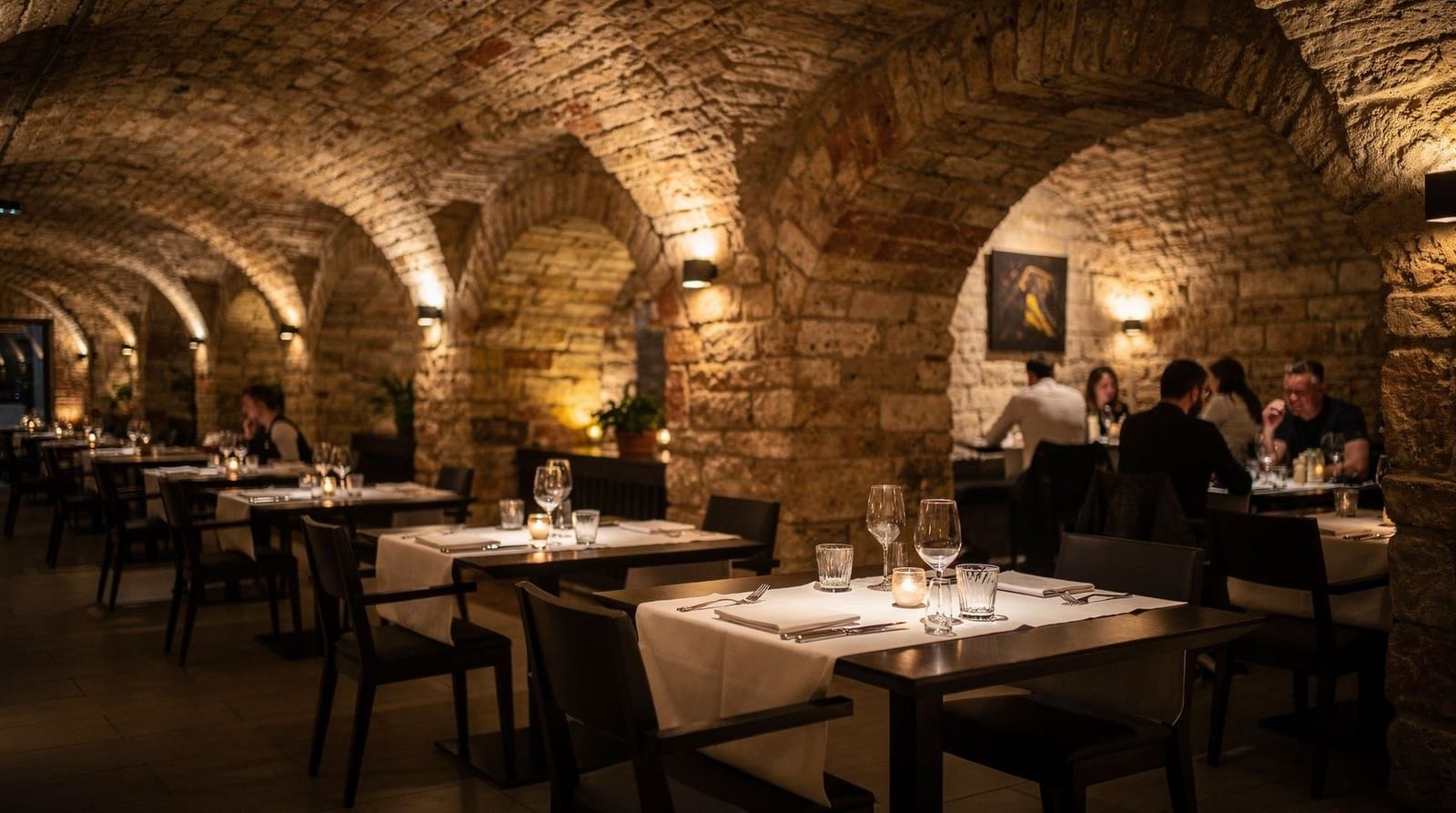
What distinguishes the historic coffeehouses from the specialty bars is pacing. At Café Mayer or Café Roland, there is no counter service, no queue, no loyalty card. You sit down, a waiter comes to you, and your order arrives when it arrives. This is not slowness as a failing — it is the whole point.
GetYourGuideBratislava guided culinary tourCheck availability →Historic coffeehouses on and around Hlavné námestie
Café Mayer
Café Mayer on Hlavné námestie is the closest thing Bratislava has to a grand historic coffeehouse in the Viennese tradition. The original establishment opened in 1873, making it one of the oldest continuously operating café names in the city, and the current premises on the main square retain a formal, somewhat stately quality that distinguishes them from the tourist cafés that surround them.
The interior mixes period detailing with 1990s-era renovation — a common compromise in Bratislava’s recovered historic buildings — but the proportion of the room, the cake counter along the side wall, and the table service create an atmosphere that holds. The cake selection is serious: dobošová torta (the Hungarian-origin layered sponge cake with caramel glaze), sachertorte, apple strudel, and a rotating selection of seasonal gâteaux made on the premises. A slice of cake costs €3.50 to €5.50.
Coffee prices are in the mid-range: espresso €2.50, cappuccino €3.20, filter coffee €2.80. The house hot chocolate (horúca čokoláda) at €4.50 is thick and proper, made with real chocolate rather than powder, and is a very reasonable alternative to coffee on a cold afternoon. Café Mayer is on the main square’s northern side, which means the terrace receives afternoon sun in summer — the terrace tables fill quickly after 15:00 on warm days.
Café Roland
Café Roland sits directly opposite Roland’s Fountain at the heart of Hlavné námestie and occupies one of the most photographed positions in the old town. It is unquestionably more tourist-facing than Café Mayer — the terrace is larger, the prices are slightly higher, and the menu extends to light meals — but it is not a tourist trap. The interior is properly done, the coffee is good, and the view of the fountain and the surrounding square from the terrace is genuinely one of the better café seats in the city.
The case for sitting at Café Roland is primarily locational: if you are going to pause for coffee in the middle of an old town tour, the fountain terrace is a natural rest point. The historical coffeehouses at the fountain’s edge have been serving this purpose for over a century. Espresso is €2.80 to €3.20, flat white €3.50, and the cake selection skews more toward international pastry than the Slovak-focused selection at Café Mayer. There is also a savoury menu of salads and open sandwiches, which makes Roland a reasonable option for a light lunch if you do not want a full restaurant sit-down.
Kaffee Mayer
The name is intentionally close to Café Mayer — this is a related café operation with a slightly different focus, located on Panská ulica one street south of the main square. Kaffee Mayer is smaller and more intimate than the main-square location, with a narrower frontage, a cozier interior, and a slightly less formal tone. It is a better choice if the main square is crowded and you want the same quality in a quieter setting. The pastry selection overlaps significantly with the main location, and prices are marginally lower. This is a useful fallback for the visitor who arrives mid-morning and finds the main square café terraces already full.
The specialty coffee scene
Bratislava’s specialty coffee scene is comparatively young — it began taking shape in earnest around 2015, following similar movements in Prague, Budapest, and Warsaw — but it has matured quickly. The city now has a credible number of specialty cafés operating at a standard that would be unremarkable in London or Berlin but remains genuinely noteworthy by the standards of its region.
The defining characteristics of the Bratislava specialty scene are: quality single-origin espresso and filter coffee from European roasters, barista staff who know what they are doing and are willing to discuss it, a counter-service format rather than waiter service, interiors that tend toward industrial or Scandinavian minimalism, and prices that are meaningfully higher than the historic coffeehouses (espresso €2.80 to €3.50, flat white €3.80 to €4.50) but still cheap by Western European standards.
These cafés also have a different social function than the historic coffeehouses. They attract a younger, largely local clientele of students, freelancers, and creative workers who treat them as workspace. The wifi tends to be reliable. The ambient noise level from pour-over ritual and espresso machines is a constant. The expectation of a long unhurried sit is present but somewhat less pronounced than in the old coffeehouses — you are more likely to be sharing a large communal table with someone working on a laptop than to have a private table to yourself.
GetYourGuideBratislava taste of Slovakia private walking tourCheck availability →Štúr Coffee
Named after Ľudovít Štúr — the Slovak linguistic reformer who standardised the Slovak language in the 1840s — Štúr Coffee is one of the best specialty cafés in the city and possibly the most influential in shaping the local scene. It operates from a premises near Obchodná ulica, the main commercial street that runs along the northern edge of the old town, and draws a loyal clientele of locals who are largely uninterested in the tourist circuit.
The coffee programme is serious: Štúr works with a rotating selection of European specialty roasters (typically sourcing from Czech and Austrian roasters alongside occasional direct-trade Slovak producers) and runs a proper filter bar alongside the espresso programme. Pour-over, Aeropress, and batch-brew options are available. The baristas are knowledgeable and enthusiastic without being performative about it.
The space is modest — twelve to fifteen seats inside, a few more outside in good weather — and fills quickly on weekend mornings. If you are arriving for a slow breakfast or a long work session, arriving before 09:30 or after 14:00 improves your chances of finding a table without waiting. Espresso from €2.80, flat white €3.80, filter €3.20. There is a small food menu of toasted open sandwiches and good pastry sourced locally.
Urpiner Coffee Bar
Urpiner Coffee Bar is one of the more prominent specialty cafés operating within the old town proper, which makes it accessible for visitors who do not want to leave the pedestrian zone. It is associated with the Slovak brewery Urpiner (based in Banská Bystrica in central Slovakia) but the coffee operation is genuinely independent in character — the brewing connection is more historical than operational.
The premises are well designed, with high ceilings and good light. The espresso programme is competent, the milk drinks are done properly, and the location makes it a natural stop mid-afternoon after visiting Michaels Gate or the Slovak National Gallery. It is busier with tourists than Štúr but not overwhelmingly so, and the staff are used to interacting with visitors who have limited Slovak. Espresso €2.60, flat white €3.60, pastry €2.50 to €4.
Good Coffee Bratislava
Good Coffee operates from a location near Námestie SNP (the main city square outside the old town, about five minutes’ walk from Hlavné námestie) and appeals to the same specialty-oriented clientele as Štúr, but with a slightly more spacious and comfortable interior. It is a good choice for a longer work session or a morning coffee meeting: there is more room than at Štúr, the wifi is reliable, and the coffee programme is consistently good.
The food offering here is more substantial than at most specialty cafés in the city — proper breakfast options and lunch salads rather than pastry alone — which makes it work as an all-morning destination rather than just a coffee stop. Prices are in line with the rest of the specialty scene.
Cake and pastry culture
Slovak pastry is a significant part of the café experience and worth approaching as its own subject. The tradition draws from both the Slovak countryside and the Habsburg urban tradition, producing a range of cakes that are distinct from (though clearly related to) what you will find in Vienna or Budapest.
Dobošová torta is the most prestigious cake in the Central European repertoire: five to seven thin sponge layers, each spread with chocolate buttercream, topped with a caramel glaze that is cut into precise segments before serving. The original recipe was invented by the Budapest confectioner József Dobos in 1884. Bratislava’s coffeehouses have been serving their own versions for as long. A proper dobošová torta requires skill to assemble, and the quality varies significantly between establishments. Café Mayer’s version is one of the better ones in the city.
Makovník is a rolled pastry made from yeasted dough filled with sweetened ground poppy seeds — Slovakia produces some of the best poppy seeds in Europe, and they appear in baked goods throughout the country. The roll is baked until golden, sliced into spirals, and served at room temperature. It is less elaborate than a layer cake but deeply satisfying: the poppy filling is dense, slightly bitter, and fragrant in a way that synthetic poppy flavouring cannot replicate. Found in traditional bakeries and the pastry cases of historic coffeehouses.
Medovník (honey cake) is a layered cake made from honey-spiced dough spread with a filling of condensed milk caramel (similar to dulce de leche) between the layers, then refrigerated to soften. The result is dense, rich, and strongly flavoured with honey and gingerbread spice. It keeps well and is often sold by the slice or as a whole cake to take away. It is widely available in supermarkets in an industrial form, but bakery and coffeehouse versions are substantially better.
Štrúdľa (strudel) appears in apple, cherry, poppy seed, and cottage cheese variants. The Slovak version tends toward a thicker, more yielding pastry than the paper-thin Viennese strudel, which divides opinion. Both are good; they are different things.
Závin is a related rolled pastry, similar to a strudel but typically made with a richer dough and wound into a spiral rather than folded. The poppy and nut variants are particularly common in Bratislava cafés.
Areas and neighbourhoods for café exploration
Hlavné námestie and Michalská ulica
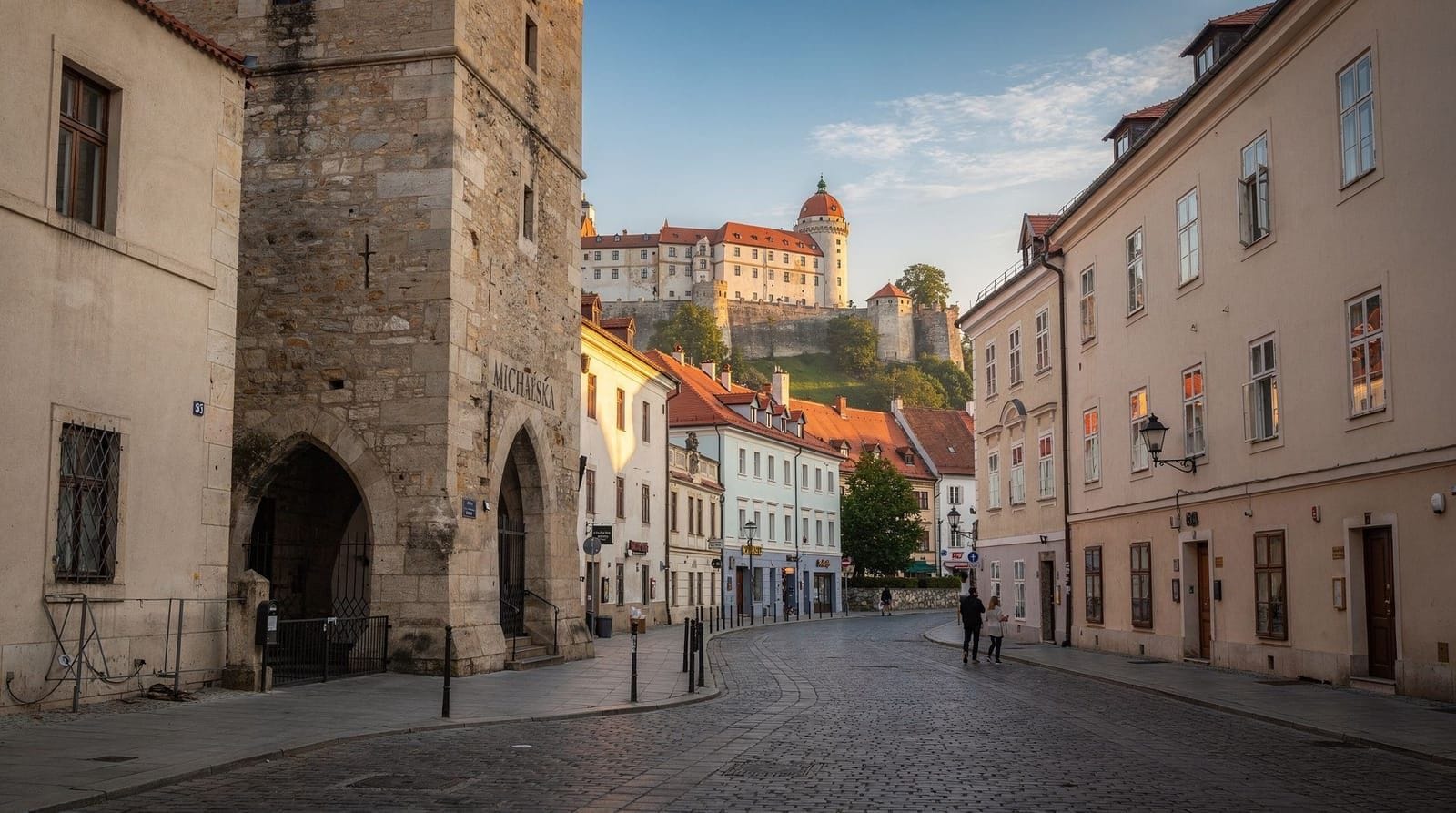
The main square and the pedestrian street leading north from it to Michael’s Gate are the most obvious café area and the most tourist-heavy. Café Roland, Café Mayer, and several less distinguished café-restaurants occupy the square and its immediate surroundings. The quality here is reliable if rarely exceptional. The terrace experience is genuinely pleasant: sitting in front of Roland’s Fountain with a coffee and cake on a warm afternoon is one of the uncomplicated pleasures of Bratislava. For the first visit, this is where to start.
Panská ulica and surrounding lanes
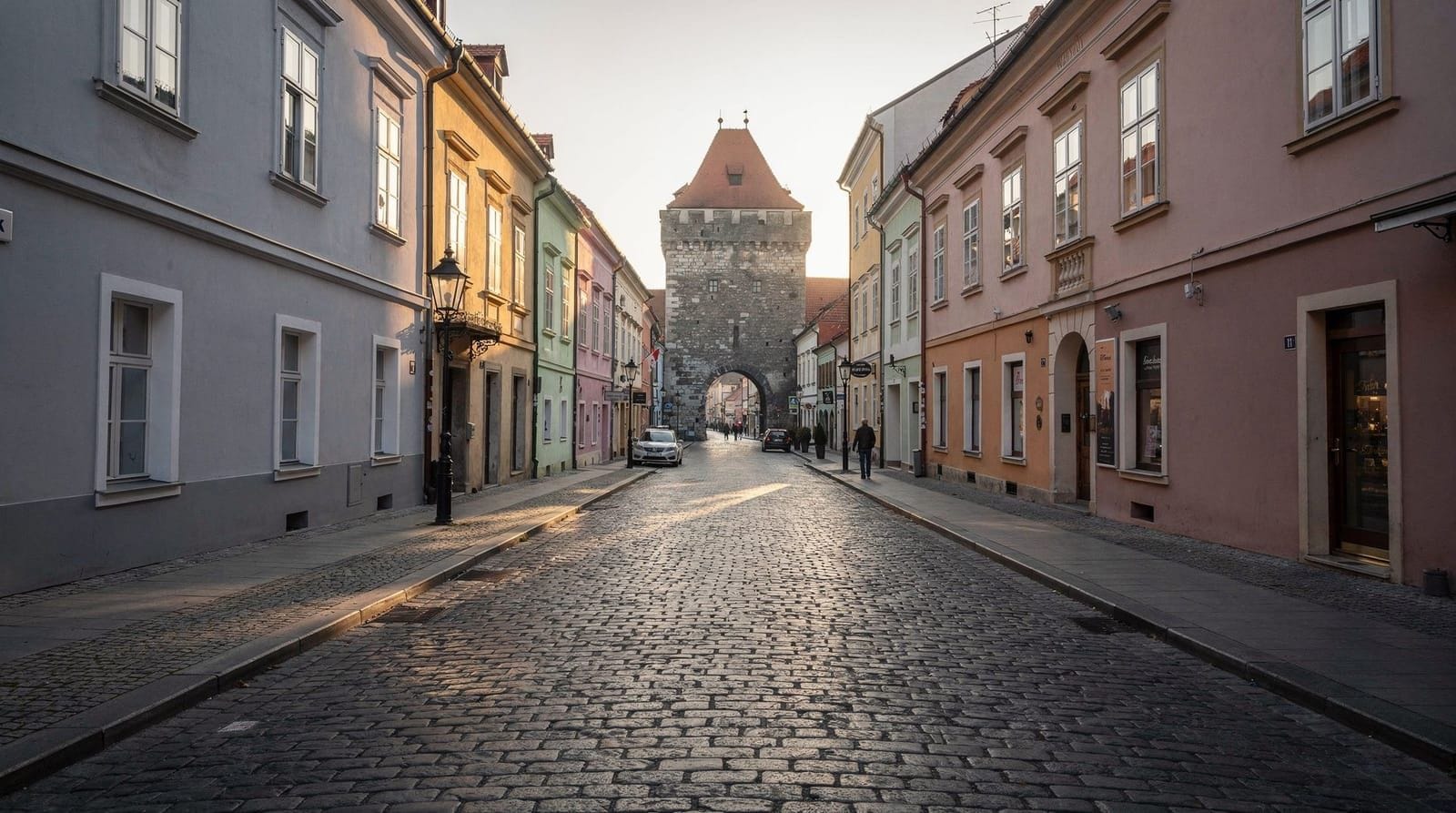
Panská Street, running south from the main square through the heart of the old town, has a higher concentration of independent cafés and wine bars than the main square itself. Several of these are locals-first operations with minimal English signage that repay a degree of curiosity. The lanes between Panská and Laurinská — particularly the short stretch around the Čumil statue — contain some of the old town’s best-kept small cafés and are worth exploring during the quieter hours of the morning or after the lunch rush clears.
Obchodná ulica
Obchodná Street runs east-west just north of the old town and is the principal commercial street of everyday Bratislava — the one where locals actually shop, as opposed to the pedestrian zone where tourists browse. The café culture here is noticeably more local in character: Štúr Coffee anchors the specialty scene, but there are also several small neighbourhood cafés that serve traditional coffee (filtered “press” coffee in the Slovak tradition, or espresso) to a clientele who have been coming to the same place for decades.
Obchodná is about a ten-minute walk from Hlavné námestie, which means most visitors on short itineraries do not reach it. If you have two or three days in Bratislava and are interested in experiencing the city at a local pace, a morning coffee on Obchodná gives a very different sense of the place than the old town café terraces.
Staré Mesto beyond the tourist circuit
The older residential streets east of Primaciálne námestie, toward Námestie SNP, contain neighbourhood cafés operating largely outside the visitor economy. Good Coffee Bratislava is the most notable, but the general density of small cafés in this area reflects a genuine local café culture. If you are staying in an apartment in the wider old town, these spots tend to become the morning default after a day or two.
When to visit: morning versus afternoon
The experience of Bratislava’s cafés changes across the day. Before 10:00, the old town is quiet and largely local. Café terraces are set up but not yet busy — this is the best time to get a table at Café Mayer without waiting, and the old town itself has an unhurried quality before the tour groups arrive. Specialty cafés near Obchodná open from 08:00 and attract a mix of commuters and remote workers.
The midday rush (12:00 to 14:00) fills main-square terraces. Tables at Café Roland may require sharing; inside seating at Café Mayer becomes more available when the terrace is full. Specialty cafés are calmer at this hour.
The afternoon window (14:00 to 17:00) is the classic coffeehouse hour: the lunch crowd has thinned, the light on the square turns warm, and sitting over coffee and cake for an extended period feels entirely natural. If you are combining an afternoon café visit with the best views of Bratislava or a walk along the Danube, the café is logically the mid-afternoon pause.
Evening café culture is less pronounced than in Italy or France. Most historic coffeehouses close by 21:00; specialty bars typically by 20:00. Evening social life tends to move toward wine bars and the bar scene.
For working remotely: the specialty cafés (Štúr Coffee, Good Coffee, Urpiner Coffee Bar) have reliable wifi. Historic coffeehouses have variable connectivity and are better suited to conversation than laptop sessions.
Seasonal considerations
Summer (June to August)
Terrace season is in full operation. The café terraces on Hlavné námestie are busy from mid-morning and difficult to claim on weekend afternoons. The early morning (before 09:30) is the exception — the square is genuinely quiet. In summer, the Danube riverside has seasonal pop-up café bars along the Tyršovo Nábrežie waterfront promenade, which offer a completely different setting: casual, outdoors, with views of the Danube and the Petržalka bank opposite.
Autumn (September to November)
Arguably the best season for café culture in Bratislava. The tourist pressure eases after September, the light in the late afternoons is exceptional, and the wine harvest season introduces new seasonal offerings to café menus: new wine (burčiak, the partially fermented grape juice available only in September and October), seasonal pastries, and a generally festive mood. The Small Carpathians wine weekend pairs well with a Saturday morning in an old town café before heading north into wine country.
Winter and Christmas markets
From late November through late December, outdoor café culture relocates to the Christmas markets on Hlavné námestie. Market stalls sell varené víno (mulled wine), punč (heated fruit punch), and svareček (hot spirits with lemon and honey). Indoor coffeehouses have an appealing quality of refuge at this time of year — the contrast between cold outside and warm interior is exactly what a coffeehouse is supposed to provide.
Spring (March to May)
Terrace season begins gradually from late March. By April, most main-square terraces are operating on warm days. Spring is a good time for café culture in Bratislava: tourist volumes are lower than summer, the city is beginning to animate after winter, and the interior window seats that defined the cold months give way to pavement tables in the sun.
Frequently asked questions about cafés in Bratislava
What is the local coffee culture like in Bratislava?
Bratislava’s coffee culture combines the Central European coffeehouse tradition — slow, seated, table service — with a growing specialty scene that is more counter-service and quality-focused. Both coexist without much tension. The historic coffeehouses emphasise atmosphere and tradition; the specialty bars emphasise the coffee itself. Most visitors find both worth experiencing.
How much does coffee cost in Bratislava?
Espresso at a historic coffeehouse or neighbourhood café costs €2 to €3. At specialty coffee bars, espresso runs €2.80 to €3.50. Milk-based drinks (cappuccino, flat white, latte) cost €3 to €4.50 depending on the establishment. Filter coffee is generally cheaper than espresso. These prices are low by Western European standards and have risen modestly since 2020 but remain reasonable.
Do cafés in Bratislava have good wifi?
Specialty coffee bars generally have reliable wifi suitable for working. Historic coffeehouses and tourist-facing cafés on the main square have variable wifi — sometimes good, sometimes patchy, often without visible password signage. If reliable wifi for work is important, the specialty bars (Štúr Coffee, Good Coffee, Urpiner Coffee Bar) are the better choice.
Are there vegan options in Bratislava cafés?
Plant-based milk alternatives (oat milk, almond milk) are available at most specialty coffee bars in Bratislava. They are less reliably available at historic coffeehouses — it is worth asking at Café Mayer or Café Roland rather than assuming. Vegan pastry is rare in traditional coffeehouses, which rely heavily on butter and eggs. Specialty bars are more likely to stock at least one vegan baked good.
Is there a Slovak equivalent of the Viennese Kaffeestunde tradition?
Bratislava has its own afternoon coffee hour, less formalised than Vienna’s but present. The period from roughly 15:00 to 17:00 is when the historic coffeehouses are at their fullest — people meet after work or between errands, and the pace is unhurried. The expectation that you will sit for an hour over a single order is still culturally intact at the older establishments.
Which café is best for a first visit to Bratislava?
Café Mayer on the main square is the default starting point: historic, Slovak pastry-focused, and table service throughout. For specialty coffee, Štúr Coffee is the clearest recommendation — the best all-around coffee bar in the city and a fair representative of how the scene has developed.
Can I combine a café visit with a food tour?
Yes. A food tour typically ends around 13:00 to 14:00, which is a natural transition point to a café for dessert and coffee before an afternoon of sightseeing or a castle visit. Some tours include a café stop — check the operator’s stop list before booking a separate visit.
Are Bratislava’s cafés cash-only?
Most accept card payment. Historic coffeehouses take both; specialty bars are often card-preferred or card-only. Carrying €10 to €20 in cash is still advisable for neighbourhood cafés and Christmas market stalls outside the main square.
Do Bratislava cafés take reservations?
Rarely, and it is rarely necessary. Historic coffeehouses on the main square operate on a walk-in basis even at busy periods; the worst case is a short wait for a terrace table. Specialty bars are counter-service and do not take bookings at all. The exception is a large group (six or more), where calling ahead to Café Mayer or Café Roland is a reasonable courtesy.
Bratislava food experiences on GetYourGuide
Verified deep-linked GetYourGuide tours. Book through these links and we earn a small commission at no cost to you.