Old Town walking guide: exploring Bratislava's historic heart
How long does it take to walk Bratislava's Old Town?
A leisurely walk covering the main sights takes 2-3 hours. Allow a full half-day if you want to enter the museums inside Michael's Gate and Primaciálne Palace.
Bratislava’s Old Town is one of Central Europe’s most underrated urban walks. Contained within a compact pedestrian zone along the Danube’s northern bank, Staré Mesto — as it is known in Slovak — packs medieval gates, Habsburg squares, Baroque palaces, and an endearing collection of bronze street statues into an area you can cross on foot in under twenty minutes.
That compactness is the secret: nothing feels rushed, everything is walkable, and stumbling onto a hidden courtyard between two Renaissance façades is genuinely part of the experience. If you are visiting on a day trip from Vienna or building a longer weekend itinerary, Old Town is the natural anchor around which everything else arranges itself.
| At a glance | |
|---|---|
| Where | Staré Mesto pedestrian core, between Michael’s Gate and the SNP Bridge approach |
| Cost | Free to walk; paid interiors (tower, palace) add up to around €13 combined |
| Time needed | 2-3 hours at a leisurely pace; a half-day if entering the paid museums |
| Getting there | 15-minute walk from Hlavná stanica, or tram 1 to Nám. SNP |
| Best time | Before 10:00 on a weekday, or golden hour in late afternoon |
Why Bratislava’s Old Town is worth your morning
Many visitors arrive expecting a miniature Prague and leave surprised to find something more personal. Bratislava’s Old Town covers roughly one square kilometre, which means crowds thin quickly once you step off the main axis between Michael’s Gate and Hlavné námestie. The city spent centuries as Pozsony — capital of the Kingdom of Hungary — and the layers of that history are legible in the architecture: Gothic churches pressed up against Baroque mansions, Rococo fountains standing in squares built for coronation processions. Eighteen Hungarian monarchs were crowned at St Martin’s Cathedral, which stands at the Old Town’s southwestern edge.
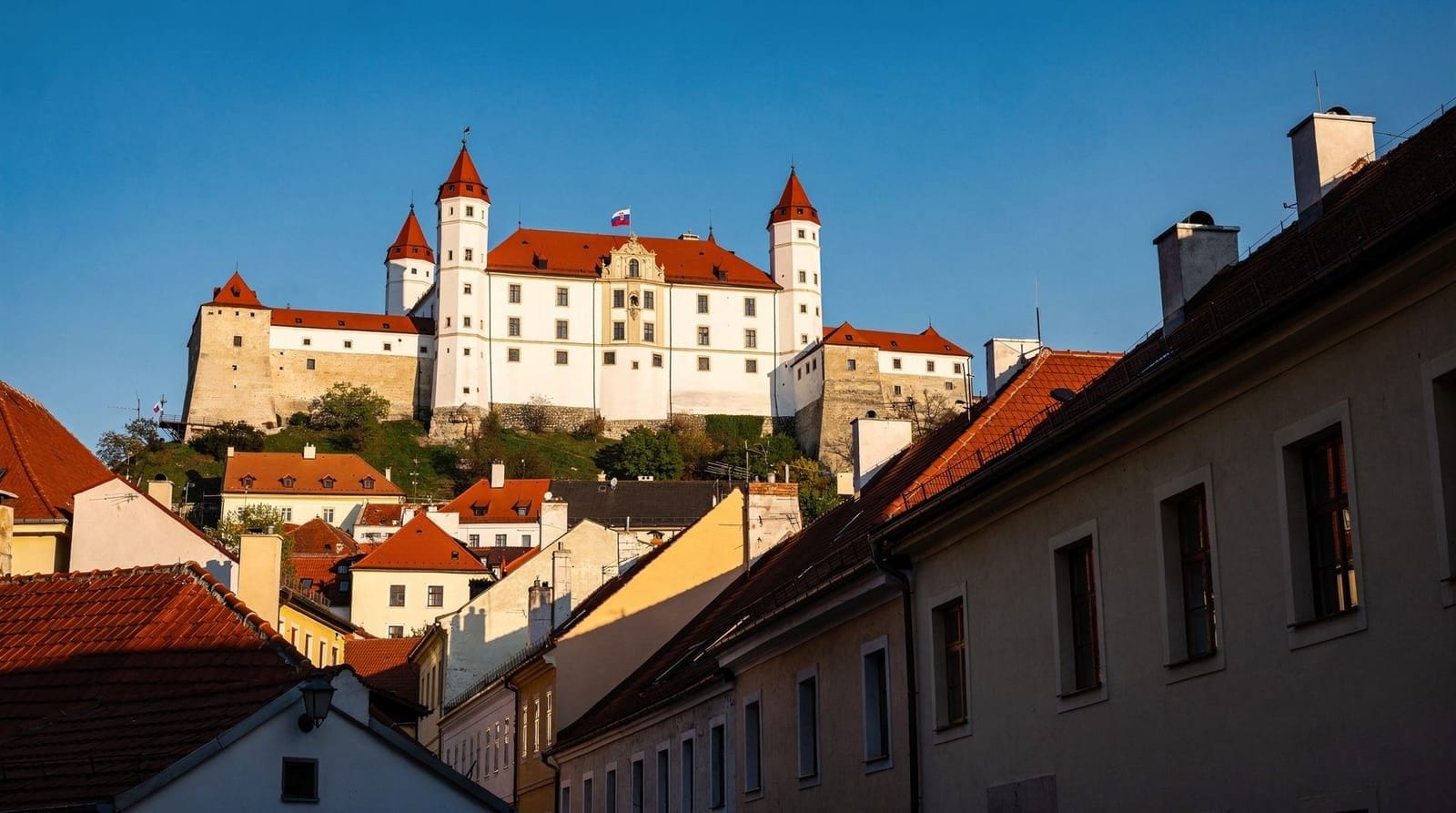
The case for visiting in the morning is straightforward. Tour buses from Vienna and Budapest begin arriving around 10:30, and the main square fills noticeably by noon. Before 10:00 the light is excellent for photography and Hlavné námestie belongs almost entirely to locals walking to work. Golden hour in the late afternoon offers a second window, and the best photo spots look entirely different lit from the west. If you plan to climb Michael’s Gate tower or visit the Primatial Palace, note that both open at 10:00 Tuesday through Sunday, so a 09:30 start lets you walk the route and arrive at the first entry just as the doors open.
One honest caveat: if you are visiting on a free walking tour budget, Bratislava Old Town is excellent value — most of its exterior pleasures cost nothing. But the paid interiors add genuine depth to the experience, and the combined entry fees for the Old Town Hall tower, Primatial Palace, and Michael’s Gate come to just €13. That is a reasonable outlay for three hours of historical context. The Bratislava City Card covers several of these entries and pays for itself quickly if you plan to see multiple attractions.
GetYourGuideBratislava 1-hour small group walking tourCheck availability →The walking route: step by step
The route described here begins at Michael’s Gate and ends near the SNP Bridge, a natural progression from the medieval northern edge of the Old Town down through its Baroque heart to the modern waterfront. The total distance is approximately 2.5 kilometres including the detour to Čumil and the Blue Church extension. Allow two hours at a brisk pace; three hours is more comfortable if you are stopping to read plaques, photograph statues, and pause for coffee.
Michael’s Gate and Michalská Street
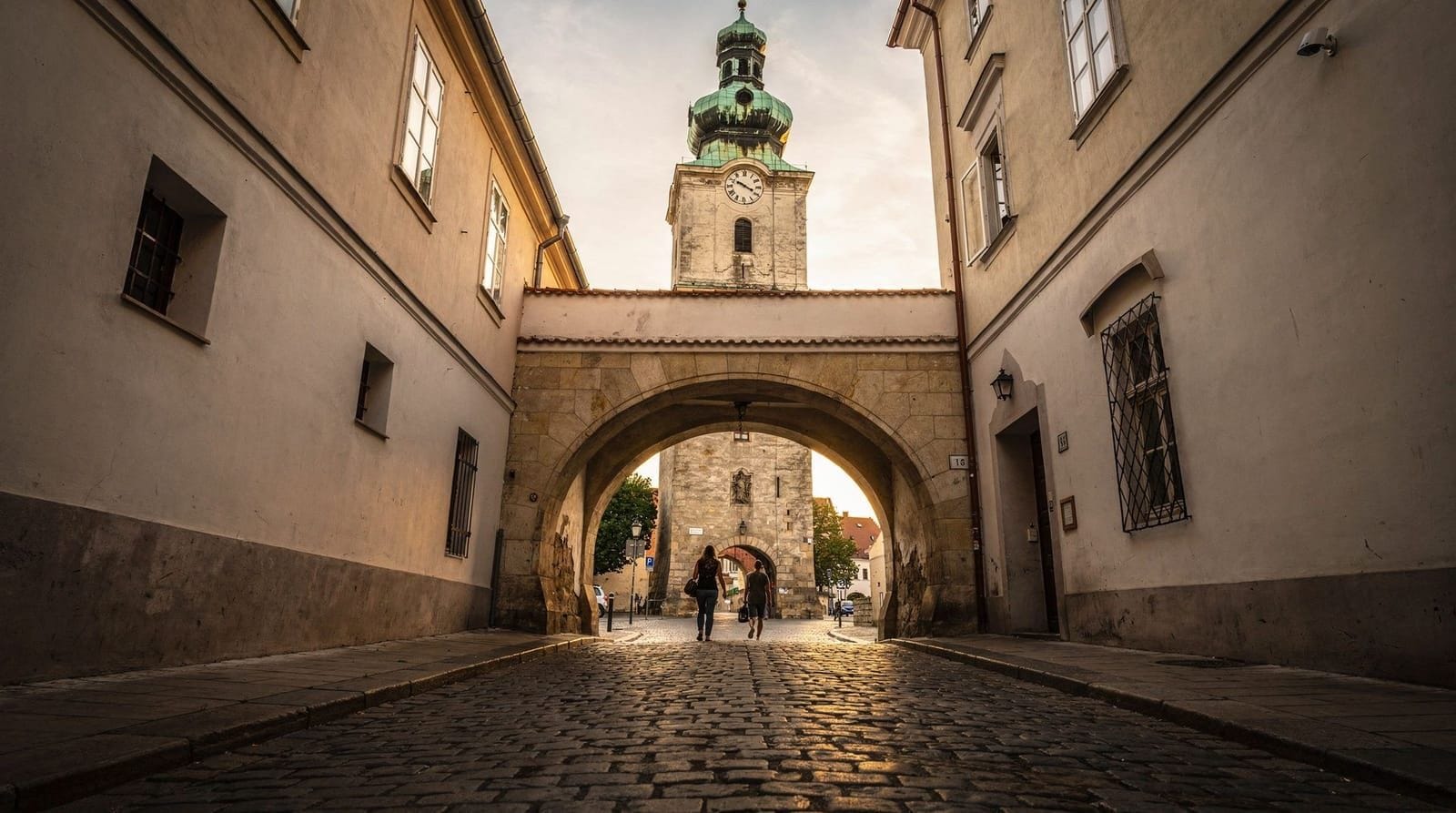
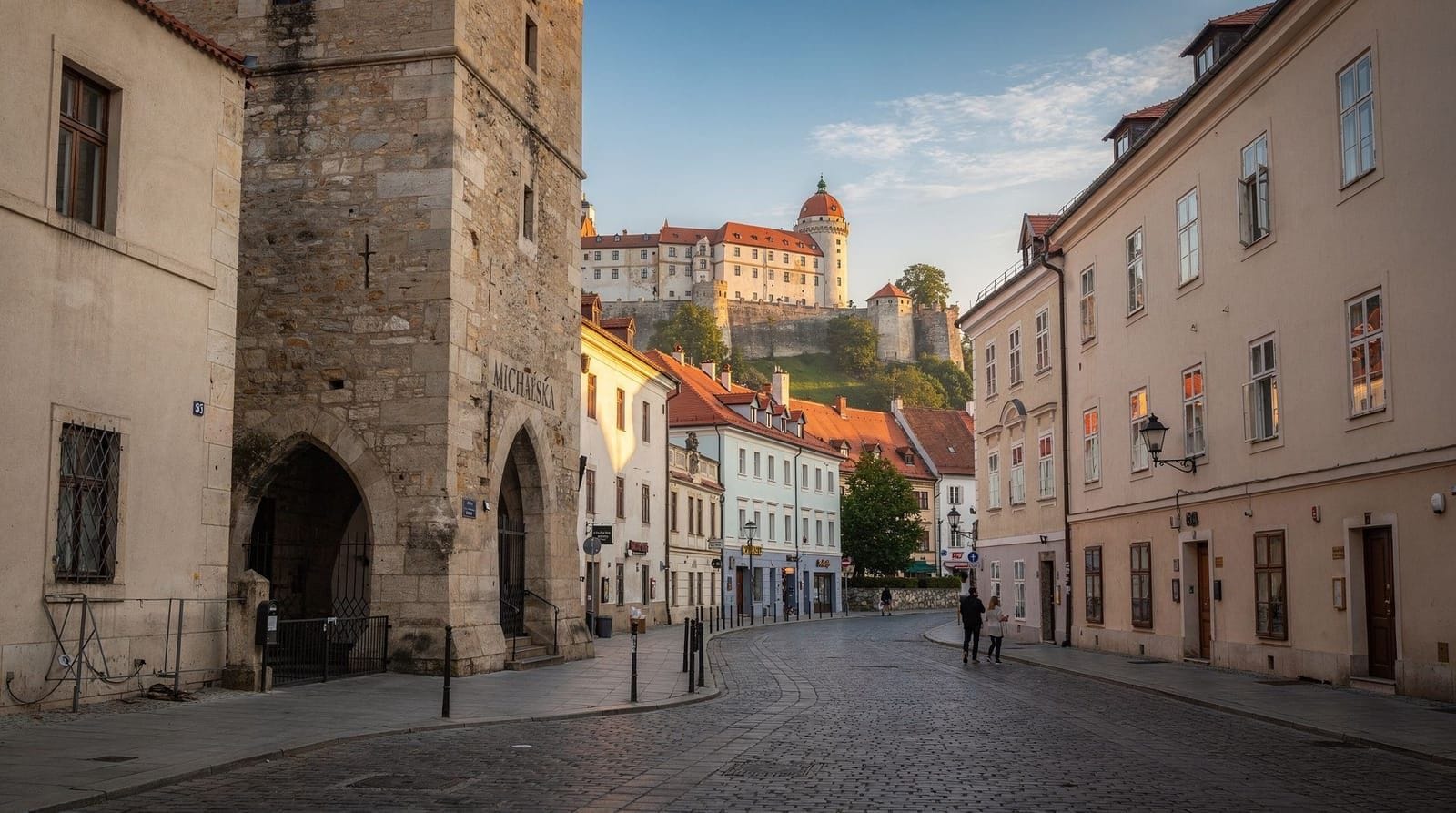
Begin at Michalská brána — Michael’s Gate — at the northern end of Michalská Street. This is the only medieval gate still standing from Bratislava’s original fortification system, and it has been watching over this corner of the city since the 14th century. The current octagonal tower was rebuilt in Baroque style in 1758, which explains why it looks somewhat more elegant than you might expect from a medieval defensive structure. It rises 51 metres and houses a small but well-curated museum of historical weapons and city maps on its upper floors.
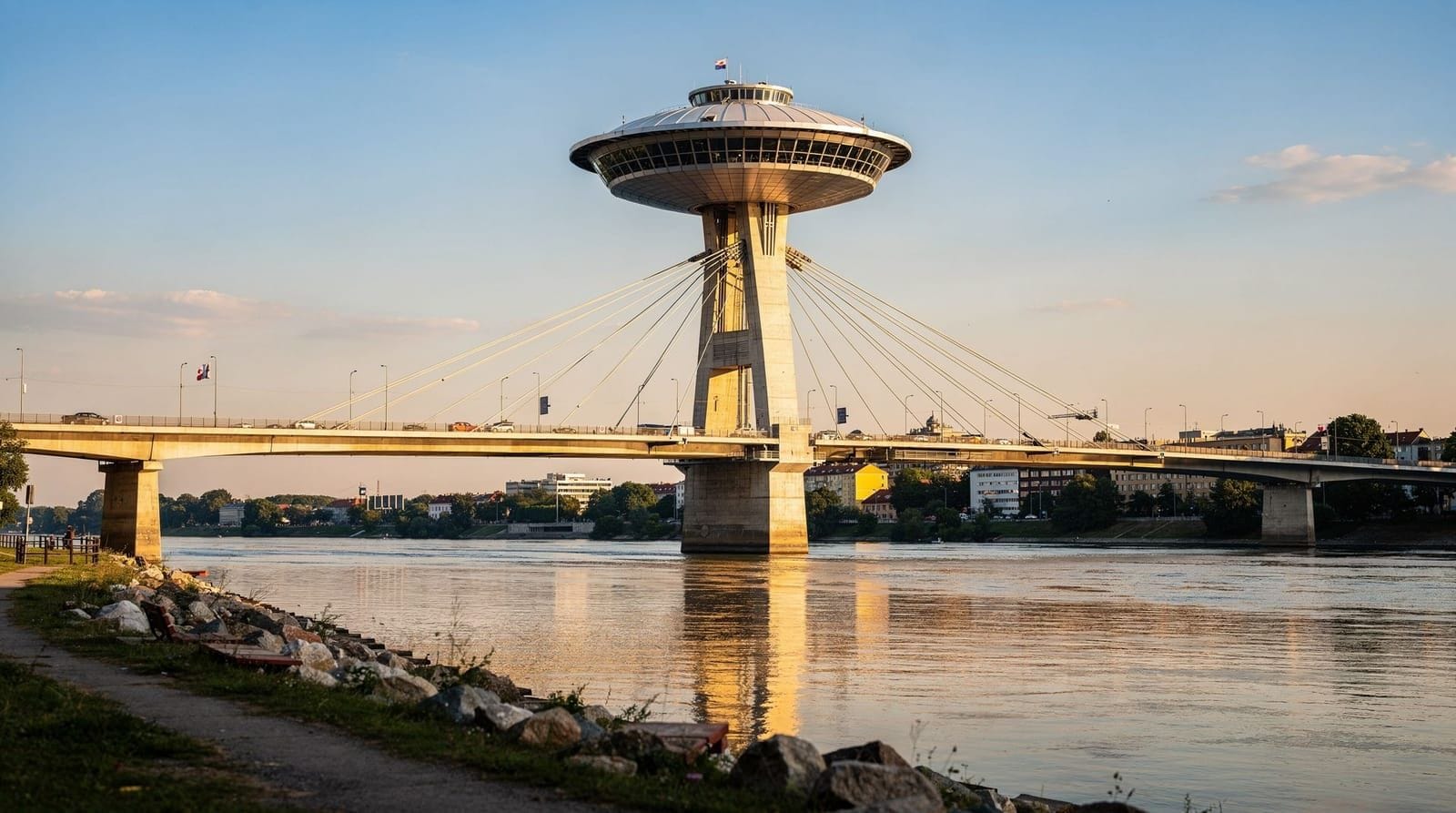
Entry to the tower museum costs €5 and is open Tuesday to Sunday from 10:00 to 17:00. The view from the top — across the Old Town rooftops toward Bratislava Castle on its hill — is one of the better elevated perspectives in the city and notably less crowded than the UFO Observation Deck on the SNP Bridge. A narrow pedestrian bridge connects the gate to a section of the old moat, now a pleasant walkway.
From the gate, walk south along Michalská Street. This is one of the Old Town’s most photogenic corridors: a gently curving medieval street lined with pastel-painted Baroque townhouses, several of which now contain upscale restaurants and wine bars. Look up as you walk — the upper floors retain their original proportions and ironwork details even where the ground floors have been converted to retail. About halfway down on the left you will pass the Pharmacy at the Red Crab (Lekáreň U Červeného Raka), one of Bratislava’s oldest pharmacies, operating since 1773.
Hlavné námestie: the main square
Michalská Street opens south onto Hlavné námestie, Bratislava’s main square and the social centre of the Old Town. The square is large by Slovak standards but intimate by Central European ones, and it has retained a coherent historical character despite several centuries of rebuilding. The dominant landmark is Roland’s Fountain at its centre, erected in 1572 and named for the knight Roland, a medieval symbol of civic freedom. The fountain is a useful orientation point and, at midday in summer, surrounded by visitors eating sandwiches on its steps.
The northern side of the square is closed by the Old Town Hall (Stará radnica), a composite building assembled from several medieval structures over the course of four centuries. Its Gothic tower — the oldest part, from the 14th century — is climbable for €5, open Tuesday to Sunday 10:00 to 17:00. The tower affords a vertical view down into the square that makes the fountain’s geometry suddenly legible. Inside the hall, the City Museum runs a permanent exhibition on Bratislava’s urban history including Roman-era finds from the nearby civilian settlement of Gerulata.
The square’s southern and eastern sides are lined with aristocratic palaces in Rococo and early Neoclassical styles. The Jesuit Church on the square’s northeast corner dates from 1638 and is notable for its unadorned white façade — unusual for a Counter-Reformation building — and for the fact that a cannonball from Napoleon’s 1809 bombardment is still visibly embedded in its wall. Look for a small plaque marking the spot at around shoulder height on the street side.
GetYourGuideBratislava classic walking tourCheck availability →Primaciálne námestie and the Primatial Palace
Leave Hlavné námestie through the archway in the Old Town Hall and emerge into Primaciálne námestie — Primatial Square — which lies immediately behind it. This quieter square is dominated by the Primatial Palace (Primaciálny palác), the pink Neoclassical residence built for the Archbishop of Esztergom between 1778 and 1781. The palace is one of the finest examples of Neoclassical architecture in Slovakia and carries genuine historical weight: it was here, in October 1805, that Napoleon Bonaparte and the defeated Holy Roman Emperor Francis II signed the Peace of Pressburg following the Battle of Austerlitz. The treaty effectively ended the Holy Roman Empire.
Entry to the palace costs €3 and is open Tuesday to Sunday from 10:00 to 17:00. The highlight inside is the Hall of Mirrors, a long gallery lined with floor-to-ceiling mirrors that was used for the treaty signing and later served as a ballroom for the Hungarian nobility. A separate wing houses the English Royal Tapestries — six large Flemish tapestries depicting the story of Hero and Leander, woven in the early 17th century and discovered behind a false wall during renovations in 1903. They are exceptional works and the Bratislava museum is one of the few places outside Britain where you can see tapestries of this provenance and scale.
The square outside the palace is pleasant for a brief pause. The central fountain features a sculpture of St George and the Dragon. In warmer months the surrounding café terraces make this a natural rest stop before continuing the route.
The Čumil statue and the hidden lanes
From Primaciálne námestie, walk east along Rybárska brána Street and then turn south onto Panská ulica. At the corner of Panská and Laurinská you will find one of Bratislava’s most photographed landmarks: Čumil, the bronze figure of a man peering up through a manhole cover at passersby. The statue was installed in 1997 as part of a public art initiative and has since become one of the city’s defining symbols. The name means roughly “the peeper” or “the curious one” in Slovak. A small warning sign nearby advises pedestrians to watch their step — partly a joke, partly practical advice given how easy it is to trip over the protruding head while looking at your phone.
This stretch between Panská and Laurinská rewards slow exploration. The blocks immediately east of the main pedestrian axis contain some of the Old Town’s best-preserved medieval streetscapes: narrow passages (called chodníky or prechody in Slovak) cut between buildings, opening onto inner courtyards with wells, climbing plants, and the occasional unexpected gallery or wine shop. The courtyard of the Academic Pharmacy on Michalská is particularly photogenic. These are the kinds of spaces that reward the traveller who ventures off the beaten path — a map helps less than simply walking until you find something that looks interesting, then walking further.
For lunch or an afternoon coffee break, the lanes around this area hold some of the Old Town’s best restaurants and several excellent independent coffee shops. The Slovak café and coffeehouse culture is less well known than Vienna’s but has its own quiet traditions, including the preference for sitting for a long time over a single espresso without anyone rushing you to leave.
GetYourGuideBratislava guided walking tour with castle entryCheck availability →St Martin’s Cathedral
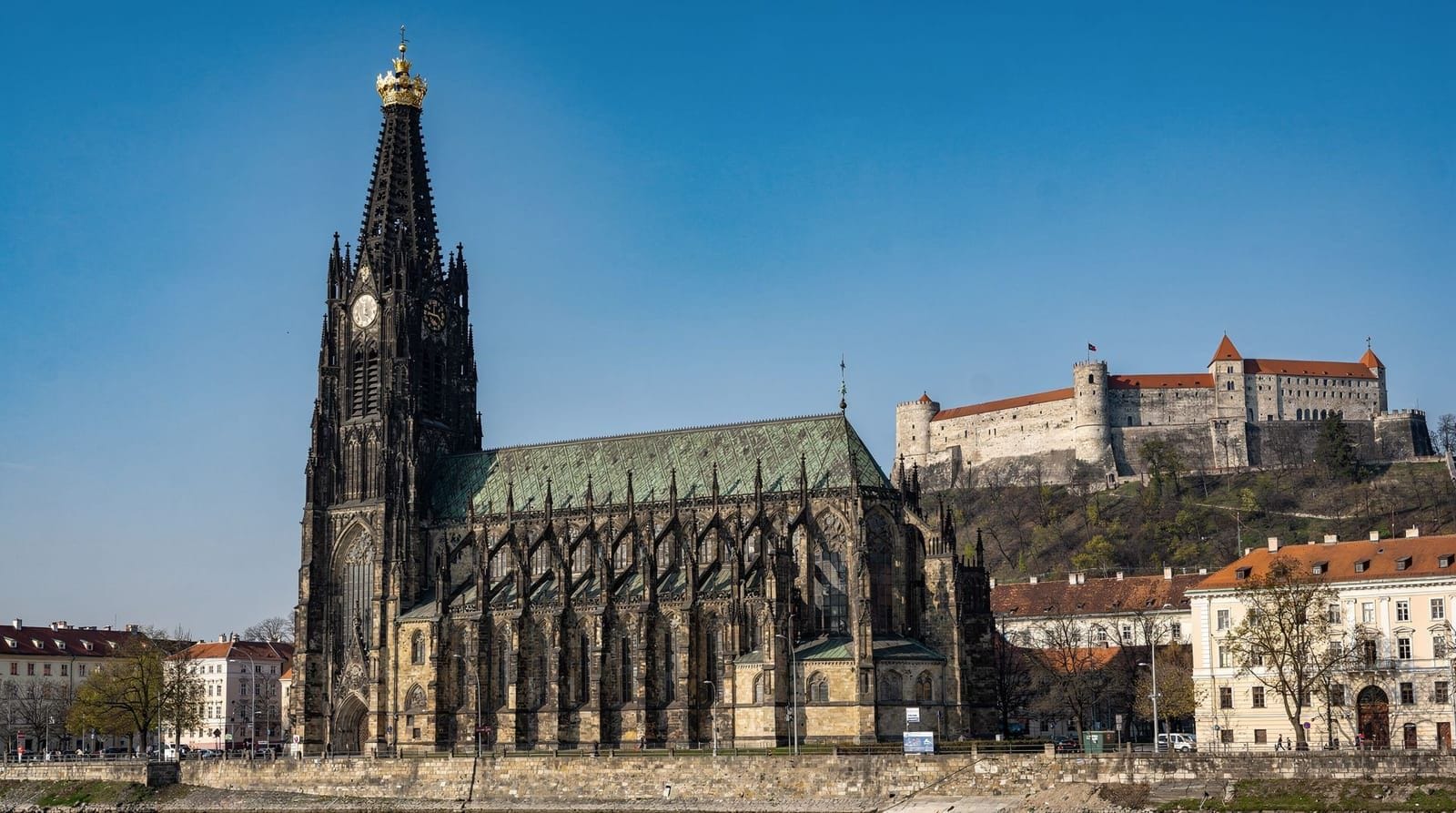
A short walk southwest from Čumil brings you to Rudnayovo námestie and the rear façade of St Martin’s Cathedral (Katedrála svätého Martina). This Gothic cathedral is the most historically significant religious building in Bratislava, having served as the coronation church for 18 Hungarian kings and queens between 1563 and 1830. Construction began in the 14th century on the site of an earlier Romanesque church, and the building took more than a century to complete. The tower rises 85 metres and is topped with a golden cushion bearing a replica of the Hungarian Royal Crown — a reminder of the city’s role as royal capital.
Entry to the cathedral is free, though a donation is appreciated. Opening hours vary by season and around religious services; the most reliable visiting windows are between 09:00 and 12:00 and again from 14:00 to 17:00. Inside, the highlight is the equestrian statue of St Martin sharing his cloak with a beggar, a work by Georg Rafael Donner dating from 1734 and widely considered one of the finest Baroque sculptures in Central Europe. The nave is Gothic, austere in the Central European manner, and visually very different from the ornate Baroque interiors of Austrian churches.
The cathedral sits almost directly beside the elevated motorway (Highway D1) that was controversially routed through the historic city centre in the 1970s — one of Bratislava’s more unfortunate pieces of urban planning, which severed the cathedral from the Danube waterfront it once overlooked. The damage is irreversible, but the cathedral remains magnificent despite its odd position.
Famous street statues: the full guide
Bratislava’s collection of public bronze statues is one of its most distinctive features — not grandiose equestrian monuments, but playful, life-size figures integrated into the street level, inviting interaction and photography. Most were installed in the 1990s and early 2000s as the city rebuilt its public identity after the Communist period.
Čumil (Man at Work) is the most famous, at the corner of Laurinská and Panská streets. He appears to be resting underground, peering up through a manhole with a beatific expression. The statue was damaged by a passing truck in 1999, repaired, and returned to its spot — where it has remained ever since.
Napoleon’s Soldier stands outside the Pálffy Palace on Panská Street, leaning on a fence post in the relaxed posture of a soldier at ease. The statue commemorates the French troops who occupied Bratislava in 1805 following the Battle of Austerlitz. Local legend holds that it brings good luck to shake his hand, which explains why the right hand has a distinctly shinier patina than the rest of the figure.
The Paparazzi (also called the Photographer) crouches with a camera near Hlavné námestie, perpetually snapping pictures of passersby. This one was installed more recently and has quickly become a favourite for meta-photographs of tourists photographing the statue photographing them.
Hans Christian Andersen sits on a bench near the Old Town Hall, in recognition of the Danish author’s documented visit to Pressburg (Bratislava) in 1841 during a journey through Europe. The figure is seated rather than standing, which makes it easy to sit beside him for a photograph.
The Schöner Náci figure commemorates a real historical character: Ignác Lamár, a well-dressed eccentric who was a fixture of Bratislava’s streets in the early 20th century, greeting passersby with elaborate courtesy. His bronze likeness now stands on Rybárska brána near Primaciálne námestie, top hat in hand, eternally welcoming visitors to the square.
Tracking down all the statues makes a natural secondary game to play while walking the Old Town, and children in particular tend to find the bronze figures immediately engaging. A food tour of Old Town is another way to combine these visual discoveries with the experience of eating and drinking your way through the neighbourhood.
GetYourGuideBratislava city sightseeing afternoon walking tourCheck availability →The Blue Church extension
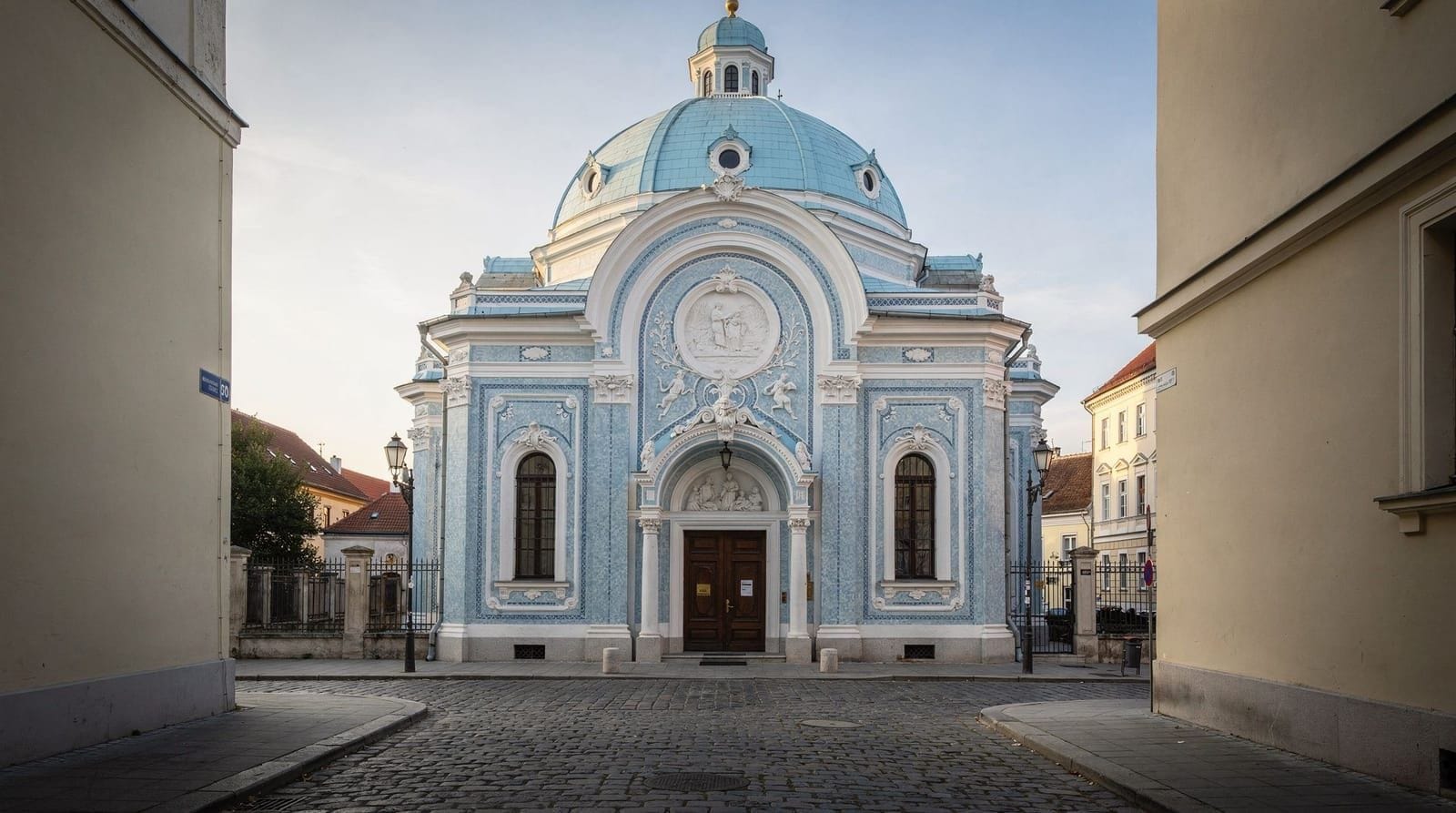
The route described so far covers the core of Old Town. If you have time and energy for an extension, the Blue Church (Kostol svätej Alžbety, or the Church of St Elizabeth) lies about 10 minutes’ walk east from Hlavné námestie, just outside the strict Old Town boundary but close enough to include in any half-day walk.
Built between 1909 and 1913 in Hungarian Art Nouveau style, the Blue Church is genuinely one of the most visually striking buildings in the city. Every surface — walls, roof tiles, towers — is covered in pale blue ceramic, with white and blue ornamental detail in the Secessionist manner. The interior continues the colour scheme with blue and white majolica tiles and a luminous quality of light that feels entirely different from the Gothic and Baroque churches elsewhere in the Old Town.
Entry is free, though the church is active and visiting hours follow the schedule of services. The best times are usually mid-morning on weekdays. Photography inside is permitted without flash.
The neighbourhood immediately around the Blue Church — the Blumentál quarter — is one of Bratislava’s less-visited historic areas and contains several interesting Art Nouveau apartment buildings from the same period, making the walk there worthwhile even on days when the church is closed.
Practical information for visiting Old Town
Getting oriented. Bratislava’s Old Town pedestrian zone is car-free throughout the central area. The main axis runs from Michael’s Gate in the north to the SNP Bridge approach in the south, approximately 800 metres. Street signs are in Slovak only, but the area is small enough that getting temporarily lost is pleasant rather than concerning. Free maps are available at the tourist information office on Klobučnícka Street (just off Hlavné námestie, open daily 09:00 to 18:00).
Getting there. The Old Town is easily reachable on foot from the main train station (Hlavná stanica) in about 15 minutes, or via tram 1 to the Nám. SNP stop. From the bus station (Autobusová stanica Mlynské Nivy, used by international coaches from Vienna, Prague, and Budapest), the journey takes around 10 minutes by taxi or about 20 minutes on foot. Detailed transport options within Bratislava are covered in our separate guide.
Entry fees summary. Old Town Hall tower: €5. Michael’s Gate museum: €5. Primatial Palace: €3. St Martin’s Cathedral: free (donation appreciated). Blue Church: free. If you plan to visit several paid attractions, the Bratislava City Card includes entry to many city museums and unlimited public transport, and is worth comparing against individual ticket prices for your itinerary.
Free walking tours. Tip-based free walking tours depart from Hlavné námestie daily, typically at 10:30 and 14:00. Several operators offer these; look for guides holding umbrellas or flags at the Roland Fountain. The tours cover the main Old Town highlights in approximately 1.5 hours and are a reasonable way to get oriented before exploring independently. Quality varies by guide.
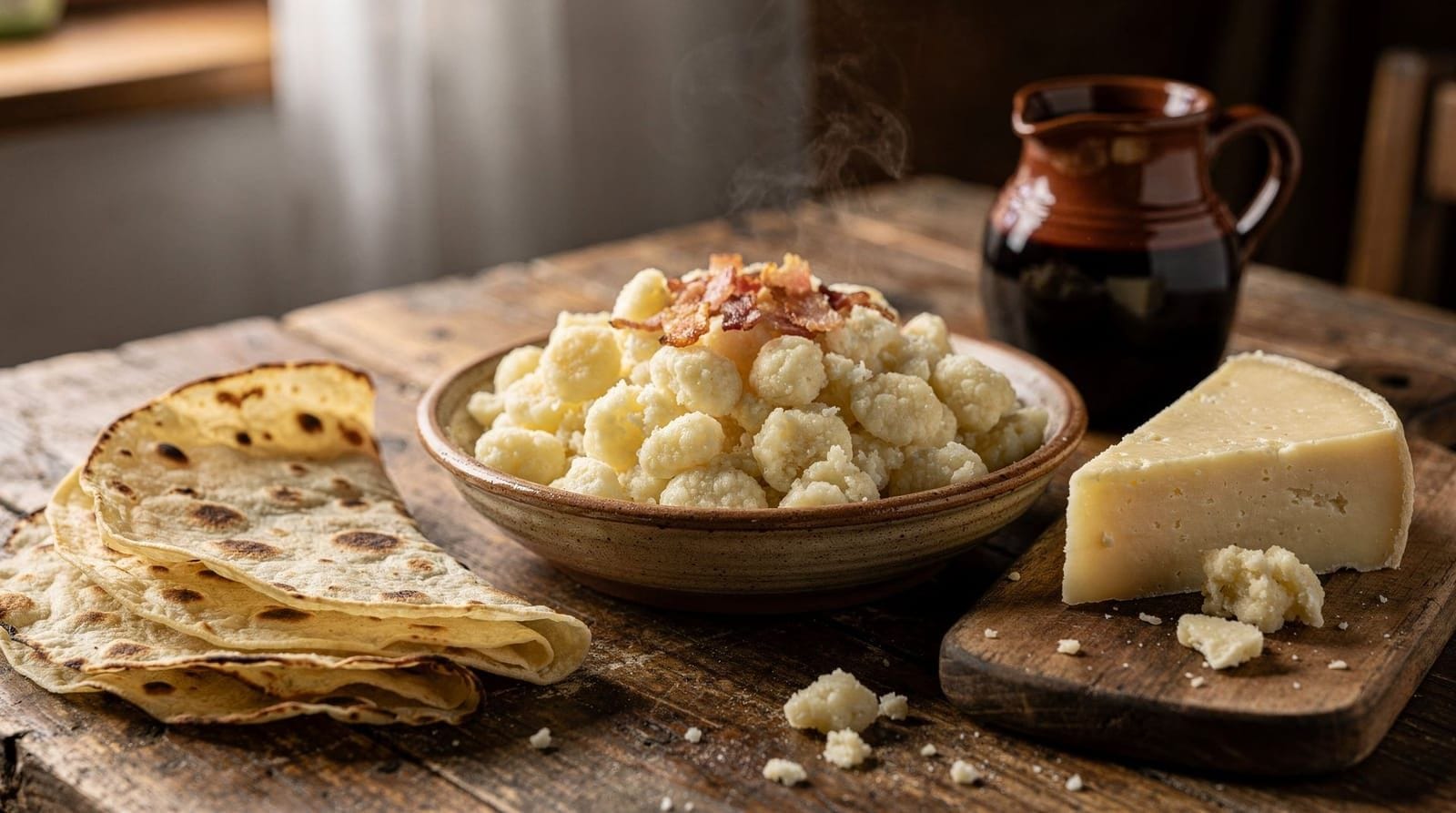
Eating and drinking. The Old Town has cafés and restaurants at every price point, though the immediate surroundings of Hlavné námestie skew toward tourist-facing menus. For better value and more local atmosphere, walk two or three streets east or north of the main square. Our guide to traditional Slovak food covers what to order; our restaurant guide covers where to order it. For a structured culinary introduction, food tours of Old Town are an efficient and enjoyable way to eat well while learning the history of the neighbourhood.
Budget considerations. Bratislava is notably less expensive than Vienna or Prague, and Old Town is among the most accessible historic city centres in Central Europe for budget travellers. A full day of sightseeing — including all three paid entries, a coffee, and a sit-down lunch — can be done comfortably for €25 to €35 per person. See our budget guide for a full breakdown.
Accessibility. The main pedestrian streets of Old Town are mostly flat and well-surfaced, though some of the older cobblestone lanes between buildings can be uneven. Michael’s Gate tower and the Old Town Hall tower both require stair climbing and are not wheelchair accessible. The ground floors of the Primatial Palace are accessible via a ramped entrance.
What to pair with Old Town. A morning in the Old Town pairs naturally with an afternoon at Bratislava Castle — the two are connected by a short uphill walk along the castle approach road. Alternatively, cross the Danube on the SNP Bridge to the UFO Observation Deck for a late-afternoon view back over the Old Town rooftops. Those interested in Bratislava’s less-discussed history should make time for the Jewish heritage sites on the Old Town’s southeastern edge. For evening plans, the area around Obchodná Street just north of the Old Town forms the backbone of Bratislava’s nightlife.
Is it worth visiting? For first-time visitors who are wondering whether Bratislava merits a standalone trip rather than just a day trip from Vienna, our honest answer is in our guide on whether Bratislava is worth visiting. The short answer for Old Town specifically: yes, unambiguously. The area is compact enough to feel achievable in a few hours and deep enough to reward a full day. It is one of the few historic city centres in Central Europe where you can still find yourself genuinely alone on a beautiful street at 09:00 on a summer morning.
Pacing the walk: three ways to do it
Not everyone wants the same Old Town experience, so it is worth mapping three realistic paces against the route described above. The fast pass (about 90 minutes) sticks to the main axis — Michael’s Gate, Michalská, Hlavné námestie, Primaciálne námestie, Čumil, and back — without entering any paid interior, and suits travellers squeezing Old Town into a longer day trip from Vienna.
The standard walk (2-3 hours, the pace this guide is built around) adds one or two paid interiors, a coffee stop, and time to actually read plaques rather than photograph past them. The full day extends to the Blue Church, a proper sit-down lunch from the restaurant guide, and an afternoon climb up to Bratislava Castle — realistically six or more hours including breaks.
Rain is common enough in Bratislava’s shoulder seasons to plan around it. Michalská, Ventúrska, and the lanes near Panská have enough café awnings and courtyard passages to shelter under without abandoning the walk entirely, and both Michael’s Gate and Old Town Hall towers are indoor stops that double as rain breaks if you time them right.
Frequently asked questions about walking Bratislava’s Old Town
How big is Bratislava’s Old Town?
Staré Mesto (Old Town) as an administrative district covers about 10 square kilometres, but the historic pedestrian core that most visitors mean when they say “Old Town” is roughly one square kilometre. The compact heart — from Michael’s Gate to Rybárska brána, and from the castle hill to Hviezdoslavovo námestie — can be crossed on foot in about 15 minutes at a purposeful pace.
Is Bratislava’s Old Town safe?
Yes, Bratislava’s Old Town is considered one of the safer historic city centres in Central Europe. Pickpocketing exists, as in any tourist area, so standard precautions apply in crowded spots like Hlavné námestie and on busy pedestrian streets. The area is well-lit and well-populated into the evening. Our guide on first-timer mistakes covers the most common things to watch out for.
Can I walk from Old Town to Bratislava Castle?
Yes, the walk from the Old Town to Bratislava Castle takes about 10 to 15 minutes on foot. The most scenic approach is via the Beblavého street staircase that climbs the castle hill from the western edge of the Old Town, passing the Castle Museum and the former Jewish quarter. The castle itself is free to enter the grounds; the museum inside costs €10.
What are the opening hours of Old Town attractions?
Most of the paid attractions in the Old Town operate Tuesday to Sunday, 10:00 to 17:00, and are closed on Mondays. This applies to the Old Town Hall tower, Michael’s Gate museum, and the Primatial Palace. St Martin’s Cathedral and the Blue Church follow their own schedules tied to religious services, generally accessible mid-morning and mid-afternoon. The tourist information office on Klobučnícka Street is open daily including Mondays.
Are there guided tours of Bratislava’s Old Town?
Yes. Options range from free tip-based walking tours (departing Hlavné námestie at 10:30 and 14:00 daily) to private guided experiences and small-group tours that also cover the castle and surrounding neighbourhoods. If you prefer a structured introduction to the city’s history before exploring independently, a guided tour on your first morning is a worthwhile investment — the context it provides changes how you read the buildings and streets you then revisit on your own. See the tour recommendations below for well-reviewed options.
When is the best time to visit Old Town to avoid crowds?
Weekday mornings before 10:30 are consistently quieter. The weekend midday peak — roughly 11:00 to 14:00 on Saturday and Sunday from April through October — is when the main square is most crowded, as it coincides with the arrival of day-trippers from Vienna and Budapest. If your schedule is flexible, a Thursday or Friday morning visit to Old Town followed by an afternoon at the castle offers a good balance of accessibility and calm. Shoulder season (March-April and September-October) is notably less busy than the July-August peak.
Do I need to book Old Town museum entries in advance?
For the main Old Town Hall tower, Michael’s Gate museum, and Primatial Palace, advance booking is not necessary — these are small, locally-managed attractions that operate on a walk-in basis. Queues are rarely more than a few minutes except on peak summer weekends. Guided tours and food experiences, however, should be booked in advance, particularly in high season.
Is the Old Town walkable for children?
Yes — Bratislava’s Old Town is particularly enjoyable for children, largely because of the street statues. Finding Čumil, Napoleon’s Soldier, Hans Christian Andersen, and the other bronze figures scattered around the pedestrian streets makes a natural treasure hunt that keeps younger visitors engaged while adults take in the architecture. The route is flat (aside from the castle extension), the streets are car-free, and gelato shops are plentiful. The one-day Bratislava itinerary includes a family-friendly sequence through the Old Town.
How much does it cost to see Bratislava’s Old Town in a day?
Walking the Old Town itself costs nothing beyond food and drink. If you add all three main paid interiors — Old Town Hall tower, Michael’s Gate museum, and Primatial Palace — the combined entry fees come to around €13. A full day including a coffee, a sit-down lunch, and those three entries typically runs €25-35 per person, as covered in the budget guide.
Culture & heritage tours
Verified deep-linked GetYourGuide tours. Book through these links and we earn a small commission at no cost to you.