Michael's Gate: Bratislava's last medieval city gate
How much does it cost to enter Michael's Gate tower?
The tower museum costs €5 per adult. It is open Tuesday to Sunday 10:00-17:00 and closed on Mondays. The gate arch itself is free to walk through at any time.
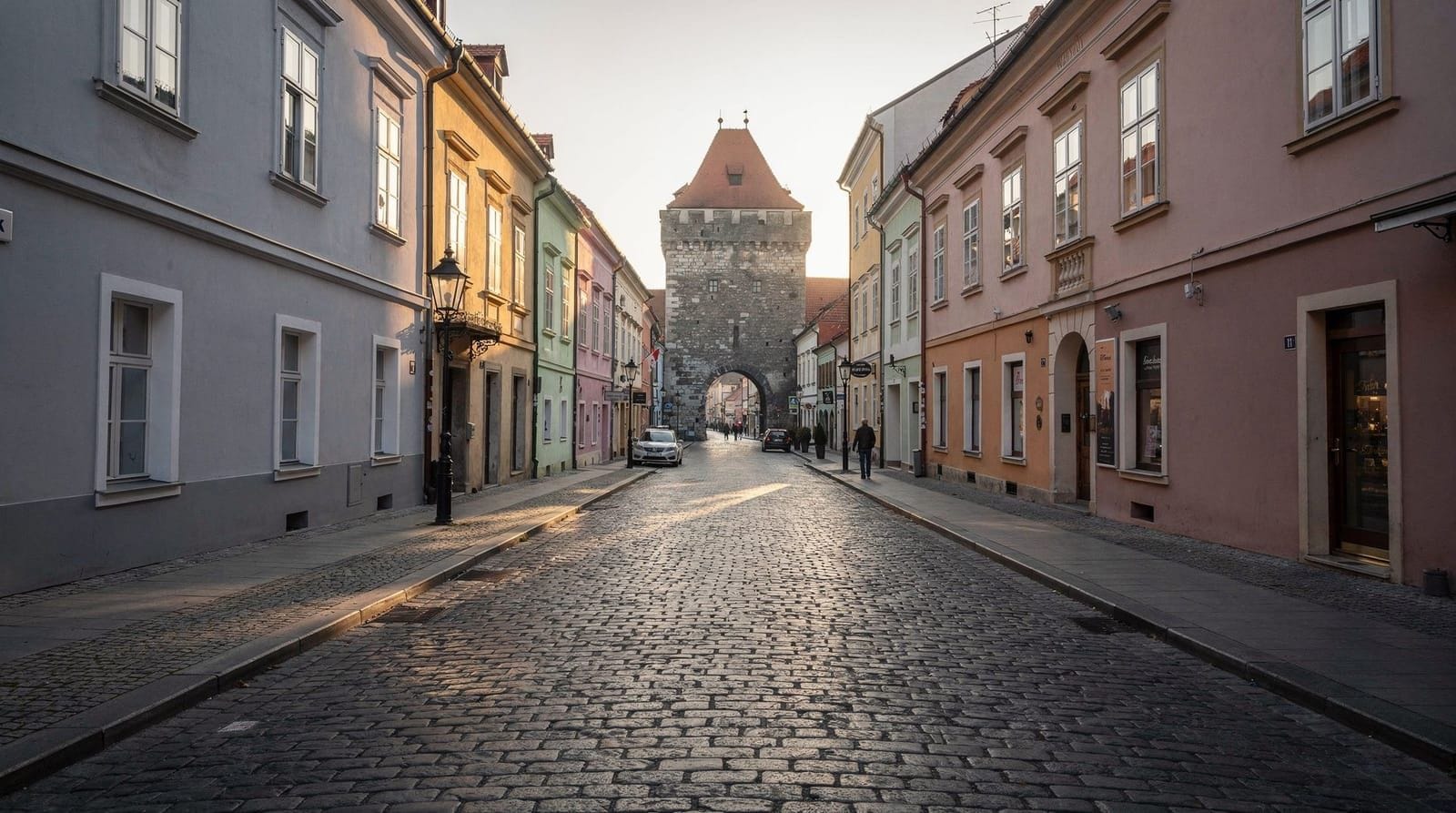
Stand at the foot of Michalská street on any given morning and you will see the same thing that merchants, diplomats, and city guards saw seven hundred years ago: a towering gate rising above the rooftops, its distinctive onion dome catching the light above the narrow lane below. Michael’s Gate — Michalská brána in Slovak — is the last of Bratislava’s four original medieval city gates, and it is in better shape today than it has any right to be. The others were demolished in the early nineteenth century as the city expanded and the old fortifications became inconvenient obstacles.
This one survived, and in surviving it became the defining image of Bratislava’s Old Town: a 51-metre landmark visible from half the city, framing photographs, sheltering pedestrians, and connecting the modern Slovak capital to the walled town it once was. Whether you visit for the arms museum inside, the panoramic views from the upper gallery, or simply to walk the atmospheric lane beneath its arch, Michael’s Gate is one of the most rewarding stops on any visit to Bratislava.
| At a glance | |
|---|---|
| Where | Northern end of Michalská street, Old Town — about 5 minutes on foot from Hlavné námestie |
| Cost | Arch: free, always. Tower museum: around €5 for adults, around €3 concessions |
| Time needed | 10-15 minutes for the arch and street; 30-45 minutes if you climb the tower museum |
| Getting there | Walkable from anywhere in the Old Town; nearest tram/bus stops within a 5-minute walk |
| Best time | Shortly after the 10:00 opening on a weekday, or early morning/late afternoon for photography |
Seven centuries standing guard: the history of Michael’s Gate
The gate was first mentioned in written records in 1300, though the fortification almost certainly existed in some form before that date. Medieval Bratislava — then known as Pressburg and a key city of the Kingdom of Hungary — was surrounded by a defensive wall pierced by four gates: the Fisherman’s Gate to the east, the Laurentian Gate to the south, the Vydrica Gate to the west, and Michael’s Gate to the north. Each gate was named after a nearby church or chapel, and the northern gate took its name from the Chapel of St Michael that once stood close by.
The original structure was a relatively modest fortified tower, typical of Central European town walls of the period. It controlled the road leading north out of the city — an important route in an era when Bratislava was a major trading hub sitting at the crossroads of routes connecting the Habsburg heartlands with Hungary and the Ottoman frontier to the south.
In the fifteenth century, as military technology advanced and cannon became a serious threat, the tower was reinforced and enlarged. A barbican — a secondary fortified enclosure projecting in front of the main gate — was added to create a killing ground between the outer and inner defences, forcing any attacker to fight through two sets of gates rather than one. Parts of this outer barbican survive today, though they are easy to miss among the later construction around them.
The gate’s current appearance dates almost entirely to the mid-eighteenth century, when it was comprehensively renovated in the Baroque style that was sweeping through Central European architecture at the time. The most visible addition was the elaborate onion dome that crowns the tower, completed in 1758 and immediately giving the gate the silhouette that appears on postcards today. Atop the dome stands a gilded statue of the Archangel Michael — the gate’s patron — in his traditional pose of defeating the dragon, added during the same renovation. The statue has been restored several times but retains its theatrical presence.
What the renovation concealed, rather than changed, was the medieval core underneath. The lower sections of the tower are built from the original Gothic masonry, and a careful look at the stonework at street level reveals the much older construction beneath the Baroque plasterwork above. The moat that once surrounded the outer wall was filled in during the 1820s, when Bratislava — like most European cities of the period — was reorganising its urban fabric for the age of commerce rather than conflict. The drawbridge over the moat, which once controlled access to the gate arch from the north, disappeared at the same time.
For anyone following the Old Town walking guide or tracing Bratislava’s long history through its streets, the gate offers one of the most tangible connections to the medieval city. The scale of the tower, seen from the narrow street below, gives a visceral sense of what it would have meant to approach Pressburg in the fourteenth century: the walls were not decorative. They were a statement of power, and passing through the gate meant entering a controlled, taxed, and policed urban space.
GetYourGuideBratislava 1-hour small group walking tourCheck availability →Inside the tower: the arms and armour museum
The tower of Michael’s Gate houses one of the branches of the Bratislava City Museum, and specifically it holds the city’s collection of historic arms and armour. It is a well-curated museum in a genuinely unusual setting: you are climbing the actual medieval and Baroque tower, floor by floor, as you work through the collection.
Entrance to the museum costs €5 for adults, with reduced tickets available for students and seniors at approximately €3. Children under a certain age enter free. The museum is open Tuesday through Sunday from 10:00 to 17:00 and is closed on Mondays. If you arrive on a Monday expecting to visit the interior, you will find only the arch open — still worth seeing, but plan accordingly if the museum is a priority. The Bratislava City Card, if you have one, may offer discounted or included admission; details about the card are worth checking before you buy individual museum tickets.
The ground-floor entrance leads you into the base of the tower, where the first displays cover the history of the gate and the broader city fortifications. Here you will find maps, engravings, and scale models showing how the medieval walls once encircled the town — a useful orientation before you go looking for remnants of those walls in the streets around the Old Town. Some sections of the original wall still stand in the lanes between Michalská and the castle hill, though they are easy to walk past without realising what you are looking at.
The arms and armour collection begins on the floors above. The holdings span several centuries and include crossbows, halberds, swords, firearms from the matchlock era, and pieces of armour ranging from full plate suits to individual protective elements. What makes this particular collection interesting is its Central European context.
The weapons here were not merely ceremonial: Bratislava in the fifteenth, sixteenth, and seventeenth centuries was a city under periodic threat from Ottoman expansion, and the civic and royal arsenals that supplied the region’s defenders are represented in the collection. There are also pieces reflecting the city’s role as capital of the Kingdom of Hungary after the fall of Buda to the Ottomans in 1526 — a period when Bratislava suddenly found itself at the administrative centre of a kingdom fighting for survival.
The climb becomes increasingly rewarding as you ascend. The upper floor opens onto a narrow external gallery that runs around the top of the tower just below the onion dome.
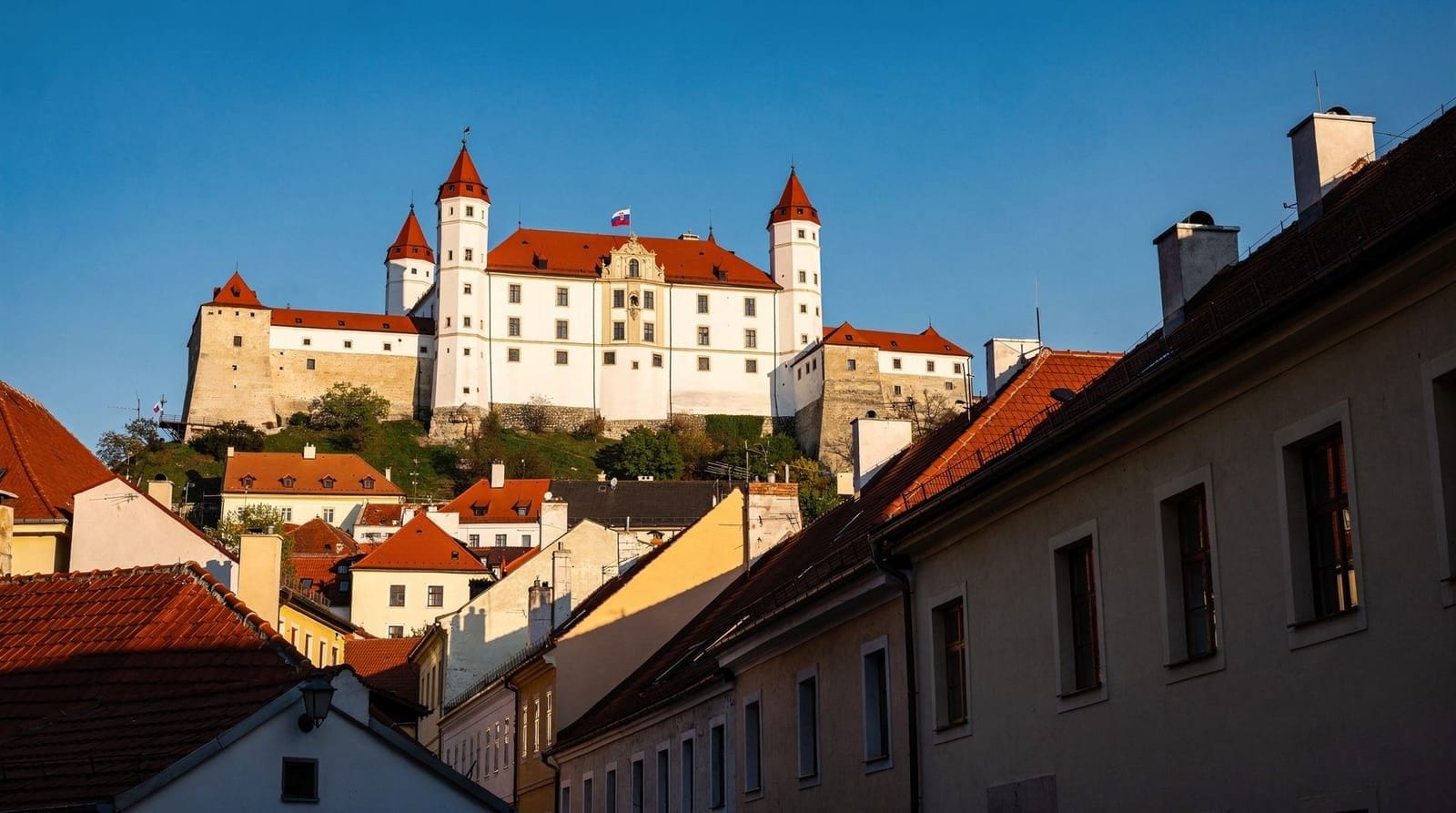
The views from here are exceptional and disproportionate to the effort: the Old Town rooftops spread out below you in a sea of terracotta and pale plaster, the Bratislava Castle rises on its hill to the southwest, the blue-green dome of St Martin’s Cathedral is close enough to feel touchable, and on clear days you can see across the Danube plain into Austria. This is one of the best elevated viewpoints in the city, and unlike some observation platforms it comes with genuine historical context rather than simply altitude.
GetYourGuideBratislava classic walking tourCheck availability →Michalská street: strolling under the gate
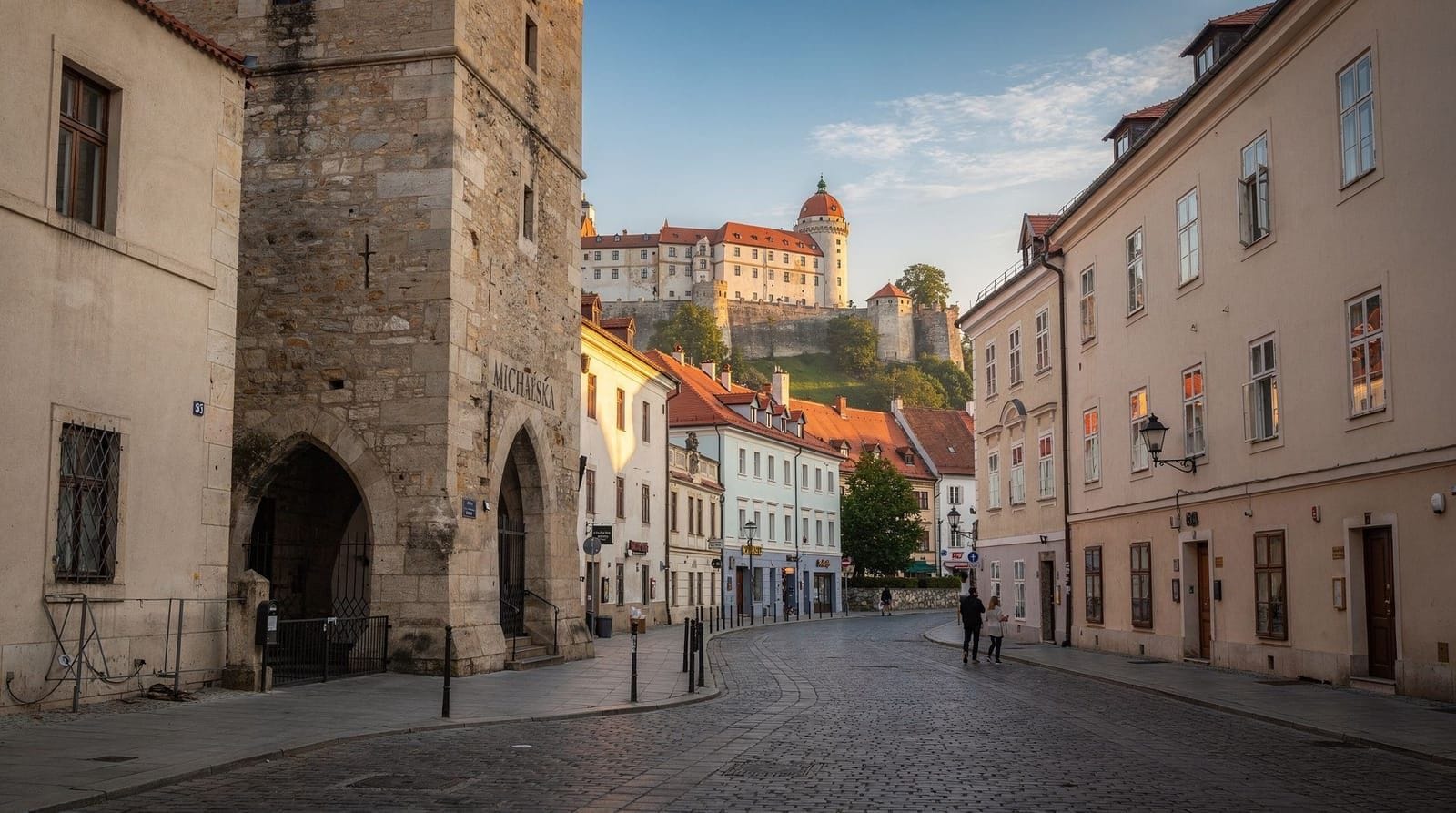
Even if you choose not to enter the museum, walking Michalská street is one of the great pleasures of a visit to Bratislava’s Old Town. The street runs from the gate southward toward the main square, Hlavné námestie, and it is entirely pedestrianised — no cars can pass through the gate arch, which has been the case effectively since the fortifications lost their military function in the nineteenth century and is now formalised.
The atmosphere on Michalská is different from the wider streets nearby. The buildings are taller relative to the lane width, creating a canyon effect that concentrates sound and makes the whole street feel slightly theatrically medieval, even on a busy Tuesday afternoon. The facades are mostly eighteenth and nineteenth century, with some older structures partially preserved behind later renovations, and the ground floors are occupied by a mix of cafes, wine bars, jewellery shops, and small boutiques. It is a street for slow walking and looking up.
The stretch closest to the gate itself is particularly photogenic. From about 50 metres south of the arch, looking back north, the gate frames perfectly above the narrowing lane: the tower rising, the onion dome silhouetted against the sky, pedestrians small beneath it. This is the photograph that appears on most Bratislava travel coverage, and it is every bit as good in person as in reproduction. Early morning and late afternoon light work best — midday sun flattens the stonework and washes out the dome’s detail.
The street is also where you will find the Pharmacy Museum, housed in what was once the Red Crab pharmacy at Michalská 26. The Lekáreň U Červeného Raka is one of the oldest surviving pharmacies in Central Europe, and the museum inside preserves the original fittings, apothecary jars, instruments, and documentation of pharmaceutical practice from the seventeenth through to the twentieth century. It is a small but genuinely fascinating stop for anyone interested in the history of medicine, and it is easy to combine with the gate visit since it is barely a two-minute walk away.
For coffee or a pause between sights, the cafes along Michalská and the parallel streets offer good options. The guide to Bratislava’s coffeehouses covers the best of them in detail, including a few that are tucked into courtyards just off the main lane.
The zero milestone and other hidden details
One of Bratislava’s most overlooked small treasures sits directly outside the north face of Michael’s Gate arch, embedded in the cobblestones of the pavement. A brass medallion — a zero milestone — marks the point from which distances to various European capitals were historically measured from Bratislava, and the marker shows those distances to cities including Vienna, Prague, Budapest, and Warsaw. It is easy to walk across without noticing, since it sits flush with the pavement and is roughly the size of a large dinner plate.
The zero milestone is a reminder of Bratislava’s geographic centrality in Central Europe — a fact that the city’s history makes clear but that visitors from western Europe sometimes underestimate. Bratislava sits at the intersection of some of the continent’s oldest trade and communication routes, and the city’s strategic importance across the Habsburg period rested precisely on this position. The milestone makes that geographic reality tangible and datable in a way that a sign on a wall cannot.
Other details worth looking for around the gate include the traces of the old barbican in the buildings and walls immediately north of the arch, the Gothic masonry visible at the base of the tower on its eastern face, and the ghost of the moat in the slight depression of the street level on the outer (north) side of the gate. The old city wall once ran east and west from the gate tower, and fragments of it survive in the walls of buildings on both sides, particularly if you walk into the lanes running east from the north end of Michalská.
For visitors interested in Bratislava’s layered history — medieval, Ottoman-era, Habsburg, communist — these small physical details are what connect the reading to the place. The communist and Iron Curtain history guide covers a very different chapter of the same city, while the Jewish heritage guide documents another dimension of Old Town’s past that is less visible but equally significant.
GetYourGuideBratislava guided walking tour with castle entryCheck availability →Practical visitor information
Address: Michalská ulica, 811 03 Bratislava. The gate stands at the northern end of Michalská street, at the point where it meets Hodžovo námestie and the start of the pedestrianised zone. It is approximately a 10-minute walk from the main train station (Bratislava Hlavná stanica) and a 5-minute walk from Hlavné námestie.
The arch: Free to walk through, 24 hours a day. There are no gates or barriers — the arch is simply part of the street.
Tower museum: Open Tuesday to Sunday, 10:00 to 17:00. Closed on Mondays and on certain public holidays. Ticket price is €5 for adults and approximately €3 for students and seniors. The ticket is purchased at the entrance to the tower, which is in the arch itself. Cash and card are generally accepted, though having smaller cash amounts is advisable at any Slovak museum ticket desk.
Accessibility: The tower is not accessible for visitors with mobility difficulties. The staircase is steep and narrow, as you would expect in a medieval structure, and there is no lift. The arch and the street are fully accessible.
Time required: Allow 30 to 45 minutes for the museum if you intend to read the displays and take your time on the upper gallery. The arch and street can be experienced in 10 to 15 minutes if you are simply passing through.
Getting there: Bratislava’s Old Town is compact and Michael’s Gate is most easily reached on foot from anywhere in the centre. The getting around Bratislava guide covers public transport options if you are coming from further afield. Tram lines and several bus routes stop within a 5-minute walk of the gate.
Photography: No restrictions on photography inside the museum. The exterior and the view from the gallery are the main draws for photographers. A wide-angle lens helps with both the confined interior and the rooftop panorama.
Budget tip: If you are visiting Bratislava on a tight budget, the arch and the zero milestone are free, and the view along Michalská street costs nothing. The museum at €5 is reasonable by any measure, but if you are choosing between paid attractions, the budget guide can help prioritise.
Combining Michael’s Gate with the rest of Old Town
Michael’s Gate sits at the northern tip of Bratislava’s Old Town pedestrian zone, which makes it a natural starting or ending point for any exploration of the centre. The most logical route runs south from the gate along Michalská, past the Pharmacy Museum, and into Hlavné námestie — the main square — which is about 400 metres away. From there the St Martin’s Cathedral is immediately visible to the southwest, and the castle hill begins its rise behind it.
A full day in the Old Town might run: Michael’s Gate tower at opening (10:00), then south along Michalská to Hlavné námestie for coffee, then to St Martin’s Cathedral, then up the castle hill for the Bratislava Castle and its museum. That sequence covers the four main historical anchors of the city in a logical geographic progression and fills a comfortable day without rushing. The one-day Bratislava itinerary maps this out in more detail with timing.
For visitors with a specific interest in medieval and early modern history, the walk from Michael’s Gate along the remnants of the city wall to the castle hill is particularly rewarding. It requires a little navigation through backstreets — the Old Town walking guide marks the route — but traces the line of the medieval fortifications more clearly than the main tourist streets.
In the other direction from the gate, heading north through the arch brings you to the edge of the Old Town and the beginning of the wider city. The SNP Bridge and its UFO observation deck are a 15-minute walk southwest, over the bridge and across the Danube. The Blue Church — the extraordinary Art Nouveau St Elisabeth’s — is about 10 minutes east on foot. Both make natural additions to a half-day that starts at Michael’s Gate.
For evening meals after a day of sightseeing, the streets around Michalská have several good options; the best restaurants in Old Town covers the reliable choices. If you are wondering whether Bratislava is worth a dedicated visit rather than a day trip from Vienna, the is Bratislava worth visiting guide addresses that question directly and honestly.
GetYourGuideBratislava city sightseeing afternoon walking tourCheck availability →The one-day Bratislava itinerary also provides a structured plan if you prefer a pre-mapped route. And if you are hunting for spots that most visitors miss, including some around the old city wall near the gate, the hidden gems guide is worth reading before you set out.
Gate or museum: deciding how much time to spend
Not every visitor needs the full museum climb, and it is worth being honest about who benefits from each option. If your interest in Bratislava is mostly about atmosphere and photography, the arch and Michalská street deliver almost everything you are looking for in ten free minutes — the onion dome, the archangel statue, the medieval scale of the lane, and the zero milestone underfoot.
The museum earns its around-€5 ticket for a narrower group: visitors genuinely curious about arms and armour, anyone chasing the best elevated view in the Old Town short of Bratislava Castle, or those who simply enjoy climbing old towers for their own sake. Families travelling with young children should note the staircase is narrow and steep with several turns, which can be tiring rather than fun for the very young.
Weekday mornings just after the 10:00 opening are consistently the quietest window — tour groups tend to reach Michael’s Gate slightly later in the morning after starting elsewhere in the Old Town, so an early climb often means having the upper gallery largely to yourself. Weekend afternoons, by contrast, can mean a short queue at the ticket desk in peak summer months, though it rarely runs longer than 10 minutes.
Frequently asked questions about Michael’s Gate
What is Michael’s Gate and why is it significant?
Michael’s Gate (Michalská brána) is the only surviving medieval city gate from Bratislava’s original four gates. Built in the 1300s and renovated in Baroque style in the eighteenth century, it has stood at the northern entrance to the Old Town for over seven hundred years. It is the most recognisable symbol of Bratislava’s medieval past and one of the best-preserved examples of fortified urban architecture in the region.
Can you go inside Michael’s Gate?
Yes. The tower houses a branch of the Bratislava City Museum, with an arms and armour collection and access to an external viewing gallery at the top. Museum tickets cost €5 for adults and approximately €3 for concessions. The museum is open Tuesday to Sunday from 10:00 to 17:00. The arch at street level is always open and free.
How tall is Michael’s Gate?
The tower stands 51 metres tall, including the onion dome that was added during the 1758 Baroque renovation. This makes it the tallest point in Bratislava’s Old Town and a useful landmark when navigating the city centre.
When is the best time to visit Michael’s Gate?
For the museum, arrive shortly after 10:00 on a weekday to avoid groups that tend to arrive mid-morning. For photography, the soft directional light of early morning or late afternoon produces the best results on Michalská street, where the gate frames beautifully from the south. Midday in summer can be crowded and the light is harsh.
Is the gate accessible for people with mobility difficulties?
The arch at street level is fully accessible on foot or by wheelchair, as Michalská street is flat and paved. The tower museum is not accessible — the staircase is steep and narrow with no lift. Visitors with mobility limitations can still experience the exterior, the arch, and the zero milestone without restriction.
What is the zero milestone outside Michael’s Gate?
The zero milestone is a brass disc embedded in the cobblestones on the north side of the gate arch, at the base of the tower. It shows the distances from Bratislava to various European capitals and marks the traditional reference point for measuring road distances from the city. It is easy to miss but worth looking for specifically — it sits flush with the pavement and is roughly the size of a large dinner plate.
How much time should I budget for Michael’s Gate?
The tower museum takes 30 to 45 minutes at a relaxed pace, including time on the upper viewing gallery. Add another 15 to 20 minutes to walk Michalská street and look at the Pharmacy Museum from the outside, or longer if you want coffee along the way. A quick visit covering just the arch and the zero milestone can be done in under 10 minutes as part of a broader Old Town walk.
Is Michael’s Gate worth visiting if I am only in Bratislava for one day?
Yes, unambiguously. The gate is on the natural route through the Old Town and adds very little time to any itinerary even if you only walk through the arch rather than entering the museum. If you have a full day, the museum and viewing gallery at around €5 are good value. See first-timer mistakes to avoid in Bratislava for more advice on prioritising your time.
Which viewpoint is better: Michael’s Gate tower or the UFO Observation Deck?
They offer different experiences rather than a straightforward better-or-worse comparison. Michael’s Gate is lower, cheaper (around €5 versus a higher ticket at the UFO Observation Deck), and gives an intimate, historically-framed view directly over the Old Town rooftops toward the castle. The UFO deck is higher, more modern, and gives a panoramic view over the whole city and the Danube, including the contrasting Petržalka housing district across the river. If you only have time for one and history matters to you, choose Michael’s Gate; if pure altitude and a 360-degree city panorama matter more, choose the UFO deck.
Culture & heritage tours
Verified deep-linked GetYourGuide tours. Book through these links and we earn a small commission at no cost to you.