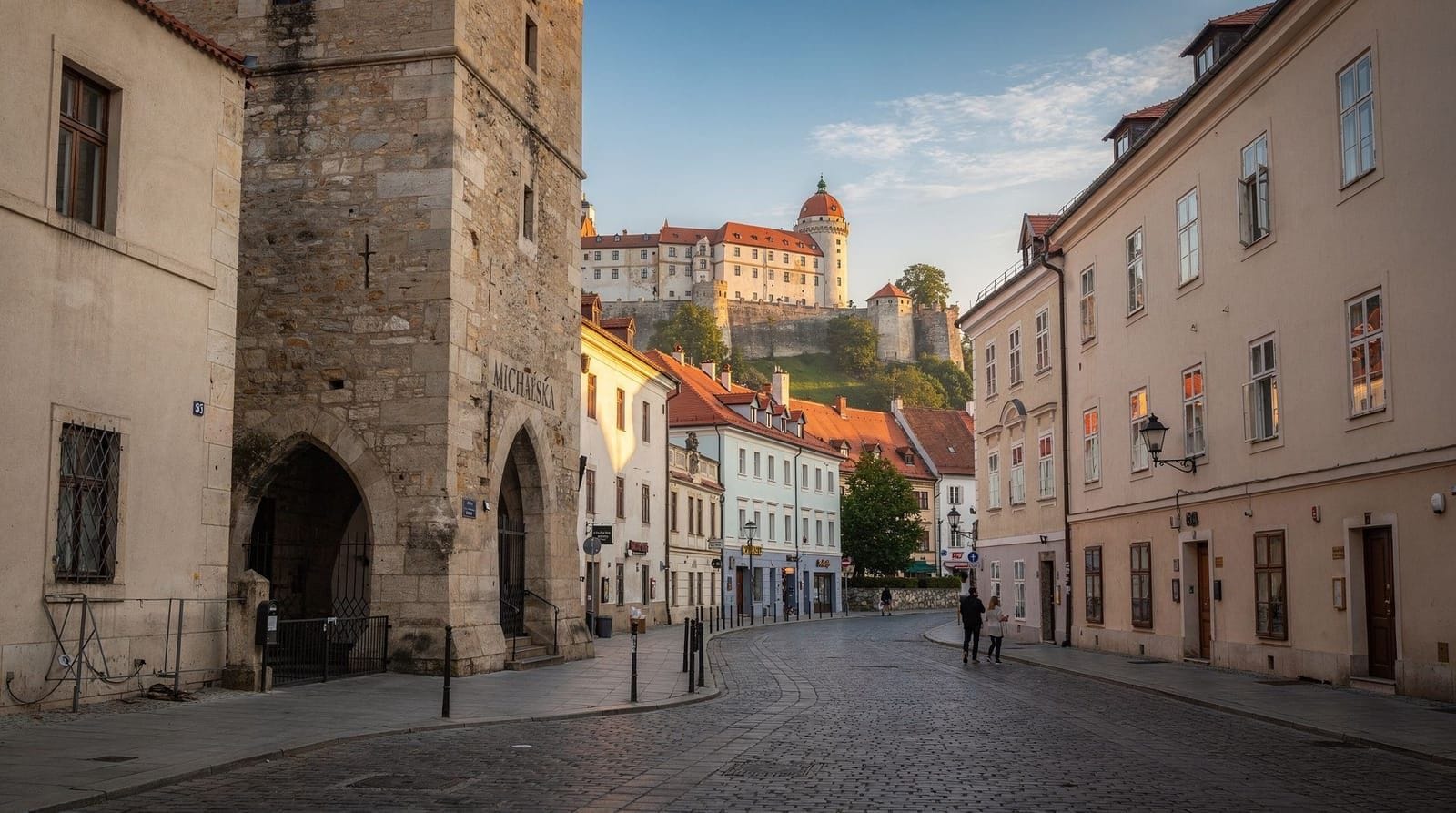
St Martin's Cathedral: Bratislava's royal coronation church
Is there an entry fee for St Martin's Cathedral?
Entry is free, though a small donation is encouraged. The cathedral is open Mon-Sat 09:00-17:00 and Sun 13:30-17:00. Visiting during Mass is not permitted for tourists.
| At a glance | |
|---|---|
| Where | Rudnayovo námestie 1, southwestern edge of the Old Town, next to the SNP Bridge ramp |
| Cost | Free entry; a donation of around €1-2 is customary |
| Time needed | Around 30-60 minutes for the interior, plus 10-15 minutes outside |
| Getting there | 5-8 minute walk from Hlavné námestie, or tram/bus to the SNP Bridge (Most SNP) stop |
| Best time | Weekday mornings for quieter light through the windows; avoid the Sunday 08:00-13:00 Mass window |
Standing at the edge of Bratislava’s Old Town, hemmed in on one side by centuries of medieval streets and on the other by the thundering ramp of a Cold War motorway bridge, St Martin’s Cathedral is one of the most dramatically situated Gothic churches in Central Europe. Formally known as Dóm sv. Martina — the Cathedral of St Martin — this soaring limestone building served as the coronation church of the Kingdom of Hungary for nearly three centuries, witnessing the crowning of 18 kings and queens between 1563 and 1830.
Today it remains an active Catholic cathedral, the seat of the Archbishop of Bratislava, and one of the most important historical monuments in Slovakia. Entry is free, the interior rewards a slow, attentive visit, and the stories embedded in every chapel and tombstone span the full sweep of Central European history — from medieval crusades to Habsburg imperialism to communist-era urban planning gone badly wrong.
From Romanesque foundations to Gothic grandeur
The site on which the cathedral stands has been sacred ground for well over eight centuries. Archaeological evidence suggests a Romanesque church existed here as early as the 11th century, though formal documentation for the parish of St Martin dates to 1221 — the year now taken as the founding of the building that eventually grew into the present cathedral. This early structure, modest by later standards, served the growing settlement that would eventually become Pressburg, the German name by which Bratislava was known for most of its history.
The transition from Romanesque to Gothic was neither sudden nor simple. Construction of the Gothic nave began in earnest during the 14th century, driven by the ambitions of the town’s merchant class and the patronage of the Hungarian royal court, which regarded Pressburg as a strategically vital city at the crossroads of the Danube trade routes. The main Gothic nave was largely completed during the 14th and 15th centuries, its pointed arches and ribbed vaulting reflecting the refined Viennese Gothic style then dominant across the region. Work continued sporadically for generations — the cathedral is less a single coherent design than an accumulation of architectural decisions made across two centuries, which gives it much of its character.
The tower, which rises to 85 metres and dominates the skyline of the Old Town from nearly every angle, was completed in the 15th century and subsequently modified. Its most distinctive feature is not Gothic at all: perched on the very tip is a gilded replica of the Hungarian royal crown, weighing approximately 300 kilograms. This crown — added to the tower in the 18th century — is a replica; the actual Hungarian royal crown is kept in Budapest, displayed in the Hungarian Parliament building. The presence of the crown replica on the cathedral spire is a permanent reminder of the building’s role as the coronation church of the Kingdom of Hungary, a function that defined its identity for three hundred years.
If you are planning a morning in the Old Town and want to understand how the cathedral fits into the broader medieval fabric of the city, pairing it with Michael’s Gate — the last surviving gate of the medieval fortifications, just a five-minute walk north — gives an excellent sense of the old city walls and the relationship between religious and civic power in medieval Pressburg. For a complete overview of the neighbourhood, the Old Town walking guide maps out a logical route connecting all the major sites.
The coronation church of 18 kings
The chapter of St Martin’s history that most visitors come to understand begins in 1563. Following the catastrophic Ottoman victory at the Battle of Mohács in 1526, the Kingdom of Hungary found itself dramatically reduced in territory. The Ottomans controlled much of the Hungarian plain, and the traditional coronation city of Székesfehérvár (Alba Regia) was inaccessible. The Habsburg rulers of the remaining kingdom were forced to look elsewhere for a suitable venue for their coronations, and Pressburg — close to Vienna, fortified, and relatively prosperous — was the natural choice. St Martin’s Cathedral, already the most prestigious church in the city, became the official coronation church of the Kingdom of Hungary.
The first coronation held here was that of Maximilian II in 1563, and from that moment the cathedral occupied a place of extraordinary symbolic importance in the political life of Central Europe. Over the following 267 years, 11 kings and 7 queens were crowned within these walls — 18 rulers in total, the last being Ferdinand V in 1830. The coronation ceremony followed a fixed ritual: the monarch would enter the cathedral, receive the crown and other regalia, then ride on horseback along the coronation road through the city to a specially constructed hillock.
On this hillock — which no longer exists, having been demolished along with much of the old city during 19th and 20th century development — the new king would wave a sword in the four cardinal directions, symbolically vowing to defend the kingdom against enemies from all sides. He would then ride back to the cathedral to complete the ceremony.
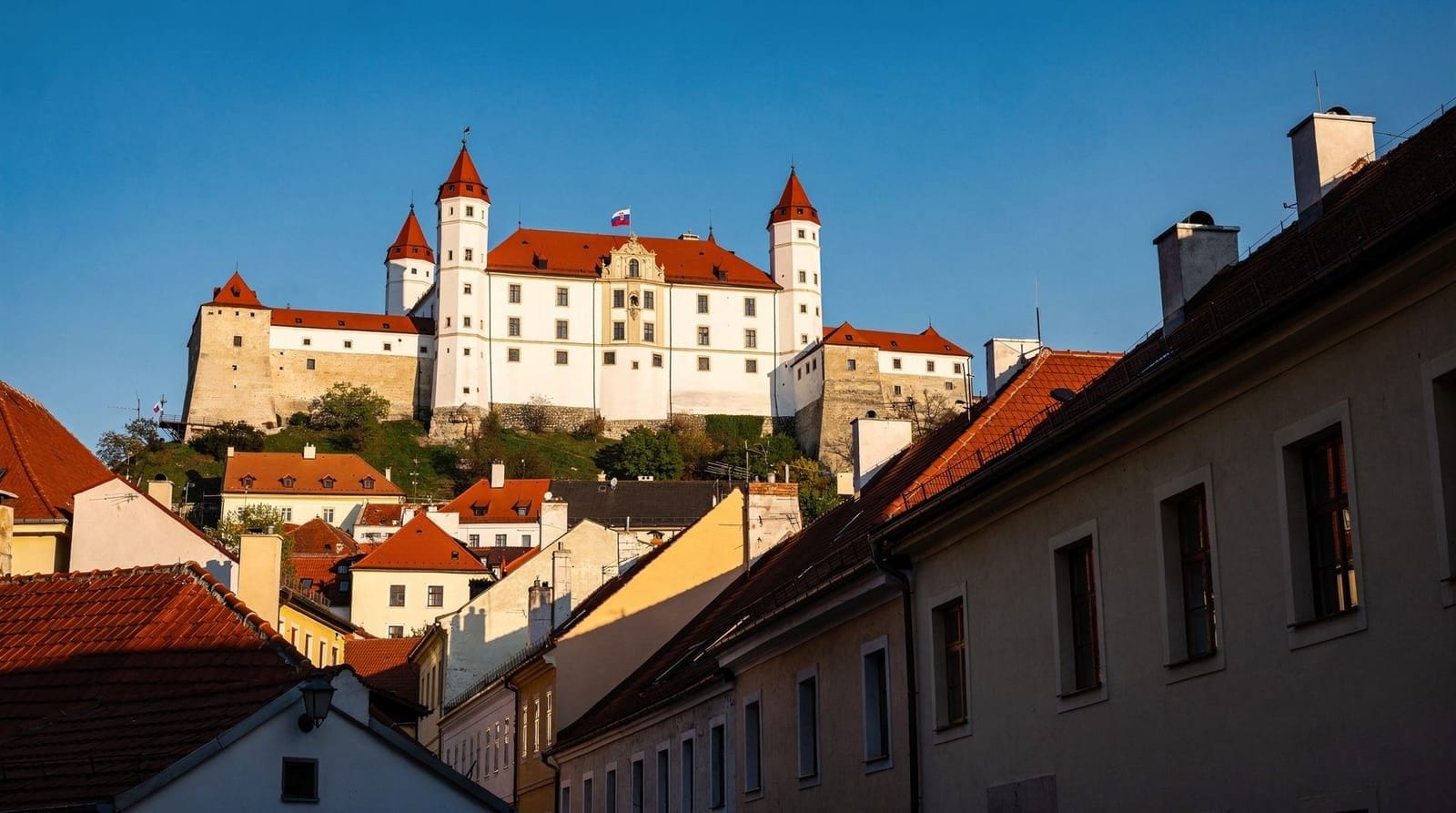
Among the monarchs crowned here, Maria Theresa holds particular significance for the city. Crowned Queen of Hungary in 1741, she had a deep affection for Pressburg and made it one of her preferred residences. Her reign saw significant investment in the city’s architecture and cultural life. Bratislava Castle, which towers over the cathedral and the Old Town from its hilltop perch, was substantially rebuilt under her patronage and became her residence during stays in the city.
GetYourGuideBratislava 1-hour small group walking tourCheck availability →The coronation regalia themselves were stored in Bratislava for much of this period, kept under lock and key in the castle above the city. The connection between the castle and the cathedral — politically, symbolically, and geographically — is one of the defining themes of Bratislava’s history as a royal capital. Understanding one without the other is difficult; visitors who make time for both in a single day will find their understanding of each enriched by the contrast.
For travellers with limited time, the Bratislava in one day guide and the one-day itinerary both include St Martin’s Cathedral as a key stop, with suggested timings that allow for a proper visit without feeling rushed.
Inside the cathedral: what to look for
Entering St Martin’s Cathedral through the main portal on Rudnayovo námestie, you step into a three-aisled Gothic interior that feels both vast and intimate — the proportions of the nave pull the eye upward toward the ribbed vaulting, while the side chapels draw you in with their accumulated layers of art and devotion spanning seven centuries.
The high altar, dedicated to St Martin himself, is the focal point of the nave. The altarpiece depicts the famous scene of St Martin of Tours dividing his cloak to share with a beggar — the act of charity that became the defining image of the saint and the central symbol of the cathedral. The surrounding choir stalls and the quality of the stonework throughout the chancel reflect the prestige that the building enjoyed during its peak as a royal coronation church.
Among the individual monuments in the cathedral, the equestrian tomb sculpture of Eleanor of Portugal deserves particular attention. Eleanor was the wife of Emperor Frederick III and died in Linz in 1467; her elaborate memorial, which features a detailed equestrian figure, is one of the finest examples of late Gothic funerary sculpture in the region. The craftsmanship of the drapery and the horse’s musculature speaks to the quality of the workshop that produced it, and it rewards close inspection.
The Chapel of St John the Almsgiver is one of the cathedral’s Baroque additions, a reminder that the building continued to be modified and enriched long after its Gothic structure was complete. St John the Almsgiver, a 7th-century patriarch of Alexandria famed for his charity toward the poor, is venerated as a patron of the poor and the sick; the chapel dedicated to him reflects the Counter-Reformation piety of the 17th century, when the Habsburgs were engaged in a systematic effort to reassert Catholic devotion throughout their territories.
GetYourGuideBratislava classic walking tourCheck availability →The Gothic baptistery, set apart from the main nave, preserves some of the oldest decorative elements in the building. The stained glass windows, while not all of medieval origin — some are 19th-century replacements or restorations — give the interior its characteristic quality of coloured light, particularly in the morning hours when the sun enters from the east. If you can visit before noon, the play of light through the windows across the stone pillars is genuinely beautiful.
Eleonóra de Medici’s chapel is another significant Baroque addition, reflecting the dynasty’s Italian connections and the broader cultural influences that shaped the cathedral’s interior over the centuries. The accumulation of these chapels — each representing a different patron, a different era, a different artistic style — is part of what makes the interior so rewarding to read slowly rather than hurry through.
Organ concerts are held periodically in the cathedral throughout the year; the acoustics of the Gothic nave are well suited to the instrument, and attending an evening concert is one of the better ways to experience the space as something more than a museum. Check local listings upon arrival, as the schedule varies by season.
The cathedral’s exterior offers its own rewards. The best vantage point for photographs is from Rudnayovo námestie itself, where you can capture the full height of the tower against the sky. For a more dramatic and unconventional angle — one that captures the peculiar tension between the medieval building and its 20th-century surroundings — the ramp of the SNP Bridge offers a striking perspective. Photographers interested in the city’s most photogenic corners will find more suggestions in the best photo spots guide.
Practical visitor information
St Martin’s Cathedral is located at Rudnayovo námestie 1, 811 01 Bratislava, at the southwestern edge of the Old Town, adjacent to the ramp of the SNP Bridge. The address is straightforward to find on any map application, and the building’s 85-metre tower is visible from much of the surrounding area.
Opening hours are Monday to Saturday 09:00 to 17:00, and Sunday 13:30 to 17:00. The cathedral is closed to tourists during Mass, which takes place on weekdays at 06:30 and 18:00, on Saturdays at 08:00 and 18:00, and on Sundays at 08:00, 09:30, 11:00, 18:00, and 20:00. It is worth checking these times before you plan your visit, particularly on Sundays when the afternoon opening window of 13:30 to 17:00 is the only slot available to tourists. The building is a functioning place of worship, and the congregation’s use of it takes precedence.
Entry is free. There is a donation box near the entrance, and a contribution of 1 to 2 EUR is a reasonable and appreciated gesture. Photography for personal use is generally permitted inside the cathedral, though flash photography and tripods are typically discouraged; observe any posted signs and be respectful of anyone at prayer.
The cathedral is fully accessible from the square, though the internal layout includes some uneven stone floors and steps into the side chapels. There is no café or shop inside the building, but Rudnayovo námestie and the immediate surrounding streets have several cafés and restaurants within a two-minute walk.
GetYourGuideBratislava guided walking tour with castle entryCheck availability →For visitors using public transport, the most convenient stop is the SNP Bridge (Most SNP) area, served by multiple tram and bus lines. The getting around Bratislava guide covers public transport options in detail. Those with a Bratislava City Card will find that it covers unlimited public transport in addition to discounts at many of the city’s museums and attractions, making it worth calculating against your planned itinerary.
Budget-conscious travellers will appreciate that St Martin’s Cathedral is entirely free to enter, making it one of the most accessible of Bratislava’s major historical sites. Combined with other free or low-cost attractions — Michael’s Gate charges a modest entry fee for the tower, but the gate itself is free to pass through — a morning spent in the Old Town can be extraordinarily rich without significant expense. The budget guide to Bratislava has a fuller breakdown of what costs what across the city.
St Martin’s and the SNP Bridge: an uneasy neighbour
No visit to St Martin’s Cathedral is complete without confronting the most jarring aspect of its present situation: the massive concrete ramp of the SNP Bridge, which sweeps within metres of the cathedral’s northern flank and effectively cuts the building off from the riverbank and the Jewish quarter that once stood between the church and the Danube.
The construction of the SNP Bridge — Most SNP, named after the Slovak National Uprising — was carried out in the late 1960s and early 1970s as part of a broader communist-era urban redevelopment of central Bratislava. The bridge itself, which carries a UFO-shaped observation deck on its single pylon (you can visit it at the UFO Observation Deck guide), was an engineering achievement of its time and remains a recognisable icon of the city. But its approach ramp required the demolition of a substantial portion of the Old Town’s southern district, including the historic Jewish quarter — a community with roots going back centuries in Bratislava, known historically as Pressburg’s Jewish ghetto.
The human and cultural cost of that demolition is documented in the Jewish heritage guide, which covers the history of Bratislava’s Jewish community and what survives of it today. The loss of hundreds of historic buildings, a medieval synagogue, and an entire neighbourhood to make way for a motorway ramp is one of the more painful episodes in the city’s modern history, and it cannot be separated from the broader story of how communist urban planning treated historical urban fabric across Central and Eastern Europe. The communist and Iron Curtain history guide places these decisions in their wider political context.
GetYourGuideBratislava Old Town with castle private tourCheck availability →For St Martin’s Cathedral specifically, the consequence is that the building now stands in permanent acoustic and visual confrontation with a six-lane expressway. The roar of traffic is audible inside the cathedral on busy days. The visual contrast between the 15th-century Gothic tower and the 1970s concrete bridge is jarring in a way that is impossible to ignore and impossible to fully reconcile — and yet it has become, in its own way, part of the cathedral’s identity and part of what makes Bratislava interesting. The city wears its 20th century poorly in some places, and nowhere more visibly than here.
Seen from a certain angle — from the observation platform of the SNP Bridge, looking back across the Danube toward the Old Town — the juxtaposition is almost photogenic: the ancient tower rising behind the modern pylons, the gilded crown catching the light above the concrete.
It is one of those views that tells you everything about a city’s layered history in a single frame, which is part of why Bratislava, for all its contradictions, is genuinely worth visiting. The hidden gems guide and the essay on Bratislava as an underrated capital both explore how the city’s unresolved tensions between eras are, paradoxically, among its most compelling qualities.
For visitors interested in the full context of the city’s architectural and cultural history, the Slovak National Museum and Gallery offers deeper exploration of Slovak artistic heritage, including works and artefacts connected to the coronation period. Pairing a morning at the cathedral with an afternoon at the museum gives a full picture of the historical and artistic forces that shaped Bratislava as a European capital.
If you are visiting on a weekend itinerary, St Martin’s Cathedral fits naturally into a morning circuit of the Old Town alongside Bratislava Castle and the Blue Church — three very different buildings in terms of style and era, but all essential to understanding the city’s character.
Frequently asked questions about St Martin’s Cathedral
What are the opening hours for St Martin’s Cathedral?
The cathedral is open to tourists Monday to Saturday from 09:00 to 17:00 and on Sunday from 13:30 to 17:00. These hours are subject to change during religious services, holidays, and special events. The cathedral closes to visitors during Mass, so it is advisable to check the Mass schedule if you are planning a Sunday visit, when the morning is entirely reserved for services.
Is there an entrance fee?
Entry to the cathedral is free of charge. A donation box is placed near the entrance, and a contribution of 1 to 2 EUR is customary and appreciated. There are no paid sections of the interior, and no timed entry system is in operation.
How long does a visit to St Martin’s Cathedral take?
Most visitors spend between 30 and 60 minutes inside. If you are taking time to read the historical information panels, examine the monuments and chapels in detail, and simply sit and absorb the atmosphere of the interior, an hour is comfortable. The exterior and the surrounding square add another 10 to 15 minutes.
What is the significance of the crown on the cathedral tower?
The gilded crown on top of the 85-metre tower is a replica of the Hungarian royal crown (the Crown of St Stephen), weighing approximately 300 kilograms. It was placed on the tower to commemorate the cathedral’s role as the coronation church of the Kingdom of Hungary. The original Hungarian crown is kept in the Hungarian Parliament building in Budapest. The crown on the tower is visible from much of the Old Town and serves as an unmistakable landmark.
Who were the most famous rulers crowned at St Martin’s Cathedral?
The most historically significant coronation at St Martin’s was probably that of Maria Theresa in 1741, who went on to become one of the most powerful rulers in European history and who had a lasting affection for Bratislava. Other notable coronations included that of Maximilian II in 1563 — the first to be held here after the Ottoman occupation of the traditional coronation city — and Ferdinand V in 1830, the last monarch to be crowned in the cathedral. A total of 18 rulers were crowned here between 1563 and 1830.
Can I attend a Mass at the cathedral?
Yes. St Martin’s Cathedral is an active Catholic parish and the seat of the Archbishop of Bratislava. Masses are celebrated on weekdays at 06:30 and 18:00, on Saturdays at 08:00 and 18:00, and on Sundays at 08:00, 09:30, 11:00, 18:00, and 20:00. All are welcome to attend as worshippers; tourists visiting for sightseeing are asked to refrain from entering during Mass.
Are there organ concerts at the cathedral?
Organ concerts are held periodically throughout the year, taking advantage of the cathedral’s excellent acoustics and its historic pipe organ. The schedule varies by season and is not fixed in advance, so the best approach is to check local event listings or ask at the city’s tourist information offices upon arrival. Concerts typically run in the early evening and often coincide with religious festivals or cultural events in the Old Town.
How close is St Martin’s Cathedral to Bratislava Castle?
The cathedral and the castle are approximately 700 metres apart as the crow flies, with the castle sitting on its hilltop directly above the Old Town. Walking from the cathedral to the castle entrance takes around 10 to 15 minutes on foot, much of it uphill. The two buildings are so closely linked historically — the castle housed the coronation regalia while the cathedral hosted the coronations — that visiting both in the same day is the natural choice for anyone interested in the royal period of Bratislava’s history.
Is St Martin’s Cathedral worth visiting if I only have one day in Bratislava?
Yes, if history and architecture interest you at all. It costs nothing, sits directly on the route between the Old Town and the SNP Bridge, and takes under an hour, so it fits easily into a one-day plan alongside Bratislava Castle and Michael’s Gate. See the Bratislava in one day guide for how to sequence it with the rest of the Old Town.
Culture & heritage tours
Verified deep-linked GetYourGuide tours. Book through these links and we earn a small commission at no cost to you.