Communist Bratislava and Iron Curtain history: a complete guide
Where can I learn about communist history in Bratislava?
The best sites are the Iron Curtain outdoor exhibit at Devín Castle (free, bus 29 from centre), the Slavín Soviet war memorial (free, open 24/7), and the Petržalka panelák district across the Danube. Specialist walking tours also cover ŠtB headquarters, SNP Square, and 1989 Velvet Revolution sites in the Old Town.
At a glance
| Where | Devín Castle (12 km west), Slavín memorial (Staré Mesto hill), Petržalka (across SNP Bridge), SNP Square (Old Town) |
| Cost | Iron Curtain exhibit and Slavín are free; Devín castle ruins around €8; UFO deck around €9.50 |
| Time needed | Half a day for the core route (Slavín, SNP Bridge/Petržalka, Devín) |
| Getting there | Bus 29 to Devín, on foot to Slavín and across SNP Bridge to Petržalka |
| Best time | Daylight hours; interpretive panels at Devín are easier to read in dry weather |
Why Bratislava is one of Europe’s most compelling Cold War destinations
Few European capitals carry the weight of the 20th century quite like Bratislava. For four decades after World War II, this city sat on one of the most heavily fortified borders on earth — a few hundred metres of water and wire separating the socialist East from the capitalist West. Vienna was 65 km away as the crow flies, yet completely unreachable. The Iron Curtain did not merely pass through Slovakia; it defined it, shaped its architecture, displaced its communities, and left scars that are still visible across the cityscape today.
That proximity to Austria made Bratislava’s stretch of the Iron Curtain uniquely tense. For the communist authorities in Prague and Bratislava, the western frontier along the Danube and Morava rivers was a constant security obsession. For ordinary Czechoslovaks, it represented both the edge of their world and an almost mythological line of freedom they risked their lives to cross. Dozens died attempting the crossing near Devín alone.
Today the city rewards travellers who look beyond the photogenic Old Town. The panelák towers of Petržalka, the watchtower reconstruction at Devín, the Red Army obelisk at Slavín, the demolished Jewish quarter sacrificed to make way for the SNP Bridge — these are not footnotes to Bratislava’s story. They are the story. This guide covers where to go, what you will see, and how to make sense of it all.
The Iron Curtain on Slovakia’s western border
The Iron Curtain stretched roughly 8,000 km across Europe from the Baltic to the Adriatic, but the Slovak-Austrian border represented one of its most militarised sections anywhere on the continent. Along the Danube and the Morava river, the communist authorities erected a layered system of defence that included electrified fences, minefields, patrol roads, watchtowers, and a deep exclusion zone that ordinary citizens could not enter without special permits.
Between 1948 and 1989, the border zone was essentially a state within a state. Villages near the frontier were depopulated or put under surveillance. Access roads were controlled. Farmers working land near the Morava needed special documentation to reach their own fields. The apparatus consumed enormous resources and manpower — all to prevent people from simply leaving.
The human cost was stark. Historians estimate that hundreds of Czechoslovaks attempted to cross the border into Austria via the Devín and Morava sector. Dozens died in the attempt — shot by border guards, drowned in the Danube, or killed by mines. Others were captured, imprisoned, and subjected to interrogation by the ŠtB, the Czechoslovak secret police. The tragedy is that many who died were young people, often in their twenties, fleeing not for political reasons but simply for a chance at a different life.
The Iron Curtain fell almost overnight on 9 November 1989, when the Berlin Wall opened. Within weeks, Czechoslovakia’s own border fences were being dismantled. By Christmas, the communist government was gone.
Devín: where the Iron Curtain meets the river
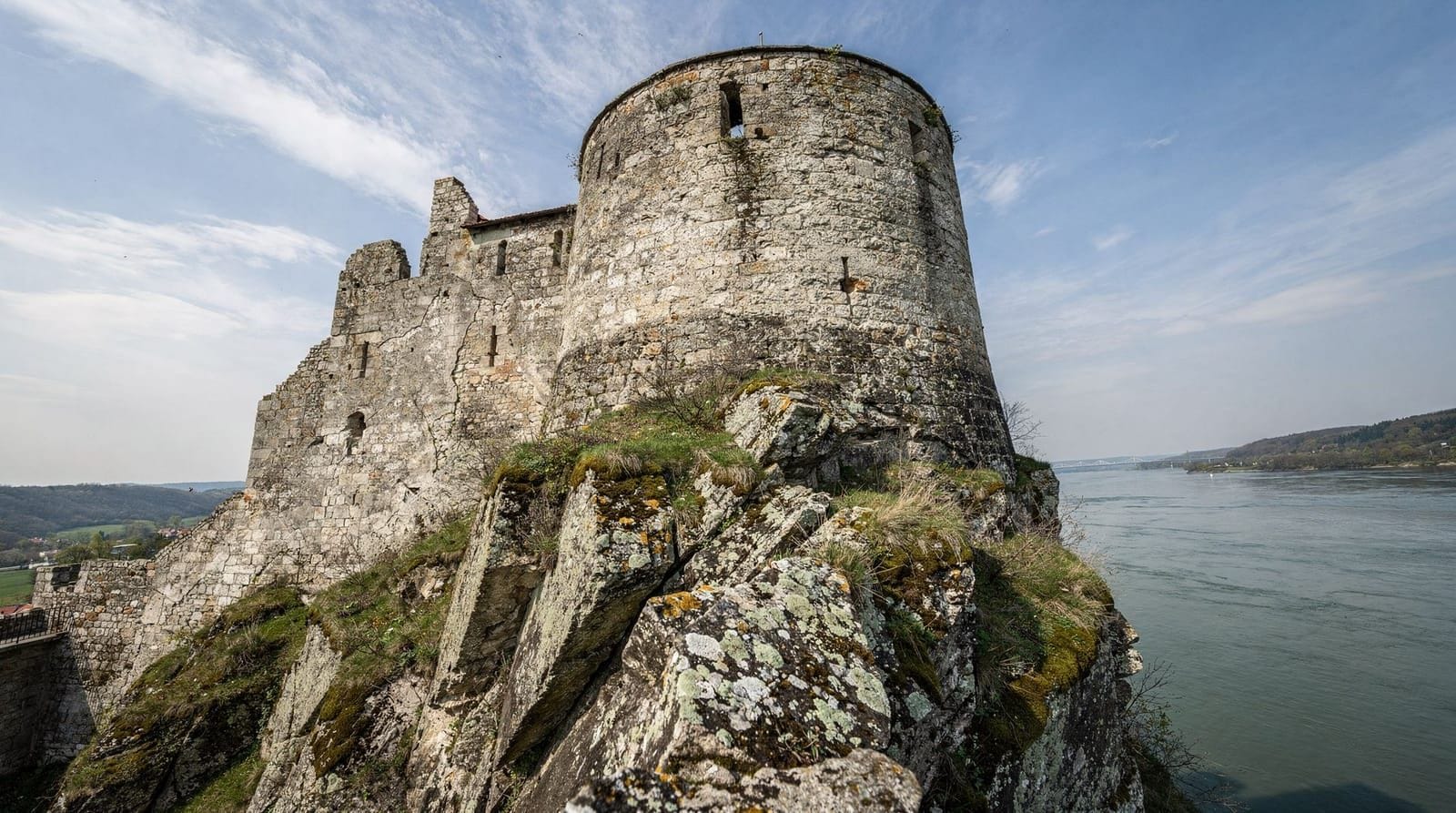
The village of Devín, now a district of Bratislava, sits at the confluence of the Danube and the Morava, about 12 km west of the city centre. It is famous for its medieval castle ruins — but for Cold War history, the site’s more recent past is equally significant.
The Devín crossing point was one of the most closely watched sections of the entire Iron Curtain. The natural geography made it both tempting for escapees (the Austrian shore was sometimes less than 300 metres away) and lethal (fast river currents, armed patrols on both banks, and watchtowers with clear lines of sight in all directions).
The Iron Curtain outdoor exhibit
Today, a free outdoor exhibit in the grounds around Devín Castle documents this history in detail. The exhibit includes reconstructed sections of the original border fence — the steel posts, the tripwires, the warning signs — along with a reconstruction of a border watchtower that visitors can approach and photograph. Interpretive panels in Slovak and English explain the mechanics of the border regime: who staffed it, how the alert systems worked, what happened to those who were caught.
The exhibit is free to visit and sits separately from the paid castle ruins area (castle entry costs around 8 EUR for adults). You can walk through the Iron Curtain installation without buying a castle ticket, making it one of the most accessible Cold War heritage sites in Central Europe. It is open during daylight hours year-round, though the interpretive panels are best read in dry conditions.
To get to Devín from central Bratislava, take bus 29 from Nový Most (the SNP Bridge bus stop) — the journey takes about 30 minutes. Buses run roughly every 30-40 minutes. You can also cycle along the Danube riverside path, a flat and scenic 12 km route. For a deeper reading of the castle’s longer history alongside the communist-era exhibits, see the Devín Castle guide.
GetYourGuideCommunist Bratislava walking tourCheck availability →GetYourGuideBratislava Soviet era and post-communist tourCheck availability →
Slavín: the Soviet memorial on the hill
On a wooded hill in Bratislava’s Staré Mesto district stands one of the most striking — and, for many visitors, unexpected — monuments in the city. The Slavín war memorial is a massive Soviet WWII memorial complex, built between 1957 and 1960 to honour the Red Army soldiers who died liberating Bratislava from Nazi German forces in April 1945.
The centrepiece is a 39-metre obelisk topped with a bronze statue of a Red Army soldier holding a flag aloft. At its base, the names of the fallen are inscribed across the memorial walls. In the gardens below, 6,845 Soviet soldiers are buried — the largest Soviet military cemetery in Central Europe. The setting is quietly monumental: manicured lawns, stone paths lined with military graves, and a viewing terrace that offers one of the best panoramic views over Bratislava’s rooftops and the Danube valley.
Slavín is free to enter. The grounds are open 24 hours a day; the memorial itself is best visited during daylight. To walk here from the Old Town, head uphill through the residential streets north of the castle for about 20-25 minutes. The address is Slavín, Staré Mesto, and it is signposted from the upper Old Town. There is no entrance fee and no ticket office.
The memorial occupies a complicated place in Slovak public memory. For older generations, it represents liberation from fascism; for others, it marks the beginning of four decades of Soviet-backed rule. Vandalism has occurred periodically over the decades, and the question of what to do with such monuments remains politically sensitive. Whatever one’s view, Slavín is a genuinely affecting place to stand and think about what the 20th century cost.
For spectacular views over the city without the historical weight, the UFO observation deck on the SNP Bridge offers a very different vantage point just down the hill.
Petržalka: living in the panelák
Cross the SNP Bridge heading south and you enter a world that feels entirely different from the baroque spires and cobbled lanes of the Old Town. Petržalka is Bratislava’s largest district and one of the largest prefabricated housing estates in Central Europe, home to approximately 100,000 people. Built in the 1970s and 1980s as the communist government’s answer to the city’s housing shortage, it is a vast grid of identical grey concrete towers — paneláky — stretching south from the Danube towards the Austrian border.
At its peak construction, Petržalka was being built at a pace of several thousand apartments per year, populated by factory workers and young families relocated from rural Slovakia. The ideology behind it was egalitarian: uniform housing, shared infrastructure, no private ownership. The reality was often cramped apartments, poor sound insulation, dysfunctional lifts, and a sense of anonymity that the original planners seem not to have anticipated.
Today, Petržalka is undergoing gradual transformation. Facades are being repainted, playgrounds upgraded, and new commercial spaces inserted between the towers. It is no longer the grim grey monolith of Cold War-era photographs — but it is still unmistakably a product of its era. Walking through it with an eye for the original architecture — the repetitive floor plans, the spacing between towers, the remnants of communal spaces — is a fascinating exercise in socialist urbanism.
The easiest way to see Petržalka is to walk across the SNP Bridge (about 15 minutes from the Old Town) and wander the residential streets closest to the river. You do not need a guide to appreciate it, but a local expert can provide social context that transforms the visual experience. The district also features in the broader walking guide to Bratislava’s Old Town as a contrasting landscape.
GetYourGuideBratislava communist architecture and history tourCheck availability →The SNP Bridge and the demolished Jewish quarter
The Most SNP — officially the Nový Most or New Bridge, more famously known as the UFO Bridge for its flying-saucer observation deck — was built between 1967 and 1972 and opened as one of the most technologically ambitious bridges in communist Czechoslovakia. It is a remarkable piece of engineering: a single-pylon suspension bridge with a restaurant and observation deck cantilevered over the Danube.
But the bridge came at a terrible cost. To make way for the wide approach roads and the bridge itself, the communist authorities demolished the historic Podhradie neighbourhood below the castle and, critically, Bratislava’s old Jewish quarter — a dense urban fabric of synagogues, Jewish community buildings, tenement houses, and streets that had existed for centuries. The main synagogue, one of the largest in Central Europe, was torn down. Thousands of residents were relocated. The entire neighbourhood was erased.
The scale of destruction is now seen as one of the most egregious acts of communist-era urban vandalism in Slovakia. What makes it especially painful is that Bratislava’s Jewish community had already been devastated by the Holocaust — and then, a quarter-century later, the physical memory of the community was systematically erased again. The Jewish heritage guide covers this history in detail, including what survived and where to find it.
The SNP Bridge and its UFO deck are still among Bratislava’s most distinctive landmarks. You can visit the observation deck (entry approximately 9.50 EUR) for views that capture both the Old Town and Petržalka simultaneously — the two Bratislavas in a single panorama.
The ŠtB and the apparatus of surveillance
The Štátna bezpečnosť — the ŠtB — was Czechoslovakia’s secret police from 1945 to 1989. Modelled on the Soviet KGB and comparable in methods to East Germany’s Stasi, the ŠtB maintained files on hundreds of thousands of citizens, ran networks of informers, and operated interrogation facilities where dissidents, would-be emigrants, and suspected enemies of the state were subjected to psychological and physical pressure.
In Bratislava, several buildings in the city centre served ŠtB functions during the communist period. The exact history of which buildings were used for what purposes is only partially declassified, but walking tours focused on communist-era Bratislava typically point out former ŠtB locations, explain how the surveillance apparatus worked in practice, and discuss the social dynamics of living under observation — the self-censorship, the coded conversations, the network of trusted and distrusted relationships that everyday life required.
The ŠtB archives were partially opened after 1989 and continue to be a source of historical and personal reckoning. Many Slovaks discovered after the revolution that neighbours, colleagues, or even family members had been informers.
The 1968 Prague Spring and its aftermath in Bratislava
On the night of 20-21 August 1968, Soviet and Warsaw Pact tanks entered Czechoslovakia to crush the reform movement known as the Prague Spring. The invasion — which the Soviet leadership called “fraternal assistance” — put an end to Alexander Dubcek’s experiment with “socialism with a human face.” Dubcek was himself Slovak, and the reform movement had been warmly received in Bratislava.
The shock of the invasion produced a wave of emigration. Thousands of Czechoslovaks who happened to be abroad at the time chose not to return. Others crossed the still-porous border in the weeks immediately following August 1968, before the security apparatus could be fully reconstituted. This was one of the largest emigration events in Czechoslovak history — and it was followed, once the borders were locked tight again, by the bleakest period of communist rule, known as “normalisation.”
Normalisation lasted from 1969 to 1989. It meant the reversal of all Dubcek’s reforms, the purging of reform-minded party members, and a return to strict ideological conformity. Many of Slovakia’s intellectuals, artists, and academics lost their jobs. Public life contracted. The effect on Bratislava was palpable — a city that had briefly felt as if change were possible became cautious, muted, watchful.
The Velvet Revolution and SNP Square
The end came in November 1989. Sparked by the brutal suppression of a student demonstration in Prague on 17 November, the Velvet Revolution — known in Slovak as the Nežná revolúcia, the Gentle Revolution — spread rapidly to Bratislava. Within days, SNP Square (Námestie SNP) in the heart of the city was filling with tens of thousands of protesters.
The demonstrations were peaceful on both sides. By the end of November, the communist government had agreed to give up its constitutional monopoly on power. By 29 December, Václav Havel was president. The revolution had taken 41 days from first spark to the transfer of power — and in Bratislava it had been conducted almost entirely in the open space of SNP Square, with crowds that at their peak numbered in the hundreds of thousands.
SNP Square today is a busy urban plaza surrounded by shops and tram lines, with little obvious marker of its revolutionary significance. But standing there, knowing what happened in November 1989, it is not hard to imagine those crowds — the noise, the fear mixed with exhilaration, the ringing of keys (the protesters’ symbol: we are unlocking the future).
GetYourGuideVelvet Revolution and communist history tourCheck availability →Practical information for visiting communist-era sites
Devín Iron Curtain exhibit Getting there: Bus 29 from Nový Most, approx. 30 minutes. Runs roughly every 30-40 minutes. Cost: Free (separate from paid castle ruins entry, approx. 8 EUR for adults). Hours: Daylight hours, year-round. Best combined with: The castle ruins and a walk along the Danube bank. See the Devín Castle guide for full details.
Slavín memorial Address: Slavín, Staré Mesto, Bratislava. Cost: Free. Hours: Open 24 hours (grounds); best visited in daylight. Getting there: 20-25 minute uphill walk from the Old Town; taxis widely available.
Petržalka district Getting there: Walk across SNP Bridge from Old Town (about 15 minutes on foot). Best approach: Self-guided walk or specialist guided tour. What to look for: The repeating tower blocks along Romanova and Bulíkova streets; the contrast between older and refurbished facades.
SNP Bridge observation deck (UFO) Cost: Approximately 9.50 EUR for observation deck entry; restaurant prices separate. Hours: Daily, typically 10:00-23:00 (check current times as they vary seasonally). For more detail: UFO observation deck guide.
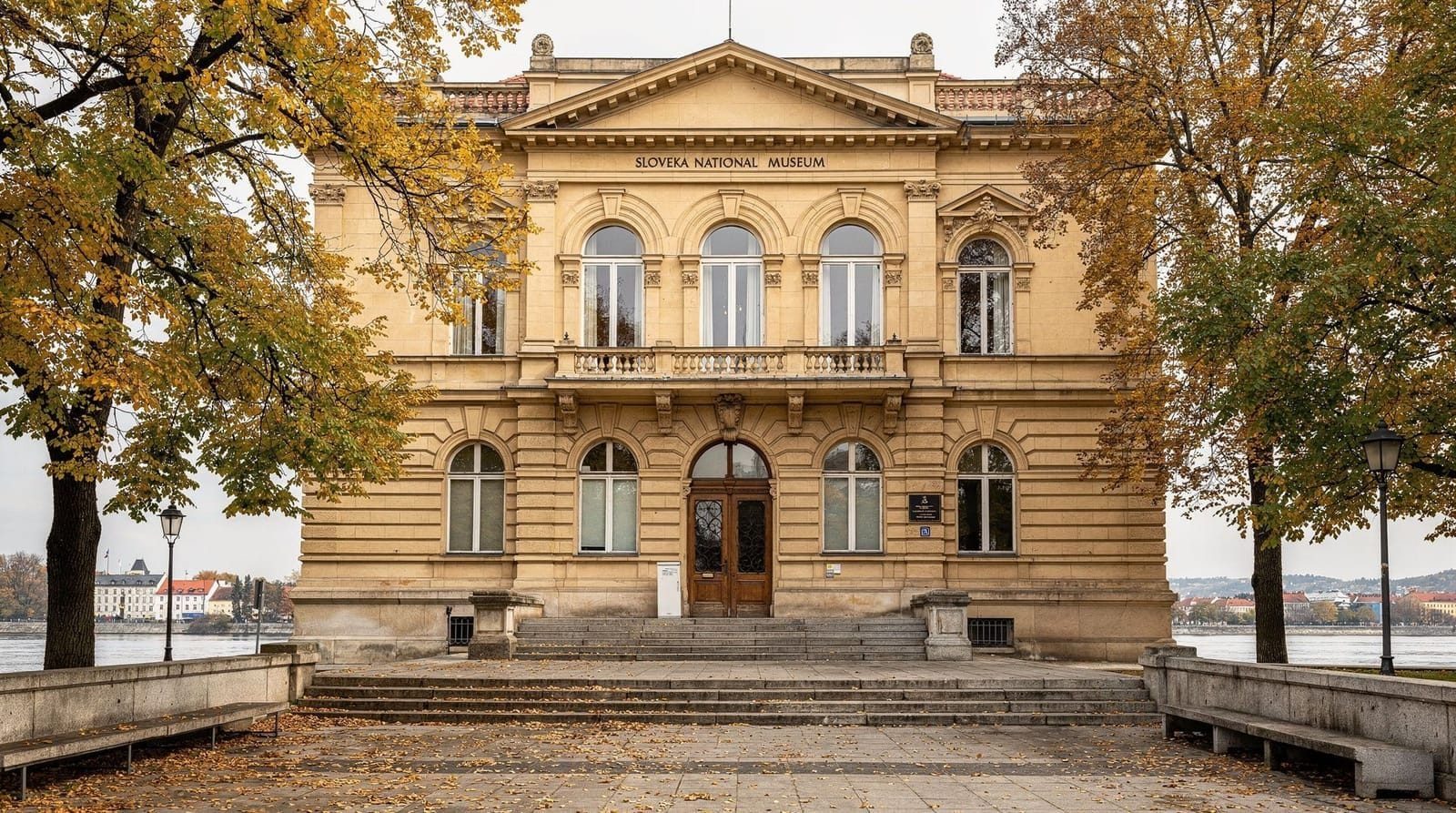
Slovak National Museum For broader historical context including the communist era, the Slovak National Museum’s main building on the Danube embankment has permanent exhibits covering 20th-century Slovak history. See the Slovak National Museum and gallery guide.
GetYourGuideBratislava history and culture walking tourCheck availability →Suggested itinerary for communist-era Bratislava
Half-day route (on foot and by bus): Morning: Walk from the Old Town to Slavín (25 minutes uphill) — spend 30-45 minutes at the memorial and enjoy the panoramic view. Descend back to the Old Town. Visit the SNP Bridge area; note the absence of the demolished Jewish quarter. Walk across the bridge to Petržalka for 30 minutes of exploration. Return to the Old Town for lunch.
Afternoon: Take bus 29 from Nový Most to Devín (30 minutes). Visit the Iron Curtain outdoor exhibit (free). Optionally add the castle ruins (approx. 8 EUR). Return by bus before sunset.
This half-day itinerary can be combined with the Old Town walking guide to make a full day, or extended into a two-day Bratislava weekend. Those planning a longer stay may also want to explore the three-day Bratislava itinerary.
Beyond Bratislava: Iron Curtain landscapes in the region
The Iron Curtain’s reach extended well beyond the city. The Small Carpathians to the north of Bratislava also contained border zone infrastructure, and several hiking trails in that region pass through areas that were once off-limits to civilians. The contrast between the now-peaceful vineyards and walking paths and their recent heavily militarised history is striking.
For those interested in Cold War history on a broader scale, the proximity to Vienna offers additional context — the Vienna day trip guide touches on how the Austrian capital lived in the shadow of the Iron Curtain, and combining a visit to Bratislava with time in Vienna creates a compelling paired perspective on what the Cold War meant on the border between East and West. The Bratislava versus Vienna comparison explores this dual identity in more depth.
Frequently asked questions about communist history in Bratislava
Is there a communist history museum in Bratislava?
There is no major standalone museum dedicated solely to the communist era in Bratislava, unlike Prague’s Museum of Communism. The best options are the free Iron Curtain outdoor exhibit at Devín Castle, which focuses specifically on the border regime and its human cost, and the Slovak National Museum’s permanent historical collections, which cover the communist period within a broader narrative of Slovak history. Specialist walking tours fill the interpretive gap and are the most effective way to understand how the communist era shaped the city’s urban landscape.
How do I get to Devín from central Bratislava?
The most convenient option is bus 29, which departs from the Nový Most bus stop near the SNP Bridge. The journey takes approximately 30 minutes and buses run every 30-40 minutes. Cyclists can follow the flat Danube riverside cycle path, which is about 12 km each way. Taxis and rideshares are also available. The Devín Castle guide has detailed transport instructions.
Is the Iron Curtain exhibit at Devín free?
Yes, the outdoor Iron Curtain exhibit in the grounds around Devín Castle is free to visit. It is separate from the paid castle ruins area, which charges approximately 8 EUR for adult entry. You can walk through the Iron Curtain installation — including the fence reconstructions, the watchtower, and the interpretive panels — without purchasing a castle ticket.
How many people are buried at the Slavín memorial?
The Slavín Soviet war memorial in Bratislava’s Staré Mesto district contains the graves of 6,845 Soviet soldiers who died in the liberation of Bratislava and surrounding areas from Nazi German forces in April 1945. It is the largest Soviet military cemetery in Central Europe. Entry to the memorial and its grounds is free.
What happened to Bratislava’s old Jewish quarter?
Bratislava’s historic Jewish quarter — the Podhradie neighbourhood below the castle — was demolished in the late 1960s and early 1970s to make way for the SNP Bridge and its approach roads. The demolition included the city’s main synagogue, one of the largest in Central Europe. The Jewish community’s physical presence in the city had already been devastated by the Holocaust; the communist-era demolition erased the remaining architectural memory of centuries of Jewish life in Bratislava. The Jewish heritage guide covers what survived and where to find it.
What is the Nežná revolúcia and where did it happen in Bratislava?
The Nežná revolúcia — the Gentle Revolution, or Velvet Revolution — was the peaceful overthrow of communist rule in Czechoslovakia in November 1989. In Bratislava, the central location for demonstrations was SNP Square (Námestie SNP) in the Old Town, where hundreds of thousands of people gathered over several weeks of protest. The revolution was sparked by the brutal suppression of a student march in Prague on 17 November and concluded with the resignation of the communist government and the election of Václav Havel as president on 29 December 1989.
What were the paneláky and can I visit Petržalka?
Paneláky (singular: panelák) were the prefabricated concrete apartment blocks built across the communist bloc from the 1950s through the 1980s. In Bratislava, the district of Petržalka — built mostly in the 1970s and 1980s — is the largest concentration of paneláky in Central Europe, housing approximately 100,000 residents. Petržalka is open and freely accessible; you can walk there across the SNP Bridge in about 15 minutes from the Old Town. It is not a museum or tourist attraction but an ordinary residential district, now gradually being modernised, that rewards thoughtful exploration.
Did people successfully escape across the Iron Curtain near Bratislava?
Yes, though the risk was extreme. Some people successfully crossed the Danube or Morava rivers into Austria during the communist period, particularly during moments when border security was temporarily relaxed — notably in the weeks after the August 1968 invasion, when thousands of Czechoslovaks escaped before the border was fully sealed again. Many others died in the attempt, killed by border guards, drowned in the rivers, or killed by mines. The Iron Curtain exhibit at Devín documents both the mechanisms of the border regime and the human stories of those who attempted to cross it.
Do I need a guide to understand Bratislava’s communist history?
Not strictly — the Devín exhibit’s interpretive panels, the Slavín memorial’s inscriptions, and this guide’s practical section cover the essentials for a self-guided half-day. A specialist walking tour adds value for the ŠtB surveillance apparatus and SNP Square, where the physical sites carry little obvious signage, and for connecting the dots between locations more efficiently than a self-guided route would. Either approach works; the self-guided route costs nothing beyond bus fare and the Devín castle ticket if you add the ruins.
Culture & heritage tours
Verified deep-linked GetYourGuide tours. Book through these links and we earn a small commission at no cost to you.