Bratislava on a budget: how to visit Europe's cheapest capital for under €50/day
Bratislava is genuinely affordable by Western European standards. It is also one of those cities where it is easy to accidentally spend more than you need to — if you eat every meal in the tourist zone around the old town, you will pay tourist prices. But step two streets away, and the economics shift completely. Lunch that costs 15 € on the main square costs 7 € on Obchodná ulica.
This guide gives you real numbers, specific places, and an honest assessment of what you can and cannot cut.
At a glance
| Daily budget range | Around 30–80 € per day depending on style |
| Cheapest sleep | Hostel dorm, roughly 15–25 € (old town), 8–12 € (Petržalka/fringe) |
| Cheapest hot meal | Denné menu lunch, around 6–9 € |
| Free sights | Old town, Slavín, Danube embankment, Blue Church exterior, castle grounds |
| Getting here cheaply | RegioJet coach/train from Vienna, Budapest or Prague |
| Best time for value | Shoulder season (spring/autumn); July–August pushes up hostel prices |
What a realistic daily budget looks like
There are roughly three modes of travelling in Bratislava, and the difference between them is large.
Backpacker mode: ~30 € per day This assumes a hostel dorm (8–12 € per night in Petržalka or fringe neighbourhoods, 15–20 € in the old town), supermarket and market lunches, one cheap sit-down meal per day at a non-tourist restaurant, and mostly free sights. You can do this, but it requires some discipline around where you eat.
Comfortable budget: ~50 € per day A private room in a mid-range guesthouse or budget hotel (25–40 € per night), one proper sit-down lunch with a beer, a coffee in the afternoon, and one paid attraction (castle or UFO deck). This is a realistic daily spend that does not feel like sacrifice.
Comfort with tours: ~80 € per day Add a half-day guided tour or a day trip to Vienna or Budapest, eat at mid-range restaurants twice a day, stay in a central hotel. Still significantly cheaper than equivalent spending in Vienna or Prague. If you want a guided introduction without a large outlay, a low-cost walking tour that includes the castle is one option.
ViatorBratislava walk tour with bonuses and castle 3€ + Tip, kids freefrom€3Check availability →The Bratislava budget guide goes deeper on neighbourhood accommodation prices and seasonal variation.
Free sights: what costs nothing
A surprising amount of what makes Bratislava worth visiting is free.
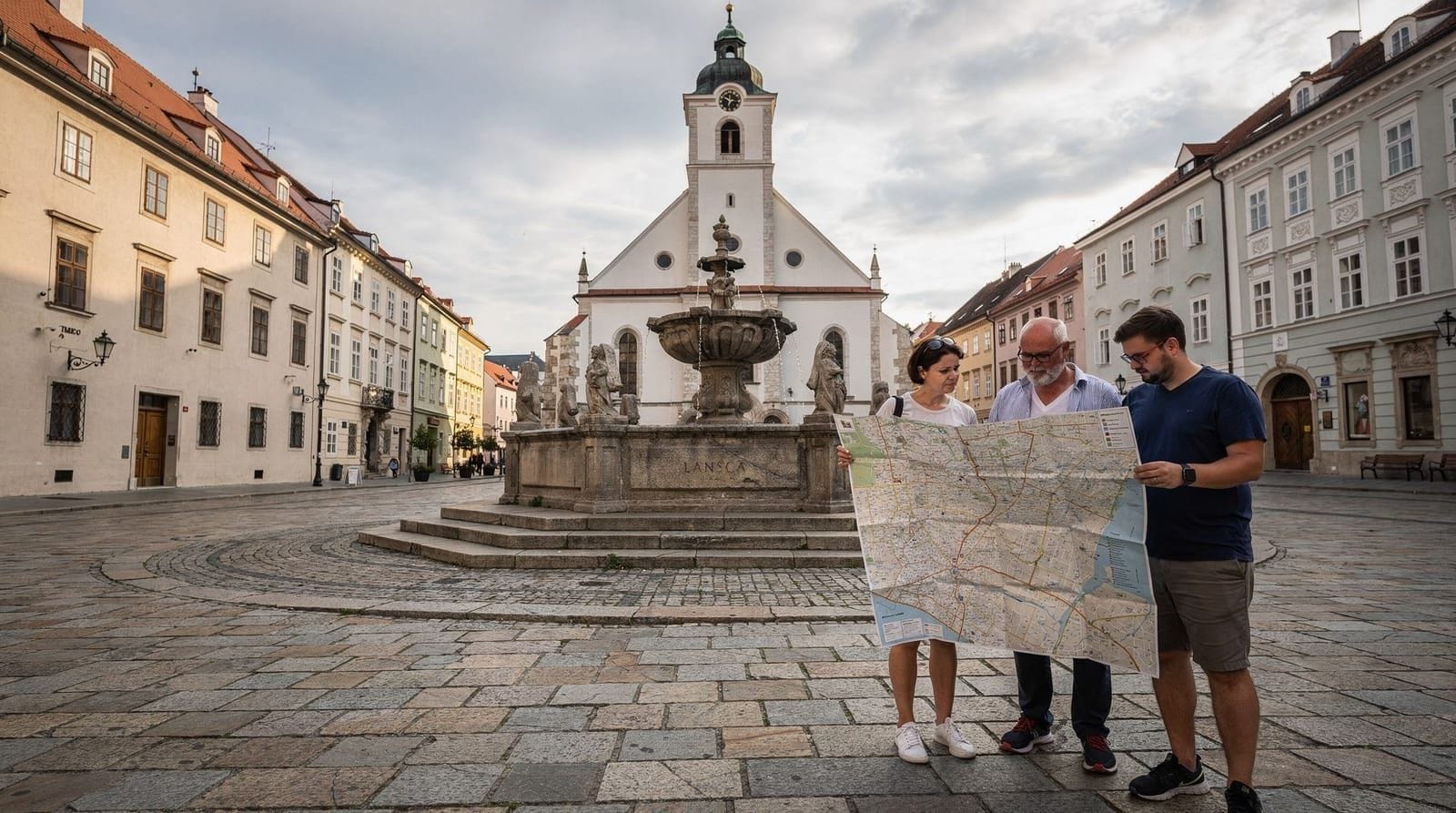
Old town self-guided walking. The entire old town is walkable for free. Hlavné námestie (the main square), Michalská brána seen from outside, the Čumil statue, Hviezdoslavovo námestie, the riverfront promenade — none of this costs anything. A self-guided morning in the old town, following the old town walking guide, costs nothing but time.
Slavín memorial. The hilltop Soviet war memorial is free, always open, and has some of the best panoramic views in the city. It is a 20-minute walk from the old town and almost always quiet. See the communist and iron curtain history guide for context.
Danube riverfront. The riverside promenade from the old town ferry landing west to the Most SNP bridge is free and pleasant. At sunset it is one of the best free experiences in the city.
Blue Church exterior. You do not need to pay to admire the exterior of the Blue Church — in fact, the exterior is the main event. The interior is open during services, also free.
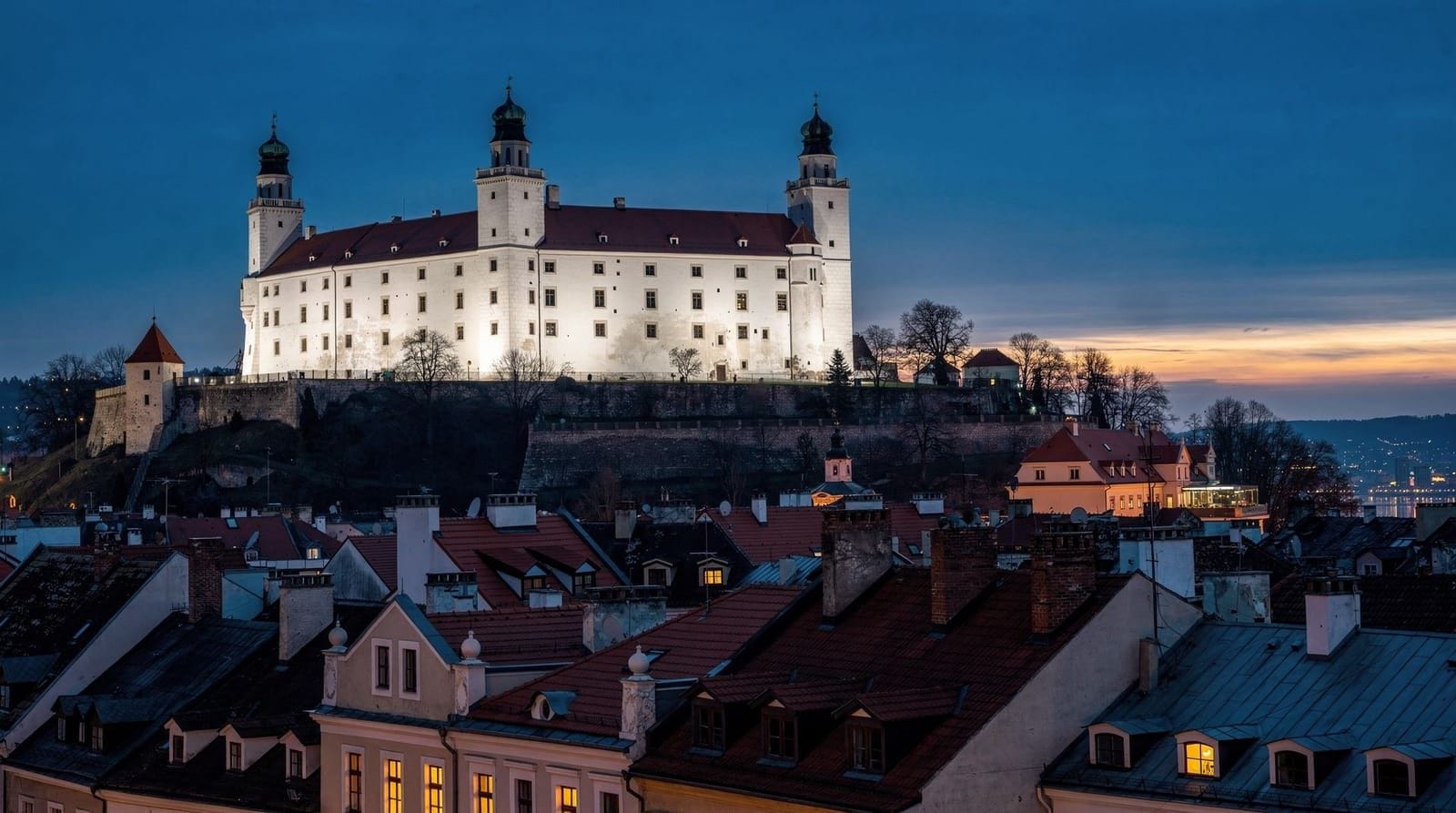
Castle grounds outer area. Walking up to the castle via the Castle Steps (Zámocké schody) and exploring the outer walls and terrace is free. Only the museum inside the castle building costs money (around 12 €). The views from the terrace are free.
Jewish Heritage quarter. The streets of the former Jewish neighbourhood below the castle, the outdoor memorial, and walking the area described in the Jewish heritage guide cost nothing. The memorial is particularly moving and completely free.
GetYourGuideBratislava classic walking tourCheck availability →Cheap eats: where locals actually eat
The gap between tourist and local food prices in Bratislava is bigger than in most Western cities.
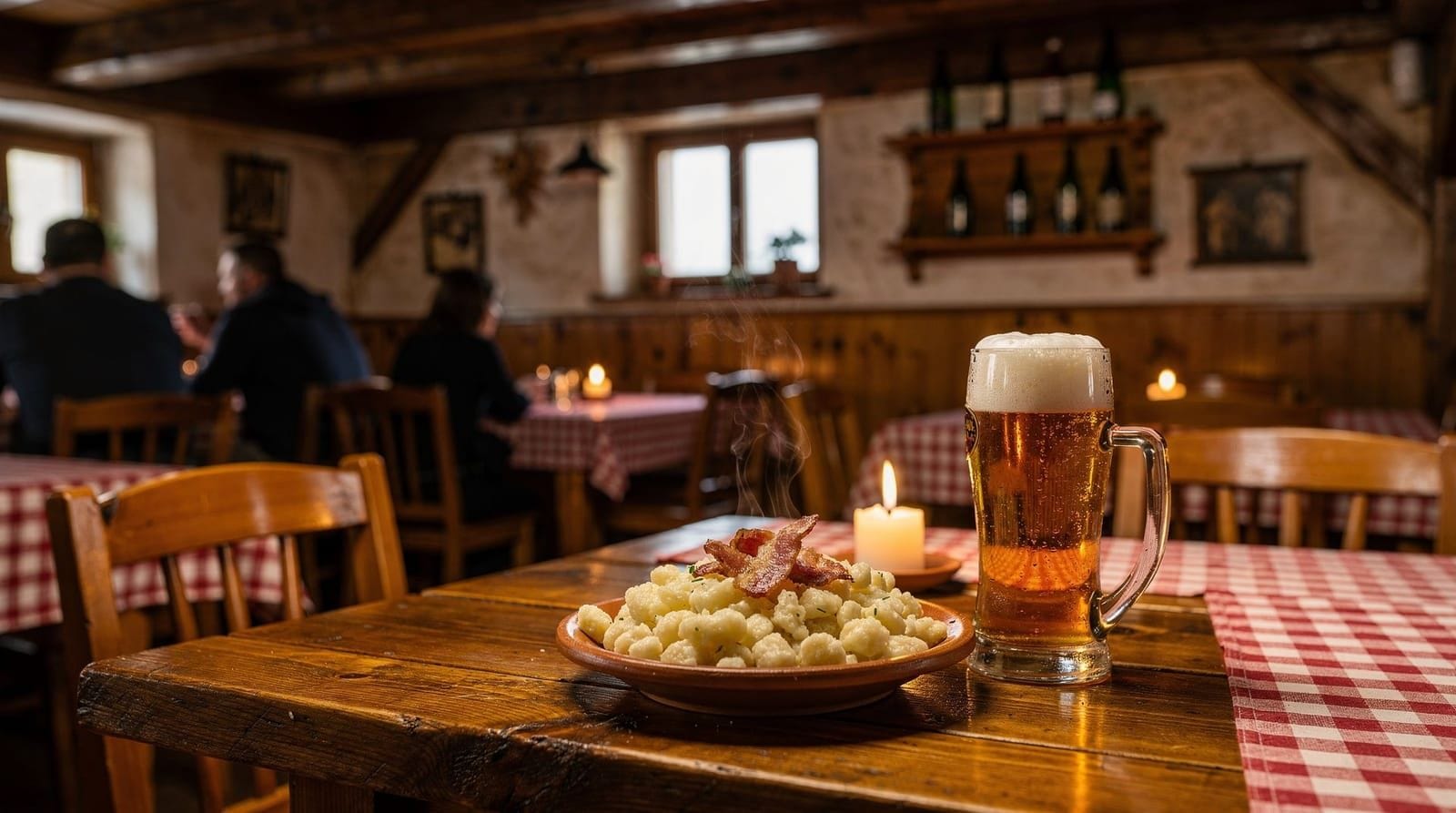
Denné menu (daily lunch special). The single best budget hack in Slovakia. Between roughly 11am and 2pm, almost every non-tourist restaurant offers a two-course lunch — soup plus a main — for somewhere between 6 and 9 €. This is real Slovak food at local prices: roast pork with dumplings, chicken schnitzel, goulash, bean soup. If you eat your main meal at lunch via the denné menu, you save significantly compared to dinner.
Look for places on and around Obchodná ulica (the main non-tourist commercial street), Štefanovičova, and the streets behind the old town walls. Avoid anything with a laminated photo menu directly on the main square — those places are fine but will consistently charge 2–3 € more per dish than equivalent food two streets away.
Krajinka. A canteen-style restaurant near the old town that serves traditional Slovak food at very reasonable prices — mains typically 8–10 €, portions generous. Popular with office workers and students. It is not atmospheric, but the food is honest and the price is right.
Supermarket lunch. Both Billa and Lidl have branches accessible from the old town. A supermarket lunch — bread, cheese, sliced meat, a pastry — costs 3–5 €. In summer this is genuinely pleasant eaten on a bench in Hviezdoslavovo námestie.
Street food on Obchodná ulica. The market stalls along and around Obchodná ulica do quick, cheap lunches — langos (fried dough with cheese and sour cream, a Slovak-Hungarian staple) for around 3–4 €, grilled sausages, pastries. Not sit-down food, but filling and fast.
Modrá Hviezda. This is a step up from budget — it is a proper restaurant with a wine list and table service — but it is worth noting that even Modrá Hviezda is not in the tourist-price bracket if you go for the denné menu at lunch. It is one of the few places where you can eat well and feel the food is actually Slovak rather than approximated for international tourists.
For a fuller picture of the local eating scene, see the best restaurants in the old town guide and the traditional Slovak food guide.
Beer: what you should pay and where
Beer prices in Bratislava vary more than you might expect.
At a local pub or sports bar away from the tourist zone, a 0.5L glass of Zlatý Bažant or Šariš (the two most common Slovak lagers) costs 2–2.50 €. This is what locals pay.
On the main square and along the tourist corridor around Michalská ulica and the castle approach, expect 3–3.50 € for the same beer. Still not expensive by European standards, but noticeably higher.
Craft beer is growing in Bratislava. You will find a few good craft bars, where 0.4L pints of local craft ales run 3.50–5 €. Still cheaper than the equivalent in Prague, and the quality has improved significantly in the last few years.
For a full rundown of the bar and pub scene, the pub and beer crawl guide covers the best spots by area and price point.
Budget accommodation strategy
The cheapest beds in Bratislava are in Petržalka, the massive Soviet-era housing estate across the Danube from the old town. It is not the most atmospheric neighbourhood, but it is not unsafe, and trams and buses cross the river quickly. A private room in a guesthouse here can go as low as 25–30 € per night in high season.
Staying slightly outside the immediate old town core — in Nové Mesto or Ružinov — is another option that saves 15–25 € per night versus an equivalent room right in the old town, with public transport still fast and reliable.
Hostels in the old town itself run 15–25 € per dorm bed in summer 2026. Worth booking early in July–August.
Free museum entry: is it possible?
The Slovak National Museum occasionally runs free entry days; the Slovak National Gallery has no standing free day, so budget for the full price there. Check the official sites before you plan around it — see the Slovak National Museum and Gallery guide for current admission. Both museums are worthwhile at normal prices (entry is 8–10 €).
Is the Bratislava City Card worth it on a budget?
The Bratislava City Card covers unlimited public transport, entry to selected museums (including the Bratislava Castle museum), and discounts on some tours and restaurants.
The 24-hour card is around 15 €. The 48-hour card is around 20 €.
For budget travellers, the honest answer is: only worth it if you are planning to use public transport frequently and visit two or more of the included attractions. If you are spending most of your time walking the free old town and eating cheap, the maths do not work out in your favour. Calculate your actual planned spend on transport and entry fees and compare.
Bratislava vs Vienna: the economics of using Bratislava as a base
One of the most underrated budget strategies in Central Europe is staying in Bratislava and day-tripping to Vienna rather than the other way around.
Vienna accommodation costs 2–3× what equivalent Bratislava accommodation costs. The train between the two cities takes about one hour from Bratislava Hlavná stanica to Wien Hauptbahnhof — a journey covered by RegioJet or the Austrian ÖBB railway, with return tickets often available for 15–20 € if booked in advance.
Staying in Bratislava for three nights and doing one day trip to Vienna saves significant money compared to three nights in Vienna and a day trip to Bratislava. The Bratislava vs Vienna comparison guide goes through this in detail.
The same logic applies to Budapest, roughly 2.5 hours by train (RegioJet or FlixBus). Day trips to Budapest from Bratislava are easy and cheap.
How to get here cheaply
From Vienna: RegioJet runs coaches between Vienna Airport and Bratislava for around 5–8 € one-way. The journey takes about 50–60 minutes depending on border traffic. This is significantly cheaper than the train if you are arriving at Vienna Airport first. See the Vienna airport to Bratislava guide.
From Budapest: RegioJet and FlixBus both run the Bratislava–Budapest route for 5–15 € depending on how far in advance you book. Journey time is about 2.5 hours. The Budapest day trip guide covers the route in both directions.
From Prague: RegioJet trains and buses run directly. The train takes about 4 hours. Prices vary but often around 10–20 € booked in advance.
Arriving at Bratislava Airport (BTS): A small airport with limited direct connections but useful for certain European routes. The Bratislava Airport guide covers onward transport into the city.
Once in the city, getting around Bratislava on public transport is cheap — a single journey costs under 1 € and the public transport guide explains the ticket system clearly.
The budget traveller’s one mistake to avoid
The main budget mistake in Bratislava is eating every meal within 200 metres of the main square. The food is fine, the setting is nice, but the prices are 30–50% higher than comparable food two streets away. One proper meal per day in a local place via the denné menu system, combined with a supermarket lunch or street food, is the single most effective budget lever in the city.
The first-timer mistakes guide covers this and other common errors.
Frequently asked questions about Bratislava budget travel
How much money do I need per day in Bratislava?
A realistic comfortable daily budget is around 50 € per day, covering a private room in a mid-range guesthouse, one sit-down lunch via the denné menu (6–9 €), a coffee, afternoon snack, and one paid attraction entry. You can push this down to 30 € per day with a hostel dorm and supermarket/street food meals, but that requires eating away from the tourist zone consistently.
Is Bratislava cheaper than Prague or Budapest?
Generally yes, especially for accommodation and food outside the tourist zone. Prague in particular has seen significant price increases in recent years. Bratislava remains noticeably cheaper for equivalent accommodation and local restaurant meals, though the tourist-facing prices in the old town have converged somewhat.
What is the denné menu and how do I find it?
The denné menu (daily lunch special) is a two-course lunch — typically soup plus a main — offered by most Slovak restaurants between 11am and 2pm at a fixed price, usually 6–9 €. Look for a board outside the restaurant listing the day’s options (it changes daily). The easiest places to find these are on Obchodná ulica and the surrounding streets, away from the main tourist square.
Is the Bratislava City Card worth buying?
Only if you plan to use public transport frequently and visit two or more of the included attractions (castle museum, city museum, etc.). For a one-day visit mostly in the walkable old town, the maths usually do not favour the card. For two days with planned trips on trams and buses and museum visits, it can break even or save a few euros.
Can I do a day trip to Vienna cheaply from Bratislava?
Yes. The RegioJet coach from Bratislava to Vienna runs for roughly 5–10 € each way, and the journey takes about an hour. The train (ÖBB or RegioJet rail) takes a similar time and can be similarly priced if booked in advance. Once in Vienna, the major attractions are not cheap (many museums charge 15–20 € entry), but the journey itself is very affordable. The Vienna day trip guide covers options and logistics.
Is Bratislava a good base for cheap day trips generally?
Yes — this is arguably the single best budget lever in the region. Beyond Vienna, Devín Castle is a 20-minute, roughly 2 € bus ride away with 7 € entry, and the Small Carpathians wine villages are reachable for a few euros by bus. The day trips ranked guide breaks down cost and time for seven options, and the Small Carpathians wine region page covers the closest countryside escape.
Seasonal budget swings worth planning around
Prices in Bratislava are not flat across the year, and knowing the pattern helps you time a trip.
| Season | Accommodation | Crowds | Notes |
|---|---|---|---|
| Winter (Nov–Feb) | Lowest, except Christmas market weeks | Low, except market weekends | Cheapest overall, but check the Bratislava in winter guide for what’s actually open |
| Spring (Mar–May) | Moderate | Low–moderate | Good value, mild weather |
| Summer (Jun–Aug) | Highest, especially July–August | High | Book hostels early; see the budget guide for neighbourhood pricing |
| Autumn (Sep–Oct) | Moderate, dips after wine harvest peak | Moderate | Wine harvest season adds some demand around St Martin’s wine harvest |
If flexible, shoulder season (April–May or September–October) tends to give the best ratio of low prices to pleasant weather — see the best time to visit guide for a fuller month-by-month picture.
Culture & heritage tours
Verified deep-linked GetYourGuide tours. Book through these links and we earn a small commission at no cost to you.