Danube capitals in 5 days: Vienna, Bratislava, and Budapest
Three capitals along one river
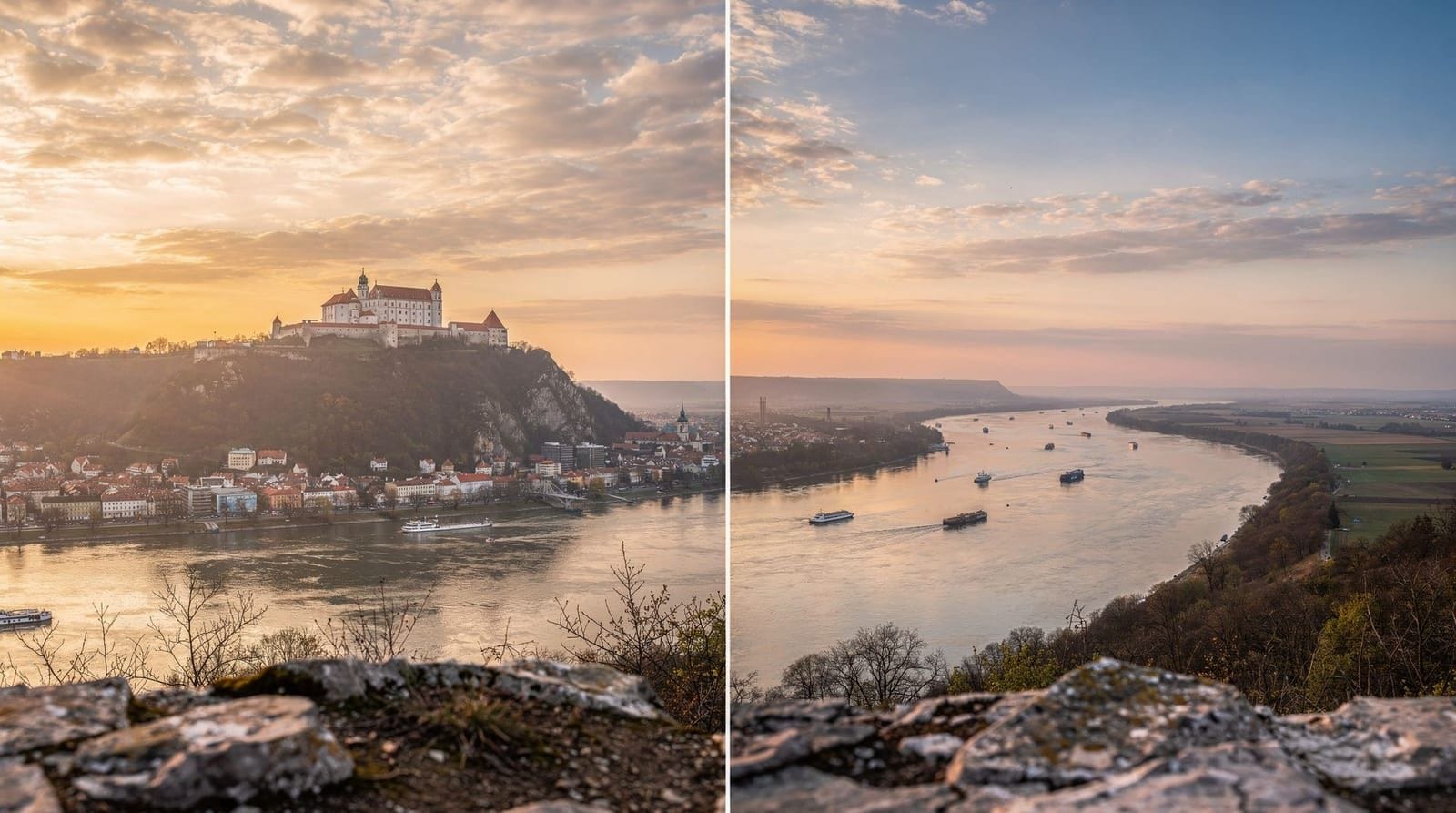
The Danube has connected Vienna, Bratislava, and Budapest for centuries — as imperial capitals, as Cold War frontiers, and now as three of Central Europe’s most compelling travel destinations. They sit within 200 km of each other, linked by fast trains and in summer by river boats. Together they form one of the great multi-city itineraries on the continent: baroque grandeur in Vienna, compact charm in Bratislava, and the grand romantic sweep of Budapest.
Five days is the right duration — enough to get beyond the surface of each city, not so long that the logistics become exhausting. This itinerary runs Vienna → Bratislava → Budapest; it works equally well in reverse, or with Budapest as the arrival point. Daily budget: 60–90 € per person for activities and meals, excluding accommodation (hotels range from 50–150 € per night in each city).
| At a glance | |
|---|---|
| Where | Vienna (Austria) → Bratislava (Slovakia) → Budapest (Hungary), roughly 200 km end to end |
| Cost | Around 570–735 € per person for 5 days, excluding international flights (see full breakdown below) |
| Time needed | 5 days is comfortable; can be trimmed to 3 by dropping Budapest (see 3-day combo) |
| Getting there | Railjet trains link all three cities; the Twin City Liner covers Vienna–Bratislava by river in summer |
| Best time | Late spring or early autumn — warm enough for the Naschmarkt and riverside walks, cool enough for a day of walking in each city |
Day 1: Arrive Vienna — the imperial opening
Afternoon and evening: first impressions (14:00–22:00)
Most intercontinental flights into Vienna Airport (VIE) land midday or early afternoon. The City Airport Train (CAT) takes 16 minutes to Wien Mitte and costs 14 € one-way. From Wien Mitte, take the U4 to your hotel in the 1st or 4th district.
Vienna rewards a gentle first afternoon. Walk the Ringstrasse — the grand 19th-century boulevard encircling the Innere Stadt — and let the Opera House, the Kunsthistorisches Museum, and the Rathaus make their impression without entering anything. The Volkspark or the Burggarten offer a bench and a coffee stop for 4–5 €.
Dinner in a Viennese Beisl (traditional tavern): Wiener Schnitzel (veal, not pork) costs 18–24 € at a proper establishment. A glass of Veltlíner or Riesling from Lower Austria accompanies it perfectly. The 1st district is full of options — Gastwirtschaft Pöschl and Zum Wohl are reliable choices.
Standing tickets at the Staatsoper for an evening performance cost 3–5 € and go on sale 80 minutes before curtain. If nothing is playing, the Musikverein or one of the smaller concert halls usually has something.
Day 2: Vienna in full — palaces, markets, and museums
Morning: Schönbrunn Palace and gardens (9:00–12:00)
Take U4 to Schönbrunn station. The Great Rooms tour (22 €) covers 40 of the palace’s 1,441 rooms in about 50 minutes, ending with the remarkable view back over the formal gardens toward the Gloriette. The gardens (free) deserve another 30–45 minutes — the geometric parterres, the Neptune fountain, and the obelisk path are at their best in morning light.
Midday: Naschmarkt and lunch (12:00–14:00)
Walk or take U4 to Kettenbrückengasse for the Naschmarkt, Vienna’s famous open-air market along the Linke Wienzeile. A Turkish börek, a wedge of local cheese, and a coffee from one of the stalls makes an excellent lunch for 6–10 €. The Naschmarkt gets crowded on Saturday mornings when a flea market extends its western end.
GetYourGuideBratislava: Devín Castle, Carnuntum & Vienna day tripCheck availability →Afternoon: Kunsthistorisches Museum or Belvedere (14:00–17:30)
Choose one of Vienna’s major art museums:
- Kunsthistorisches Museum (21 €): one of the world’s finest collections of Old Masters, including Bruegel’s complete cycle of seasons, Vermeer, and the largest collection of Rubens outside the Prado.
- Upper Belvedere (19 €): Klimt’s “The Kiss” is here, along with a strong collection of Austrian art from 1850–1950 and ornate baroque gardens.
Either requires 1.5–2 hours. Book tickets online to avoid the often long queues.
Evening: wine bar and dinner (18:00–22:00)
Vienna has a thriving Heurigen (wine tavern) tradition — these outdoor taverns in the wine-growing suburbs (Grinzing, Heiligenstadt, Neustift am Walde) serve local wines and cold platters. A taxi or U-Bahn plus a short bus ride gets you there; a full evening with food and wine costs 20–30 € per person. Alternatively, stay in the centre and explore the bar scene around the Bermuda Triangle (Rabensteig and Seitenstettengasse).
Day 3: Vienna → Bratislava by train or river
Morning: check out and travel (9:30–11:30)
Check out of your Vienna hotel and take the Railjet train from Wien Hauptbahnhof to Bratislava Hlavná stanica — roughly 1 hour, from 10 € one-way. Trains depart about every 2 hours. Alternatively, in the summer season, the Twin City Liner river boat departs from Schwedenplatz (Vienna city centre) and arrives at Bratislava’s passenger port in about 1 hour 40 minutes.
See the Twin City Liner guide and the Danube cruise overview for the river option. The Vienna to Bratislava guide covers both options in detail.
Midday: old town orientation and lunch (11:30–14:00)
Arrive in Bratislava and check in. Walk 15 minutes from the station to the old town. Lunch at Slovak Pub on Obchodná — bryndzové halušky (potato dumplings with sheep’s cheese) for 8–12 € is the essential introduction to Slovak cuisine. See the traditional Slovak food guide for what else to order.
GetYourGuideFrom Vienna: Bratislava day trip like a localCheck availability →Afternoon: Bratislava Castle, UFO deck, old town (14:00–18:00)
The afternoon in Bratislava follows the essential sequence: climb to Bratislava Castle via Zámocká lane (12 minutes uphill), spend 45–60 minutes on the terrace and in the museum (10 €), then cross SNP Bridge to the UFO observation deck (14 €; book online) for 30 minutes of 360° views. Descend and spend an hour wandering the old town lanes — Michalská brána, St Martin’s Cathedral, and the satirical bronze statues that children and adults both inevitably photograph.
Evening: craft beer in Bratislava (19:00–22:00)
Bratislava’s old town is noticeably more relaxed and cheaper than Vienna’s evening scene. Dinner at a restaurant on Ventúrska or Laurinská costs 12–16 € for mains; craft beer at 2.50–3.50 € a glass makes the evening comfortable for any budget. The Bratislava nightlife guide covers the bar options in detail. See also best bars in the old town for specific recommendations.
Day 4: Bratislava → Budapest
Morning: Devín optional, then train east (9:00–14:00)
If your train to Budapest departs in the afternoon, squeeze in a quick visit to Devín Castle: bus 29 from Nový most, 20 minutes each way, entry 7 €. Allow 1.5 hours at the site and return by 11:30.
GetYourGuideDay trips from Vienna: Bratislava and Budapest with guideCheck availability →The Bratislava–Budapest Railjet takes about 2.5 hours and departs from Bratislava Hlavná stanica. Tickets from 15 € one-way. Aim for a departure between 12:00 and 14:00 to arrive in Budapest by mid-afternoon. Alternatively, check the Danube cruise to Vienna page for seasonal river connections that extend to Budapest.
Afternoon and evening: Budapest first impressions (16:00–22:00)
Arrive at Budapest Keleti station and take the M2 metro two stops to Blaha Lujza tér, or walk 20 minutes to the centre. Check into your hotel.
The Hungarian capital announces itself immediately: the scale is larger, the architecture more monumental, the Danube wider. Walk to the Chain Bridge (Széchenyi lánchíd) as your orientation point — it connects Pest on the east bank to Buda on the west and the view of the parliament building from the bridge is among the most famous in Central Europe.
Dinner on the Pest side: goulash soup (gulyásleves) to start (3–5 €), then a main of pörkölt (braised beef in paprika sauce) for 10–14 €. A glass of Egri Bikavér (Bull’s Blood of Eger) costs 3–5 €. The Budapest day trip guide covers the essential context for your time in the city.
Day 5: Budapest — Buda Castle, baths, and ruin bars
Morning: Buda Castle and Fisherman’s Bastion (9:00–12:30)
Cross the Chain Bridge and take the funicular (5 €) or walk the steep path up to the Buda Castle district. Buda Castle itself houses the Hungarian National Gallery (entry around 8 €) and the Budapest History Museum. Above it, the Fisherman’s Bastion — a neo-Romanesque terrace with turrets — offers the classic postcard view of the Parliament across the Danube. Free to enter outside peak hours (a small fee applies 9:00–19:00 in summer).
GetYourGuideFrom Budapest: Bratislava day tripCheck availability →The Matthias Church next to the Bastion is worth 20 minutes inside — the interior decoration is an astonishing mix of Hungarian folk patterns and neo-Gothic architecture. Entry around 6 €.
Midday: Széchenyi Thermal Baths (12:30–15:30)
The Széchenyi Baths in City Park are the most famous of Budapest’s many thermal bathing complexes. The neo-baroque building houses indoor and outdoor pools fed by geothermal springs at 36–38°C. Entry costs around 28–32 € for the basic ticket; book online to guarantee access on busy days. Plan 2–2.5 hours here — a post-lunch thermal soak is one of the great Central European pleasures.
GetYourGuideFrom Vienna: Bratislava & Budapest day tour with photographerCheck availability →Afternoon and evening: the Great Market Hall and ruin bars (16:00–late)
The Nagy Vásárcsarnok (Great Market Hall) near Szabadság Bridge is a spectacular Victorian iron structure housing food stalls on the ground floor and folk crafts above. Buy lángos (deep-fried dough with sour cream and cheese, 3–4 €) and browse the paprika and salami stalls.
Budapest’s ruin bars (romkocsma) are a cultural institution — bars built into the shell of derelict buildings in the Jewish Quarter, with layers of mismatched furniture, graffiti, and a chaotic interior design that manages to feel both authentic and deliberately eccentric. Szimpla Kert, the original, is on Kazinczy street; a beer here costs 3–4 € and the atmosphere is unlike anything in Vienna or Bratislava.
Farewell dinner at one of the riverside restaurants: 15–22 € for mains. The view of the Parliament lit up across the Danube makes for the kind of final image that sticks.
Logistics and practical information
Booking trains in advance: Railjet trains between Vienna, Bratislava, and Budapest can be bought at Austrian Federal Railways (OBB) or directly at the station. Book at least a few days ahead for weekend travel in summer, when demand is high.
Currency: Austria and Slovakia use the euro (EUR). Hungary uses the forint (HUF). At mid-2026, 1 € equals roughly 380–400 HUF. Cards are widely accepted in Budapest’s tourist areas, but carry some cash for smaller restaurants and market stalls.
Accommodation: Vienna is the most expensive (mid-range hotel 100–150 € per night). Bratislava is significantly cheaper (60–100 €). Budapest sits between the two (70–110 €). Budget travellers can find excellent hostels in all three cities from 20–30 € per bed.
Luggage storage: All three main train stations have left-luggage lockers or storage services — useful on checkout days when you’re still exploring.
Day-by-day summary
| Day | City | Focus |
|---|---|---|
| 1 | Vienna | Arrival, Ringstrasse walk, Beisl dinner, cheap standing-room opera |
| 2 | Vienna | Schönbrunn, Naschmarkt, a major museum, Heurigen evening |
| 3 | Vienna → Bratislava | Train or river crossing, old town orientation, Bratislava Castle and UFO deck |
| 4 | Bratislava → Budapest | Optional Devín Castle morning, afternoon train, first Budapest impressions |
| 5 | Budapest | Buda Castle district, Széchenyi Baths, Great Market Hall, ruin bars |
Making the most of the Bratislava stop
Because Bratislava only gets one full day in this itinerary, it’s worth being deliberate about what to skip. The old town core — Michael’s Gate, the castle, St Martin’s Cathedral — can genuinely be covered on foot in an afternoon, which is the pace this itinerary assumes.
If you find yourself wanting more, the Bratislava in one day guide has a tighter, more complete single-day plan that could replace Day 3’s afternoon if trains allow a slightly earlier arrival. Travellers who fall for the city sometimes wish they’d budgeted a second night — worth knowing before you book onward tickets, since Bratislava hotel prices are the cheapest of the three cities on this route.
If your dates land in September or October, consider swapping the Devín morning on Day 4 for a half-day out to the Small Carpathians wine region instead — it’s a similar time commitment and gives Bratislava a genuinely distinct flavour from Vienna and Budapest’s museum-heavy days. The dedicated small carpathians wine weekend itinerary shows how that day could be structured if you decide to linger.
Frequently asked questions about the Danube capitals trip
What is the best order — Vienna first or Budapest first?
Vienna first works well if you’re flying into VIE (the busiest airport of the three) or arriving from Western Europe. Budapest first suits travellers arriving from Eastern Europe or wanting to save the most impressive capital for last. Bratislava is always in the middle — it makes no sense as a first or last stop, but it’s essential as a link.
How much does the entire 5-day trip cost?
Rough budget per person: 3 nights accommodation at 90 € average = 270 €. Train tickets (VIE → Bratislava + Bratislava → Budapest) = 25–40 €. Activities = roughly 30–50 € per day × 5 = 150–250 €. Meals at 25–35 € per day × 5 = 125–175 €. Total: approximately 570–735 € per person, excluding international flights.
Can I do this trip without booking anything in advance?
The trains can be bought at the station, but prices are lower and seats guaranteed if booked ahead. The Széchenyi Baths in Budapest genuinely benefit from advance booking in summer — the online queue saves real time. Everything else on this itinerary is walk-in.
Is English spoken in all three cities?
English is excellent in all three cities’ tourist areas. Vienna and Bratislava have strong German as a secondary language. Budapest locals often speak German or Russian as their second language; English is common among younger people and in the hospitality industry.
What if I only have 3 days instead of 5?
Use the Bratislava–Vienna 3-day combo itinerary and skip Budapest for this trip — save it for a dedicated visit. Budapest alone deserves at least 3 days and feels rushed as a half-day add-on. The Bratislava vs Prague and Budapest comparison helps weigh the options.
Can I do the trip by river instead of train?
In summer, yes — partially. The Twin City Liner operates between Vienna and Bratislava (see Twin City Liner guide). Some seasonal river cruises connect Bratislava and Budapest. But a full river-only journey between all three cities typically takes 1–2 days per leg and is better suited to dedicated river cruise ships. The train is faster and more flexible for independent travellers.
tours.vienna
Verified deep-linked GetYourGuide tours. Book through these links and we earn a small commission at no cost to you.