Železná studienka: Bratislava's favourite forest escape
What is Železná studienka?
Železná studienka is a forested valley park 8 km northwest of Bratislava's centre, popular for jogging, walking, and picnics. It is free to enter and reached by bus or bike in under 30 minutes.
At a glance
| Where | 8 km northwest of the Old Town, at the foot of the Small Carpathians |
| Cost | free — no entrance fee, no gate |
| Time needed | 1–2 hours for the valley floor; half a day with the Kamzík climb |
| Getting there | bus 83 from Hodžovo námestie, around 20–25 minutes |
| Best time | May (wild garlic) or October (leaf colour); summer for shade on hot days |
Most European capitals make you work to reach a forest. Bratislava is different. Železná studienka sits 8 km northwest of the Old Town, inside a beech-forested valley in the foothills of the Small Carpathians, and you can be standing under a full tree canopy within 25 minutes of leaving Hlavné námestie without a car, without a tour, and without paying an entrance fee. That combination — genuine, mature woodland this close to a city centre, free, flat enough for a pushchair on the main paths but connected to serious hiking trails higher up — is rare enough that Bratislavans guard the place with genuine affection.
Locals jog here before work, families pack Saturday lunches for the picnic benches, mushroom-pickers disappear into the trees in September, and trail runners carve routes up to Kamzík hill in every season. If you are spending more than a day or two in Bratislava and you want to understand how the city actually lives rather than just what it looks like, Železná studienka is where you come.
Why this valley matters to the city
Bratislava’s compact geography is one of its great assets for visitors, but it also means the city sits directly against the southern edge of the Small Carpathians — a forested ridge that begins almost at the city limits and stretches north into the wider Carpathian arc. The Koliba district and the Kamzík area above it form the urban-forest interface, and Železná studienka valley is the most accessible entry point into that landscape for the majority of the population who live in Nové Mesto, Ružinov, or the Old Town itself.
There is no gate, no ticket office, no official opening hour, and no charge. The valley is public land managed as part of Bratislava’s green infrastructure. The city’s relationship with it is informal and genuinely democratic: you will see pensioners with walking poles next to ultrarunners in technical kit next to teenagers sitting on logs next to families with three children and a labrador. The mix is part of what makes it appealing.
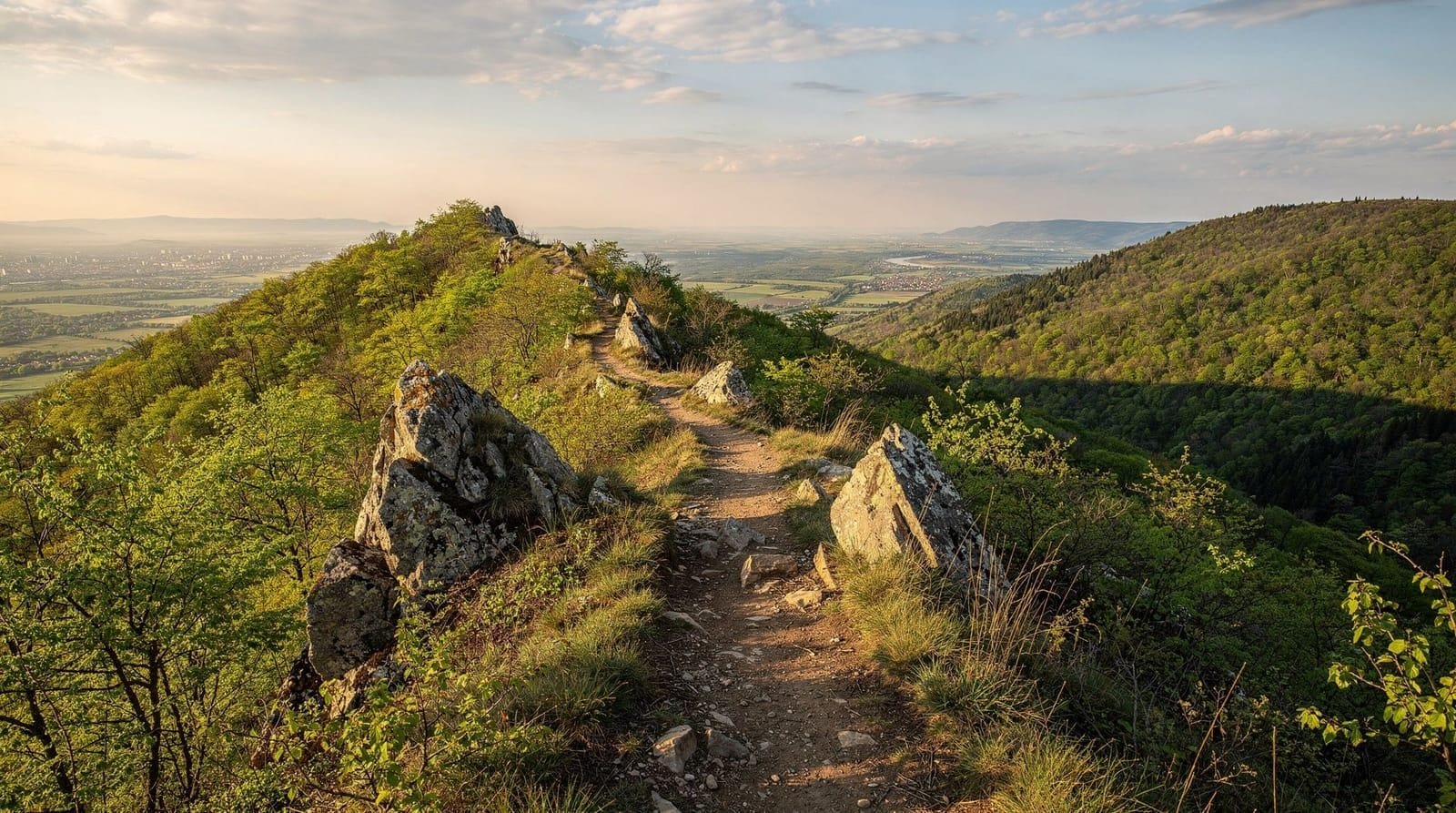
The Kamzík hill at the top of the valley reaches 439 metres, which gives a sense of what kind of terrain you are entering. The valley floor from the bus stop is flat for the first kilometre or so before the gradient increases steadily. You do not need to climb to Kamzík to enjoy the park — the valley itself on a warm May morning is already sufficient — but the option to extend upward into the forest and arrive at panoramic views over Bratislava is what turns a stroll into an excursion.
The name and the spring
The name Železná studienka translates directly as “iron spring” or, more literally, “iron little well.” Železná comes from the Slovak word for iron; studienka is a diminutive of studňa, a well or spring. Both halves of the name point to the same thing: a mineral spring naturally high in iron content that rises in the valley and has been known to local people since at least the medieval period.
The spring water is safe to drink. It looks clear but carries a faint rust-orange tinge where it has been sitting against stone, and the taste is distinctively mineral — slightly metallic, slightly earthy, not unpleasant once you expect it. Local Bratislavans treat it as a health-giving curiosity: you will regularly see people arrive with empty plastic bottles specifically to fill from the spring and take home. If you have never tasted naturally iron-rich mineral water, it is worth trying. The spring structure itself is simple — essentially a small covered fountain set into the hillside — and easy to find near the valley entrance.
Iron springs were valued across Central Europe for centuries, and Bratislava’s proximity to the Hungarian and Austrian aristocracy meant that mineral waters of all kinds acquired social and medical prestige during the Baroque and Biedermeier periods. Železná studienka was probably used by bourgeois Pressburgers (the German name for Bratislava) long before the city grew to surround it on three sides. That historical depth sits quietly behind what is now a weekend picnic destination.
How to get there
By bus — the easiest option: Bus 83 departs from Hodžovo námestie, a square near the Old Town that sits just a few minutes’ walk from the Presidential Palace and the Grassalkovich Palace gardens. The stop is clearly signposted. The bus runs regularly throughout the day and takes around 20 to 25 minutes to reach the Železná studienka stop, which is at the valley entrance.
Validate your ticket as you board — Bratislava’s public transport requires validation and inspectors do check. A single ticket costs under €1.50 and covers the full journey. The public transport guide covers tickets and apps in detail. Bus 83 operates in both directions, so the return is straightforward: wait at the same stop on the opposite side of the road.
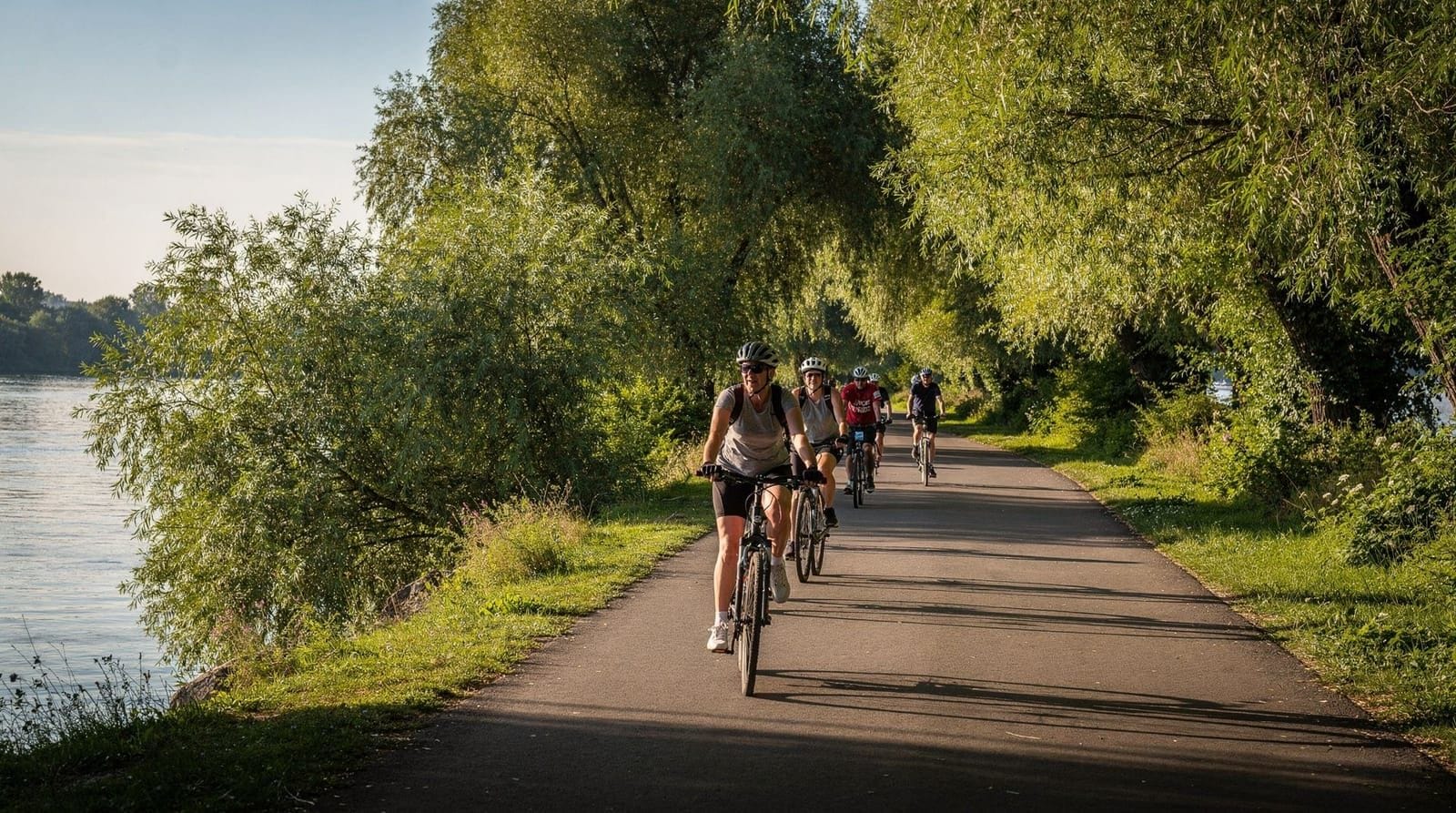
By bicycle: Cycling from the Old Town to Železná studienka takes 30 to 40 minutes depending on your pace and route. The most direct route goes north through Kramáre and then up through the Koliba district on roads that carry relatively light traffic. Some sections include dedicated cycling infrastructure; others are shared road. The climb through Koliba is moderate — manageable for a reasonably fit cyclist but not flat. The Danube riverside cycling guide covers Bratislava cycling generally, including where to rent bikes in the centre.
By car: If you are travelling with young children or heavy picnic equipment, driving is practical. There is a small car park near the valley entrance, but it fills quickly on warm weekend mornings — arrive before 10:00 to be confident of a space. Parking is free. On busy summer Saturdays, expect to park 500 metres away and walk.
By taxi or rideshare: A taxi or rideshare app (Bolt and Uber both operate in Bratislava) from the Old Town costs roughly €8 to €12 depending on time of day. For a group of three or four, this is competitive with the bus and considerably faster.
GetYourGuideBratislava riverside, castle or complete city segway tourCheck availability →What you find at the valley entrance
The entrance area is modest but functional. There are information boards with trail maps (photograph them with your phone as a backup), several sets of picnic benches under the trees, a children’s playground with basic equipment well suited to ages 2 to 8, and public toilets. A seasonal refreshment kiosk operates from late spring through early autumn — usually selling coffee, soft drinks, ice cream, and simple snacks — but do not depend on it being open outside those months or early in the morning. The valley entrance has a slightly festive atmosphere on sunny weekends: there is often a background murmur of Slovak families setting up for the day, dogs being unleashed for the first time, and children charging toward the playground.
The spring is located a short walk from the entrance, signposted and easy to find. Even if you have no interest in the mineral water itself, it makes a natural first landmark to orient yourself.
Trail options and what to expect
The valley floor route: The main path running up the valley from the entrance is surfaced and suitable for pushchairs, cycling, and anyone who wants a level walk. The path follows a small stream through beech and hornbeam forest. This is the route most families with young children take and remains pleasant for 2 to 3 kilometres before the terrain begins to steepen noticeably. You can turn around at any point; the view changes gradually rather than dramatically, and the chief reward is the forest itself — the quality of light through beech canopy in summer, the sound of the stream, the particular silence of a working-day morning when you have the path largely to yourself.
The Kamzík hill ascent: The blue-marked trail from Železná studienka climbs to the summit of Kamzík hill at 439 metres. The ascent covers about 3 kilometres with roughly 220 metres of elevation gain, taking a moderately fit walker 60 to 90 minutes to reach the top. The path moves through dense beech forest for most of the climb and is well-maintained, though roots and rocks make it unsuitable for wheeled buggies once you leave the valley floor. The gradient is steady rather than severe — it is not a technical scramble, just a proper forest climb.
At the summit, the forest opens suddenly to reveal the TV tower and the Kamzík rotating restaurant. The restaurant occupies the lower part of the tower structure and rotates slowly, giving a complete 360-degree view over Bratislava, the Danube plain, and on clear days, the Austrian Alps and the Hungarian lowlands. The views are genuinely exceptional. The restaurant serves Slovak cuisine and standard European dishes; it is popular enough that booking ahead is strongly advised on weekends. Even if you do not eat there, the exterior viewing area and the sense of arrival at the top are their own reward.
The TV tower itself is not open for public ascent beyond the restaurant floor. There is also a chairlift (lanovka) that connects the Koliba area to near the summit and operates seasonally — check current operating hours before depending on it for your descent, as it does not run year-round or in all weather conditions.
Connecting to the Small Carpathians ridge: From Kamzík, the red-marked trail joins the main Small Carpathians ridge route, which can take walkers north toward Pezinok or south toward the city’s edge over several hours. This is the entry point for serious hiking in the broader range. The Small Carpathians hiking guide covers these longer routes in detail. If you plan to return to Bratislava rather than continue to a village with a bus connection, the simplest option is to descend back via Železná studienka; if you want to continue, plan your exit point before you start.
GetYourGuideBratislava riverside, castle or complete e-scooter tourCheck availability →Seasonal character and what to expect each time of year
Spring (March to May): This is one of the loveliest times to come but also the muddiest. Snowmelt from the Carpathians drains through the valley paths and turns them soft in places until April. The compensation is wildflower season: wild anemones appear first, followed by carpets of wild garlic (medvedí cesnak in Slovak — “bear’s garlic”) in April and early May that turn the forest floor white and fill the air with a gentle onion scent. By late May the beech canopy is fully out and the forest feels complete. Crowds are light in March and April; May weekends begin to fill.
Summer (June to August): Peak season. The beech canopy makes Železná studienka meaningfully cooler than the city below on hot days — sometimes by 5 to 8 degrees Celsius — and this is the main reason families and cyclists make the effort on 30-degree afternoons. Weekend mornings fill early; the picnic benches are often taken by 11:00. Joggers and trail runners are present at all hours. The kiosk is reliably open. This is the best time for families with small children and for anyone combining the park with the Kamzík restaurant.
Autumn (September to November): The season that locals describe most fondly. September and October bring mushroom-picking season, and Bratislavans take this seriously — walk quietly through the forest on a Saturday morning and you will see people methodically checking beneath the leaves with a focused expression that suggests years of practice. Bring a basket if you know what you are looking for; do not pick anything you cannot positively identify. The leaf colour peaks in mid-October, when the beeches turn from yellow through copper to deep orange. The air is sharp and the light low and golden. Crowd levels drop but dedicated walkers remain throughout. November brings the first frost and the last of the colour.
Winter (December to February): Quiet and often beautiful. When snowfall is sufficient, the valley and Kamzík hill become a cross-country skiing and snowshoeing destination — not formally groomed, but the terrain suits it. The chairlift to Kamzík may or may not operate; check. The Kamzík restaurant is open year-round. On a cold clear day, the views from the summit are exceptionally sharp. The valley itself is largely empty on weekdays and carries a contemplative quality that the summer crowds never quite allow.
Bratislava’s running community and Železná studienka
The park is the heart of Bratislava’s outdoor running scene. Trail running groups use it regularly for weekend long runs, the dirt and compacted-gravel paths provide a softer surface than city pavements, and the elevation profile — flat valley approach, steeper climb, optional ridge extension — allows runners to calibrate effort precisely. Parkrun operates on a regular schedule in the Bratislava area, with routes that use sections of the forest. If you are a runner visiting the city, the park is worth adding to your itinerary not just for the exercise but for the atmosphere: running with a view of beech forest rather than car traffic has a specific quality that is hard to replicate.
Dog-friendly character
Železná studienka is among the most dog-friendly public spaces in Bratislava. Dogs may run off-lead in the forest sections away from the main path, subject to local signage. The park is enormously popular with dog walkers of all breeds and sizes — bring bags, fill from the stream if your dog is thirsty, and expect to share the path generously with others. The parking area and picnic zone near the entrance have lead requirements; once in the forest proper, enforcement is informal and the culture is relaxed.
Kuchajda lake as a complementary stop
If you are spending a full day on this side of the city, the Kuchajda artificial lake in Nové Mesto is a natural complement to Železná studienka. Kuchajda is 10 to 15 minutes away by bus, sits in a flatter urban setting, and has a very different character — open water for swimming in summer, paddleboat rental, a lakeside café, and a playground that is particularly well-suited to younger children. The combination of forest valley in the morning and open lakeside in the afternoon makes for a varied and entirely Bratislava-specific day without needing a car.
Food and refreshments
The seasonal kiosk at the valley entrance covers coffee and light snacks from late spring onwards. For a proper meal, the Kamzík rotating restaurant at the summit is the main option within the park, serving Slovak and Central European dishes with views — book ahead for weekend lunch. The Koliba district nearby (a neighbourhood whose very name derives from a type of pastoral mountain shelter) has a handful of traditional Slovak restaurants and guesthouses serving hearty food; it is worth exploring if you descend via a different route.
The picnic culture in the park is well-established and entirely accepted. There are no prohibitions on bringing your own food, and the picnic benches at the entrance are specifically there for this purpose. A cold Slovak beer (widely available in supermarkets along the bus route back toward the centre), some cured meats and bread, and a bench in the shade is arguably the most authentically local way to spend a Bratislava afternoon.
Practical tips before you go
Wear proper walking shoes even if you plan to stay on the valley floor path — roots break through the surface in places and can be slippery after rain. Bring a water bottle: the iron spring water is drinkable and filling from it is part of the experience, but the kiosk is seasonal. The information boards at the entrance display trail maps in Slovak; the Mapy.cz app (available free for iOS and Android) covers the entire Small Carpathians in detail with marked trails, and works offline — download the relevant region before you arrive. Mobile signal is adequate for internet use in the lower valley but can be patchy higher on the ridge.
The park has no lighting. If you plan an evening walk in autumn or winter, bring a torch.
Combining Železná studienka with a fuller day
A morning in Železná studienka pairs naturally with a walk through the Small Carpathians or a detour to Pezinok and Modra for wine tasting in the afternoon, particularly in autumn. If you are staying in the Old Town and want a complete Bratislava day without leaving the city, combine the forest in the morning with lunch at Kamzík, an afternoon descent, and an evening meal in the centre. The getting around Bratislava guide has everything you need on transport logistics for stringing stops together.
Seasonality at a glance
| Season | Weather | Crowds | Highlight |
|---|---|---|---|
| Spring (Mar–May) | Mild, muddy early on | Light in Mar/Apr, filling by May | Wild garlic carpets, first canopy |
| Summer (Jun–Aug) | Hot, 5–8°C cooler under canopy | Heavy on weekend mornings | Shade, family picnics, Kamzík views |
| Autumn (Sep–Nov) | Cool, crisp, golden light | Moderate | Mushroom season, beech leaf colour |
| Winter (Dec–Feb) | Cold, occasional snow | Quiet, especially weekdays | Snowshoeing, sharp long-distance views |
Who this park suits — and who can skip it
If you’re staying in Bratislava for a single night with a packed sightseeing list, Železná studienka is easy to leave out — the old town, castle, and riverfront covered in the main Bratislava destination guide are the priority. But for anyone staying two nights or more, especially with kids or an interest in the outdoors, it’s one of the best low-cost additions to a Bratislava itinerary.
It pairs naturally with a quieter day after a busier one — a good complement if you’ve just done a wine tasting tour or a full day in the Small Carpathians and want something gentler the next morning. Families choosing where to stay in Nové Mesto or the northern edge of the Old Town will find the bus connection especially convenient.
Frequently asked questions about Železná studienka
Is Železná studienka free to enter?
Yes. There is no entry fee, no gate, and no ticket of any kind. The park is public land and open at all times. The only costs you will encounter are optional: refreshments at the seasonal kiosk, food at the Kamzík restaurant, or the chairlift if it is operating and you choose to use it.
How do I get to Železná studienka by public transport?
Take bus 83 from Hodžovo námestie, which is near the Presidential Palace and a short walk from the Old Town. The journey takes approximately 20 to 25 minutes and deposits you at the Železná studienka stop at the valley entrance. Validate your ticket on board. The bus runs throughout the day in both directions.
Can I walk from the city centre to Železná studienka?
It is possible but takes about 60 to 90 minutes on foot and involves climbing through the Koliba district, which is moderately hilly. Most visitors take the bus or cycle. The walk is pleasant through quiet residential streets and increasingly forested terrain, but the bus is far quicker.
Is the iron spring water actually safe to drink?
Yes. The spring is a naturally occurring mineral water source with a high iron content, not a polluted source. Many local Bratislavans drink it regularly and bring bottles to fill. The taste is distinctively mineral and slightly metallic — taste a small amount first if you are uncertain. It is not recommended for people on very low-iron diets for medical reasons, but for healthy adults it is harmless.
Can I reach Kamzík hill from Železná studienka?
Yes. The blue-marked trail from the valley climbs approximately 3 kilometres to the summit at 439 metres, taking 60 to 90 minutes at a moderate pace. The route is through beech forest the entire way and is well-signposted. At the summit you will find the TV tower, the rotating Kamzík restaurant, and views over Bratislava and the surrounding region.
Is Železná studienka suitable for families with pushchairs?
The main valley-floor path is suitable for compact pushchairs — it is wide and mostly flat for the first couple of kilometres. The trail becomes rougher with roots and stones as you climb toward Kamzík, and is not suitable for wheeled buggies from that point. The entrance area with picnic benches, playground, and toilets is fully accessible. For families with children, see the Bratislava with kids guide for how to combine the forest park with other family-friendly activities.
What is the best time of year to visit?
Every season has a distinct character, but locals tend to agree that May (wild garlic carpets) and October (beech leaf colour) are the most visually spectacular months. Summer is best for shade and cool air on hot days. Autumn is best for atmosphere and mushroom picking. Winter is quiet and beautiful when there is snow. Spring can be muddy but is rich with wildflowers.
tours.nature
Verified deep-linked GetYourGuide tours. Book through these links and we earn a small commission at no cost to you.